Are We Teaching Young Veterinarians to Fear the Cases They Were Trained to Handle?
You know the pause. A horse in a barn aisle. A presentation you recognise from lectures, clinics, and late-night study. A client watching your face for the next step.
Somewhere between “I was trained for this” and “I’ve never stood here with *this* horse, today,” there is a quiet beat where veterinary clinical confidence either holds or wavers.
Lately our profession has been arguing about that pause. Some clinicians wonder whether newer veterinarians are less willing to take on cases they were prepared to handle.
Others hear a different story: less supervised hands-on volume early in careers, a referral culture that kicks in sooner, and a world where every difficult moment can feel permanently visible. Both sides are pointing at something real. Neither side is helped by turning it into a toughness contest.
What I keep coming back to is a quieter distinction. “I don’t know how to do this” is not the same as “I’ve never done this before.” The first is a competence problem. The second is often a confidence-and-bridge problem.
And when we confuse the two, we risk either pushing people past safe limits or shrinking the scope of first-opinion practice until horses and clients feel the cost.
This piece is about that bridge: from graduation to independent clinical confidence.
We’ll separate confidence from competence, look honestly at referral culture, ask why equine and rural practice make the stakes concrete, and talk about what actually helps: mentorship, practical continuing education, wet labs, and a professional culture that lets us expand our scope carefully.
Why Are New Veterinarians Less Confident?
When we say newer veterinarians seem less confident, we should be careful what we mean. Veterinary school is designed to build a defensible foundation: knowledge, reasoning, and enough clinical exposure to recognise common problems and know when a case is beyond your current reach. That is competence on paper, and it matters.
Early practice asks for something more specific. It asks for pattern recognition under uncertainty, with a client present, a horse that does not read the textbook, and limited time to decide how far to go before you escalate. That skill is built by repetition with a safety net – guided exposure, debriefs, and permission to ask without shame.
Older cohorts often describe learning by doing in a different climate: more autonomy earlier, different expectations around liability, and less public visibility of every imperfect moment.
Younger cohorts more often describe tighter supervision of hands-on volume, earlier referral pathways, and higher social and legal awareness of error. None of that makes one generation braver or weaker than another. It describes different training ecologies.
I see this playing out in the graduates choosing internships over general practice roles straight out of university. Many of them are drawn to the built-in supervision an internship structure guarantees, a scaffold they don’t yet trust themselves to build alone. That instinct serves plenty of people well.
Others skip the internship route entirely, land in a busy mixed or ambulatory practice with far less formal structure around them, and rise to meet it.
Sink or swim works for a surprising number of graduates too. What sits underneath both choices is the same gap: a bridge from theoretical competence to independent clinical confidence that hasn’t fully formed yet, and two different, valid ways of building it.
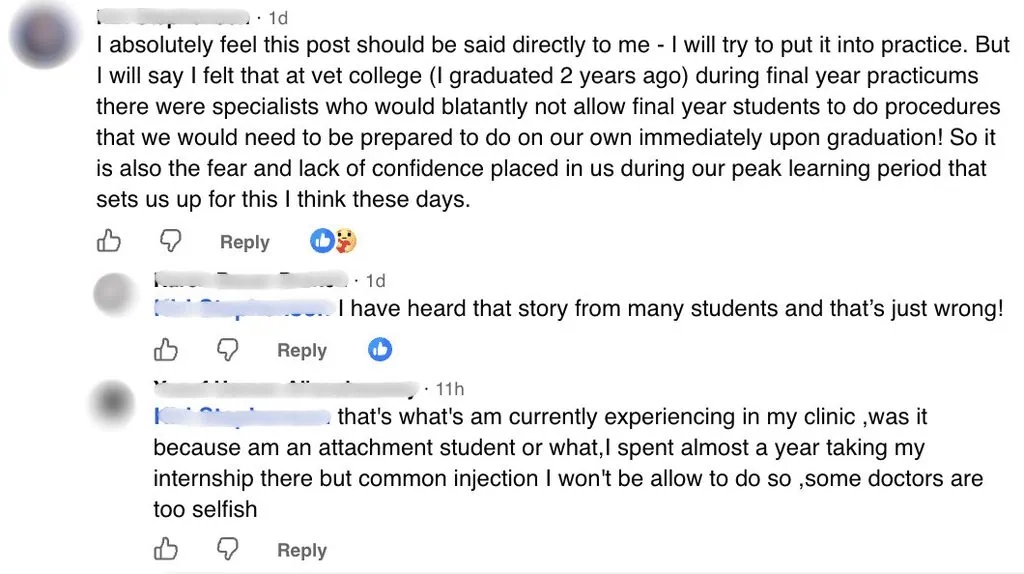
KS, veterinarian (graduated ~2 years) – on limited hands-on access during final-year training.
So the useful reframe is this: less confident does not mean less capable. Sometimes hesitation is rational risk management when the scaffold after graduation is thin. If you were trained for a case class but have not yet lived enough supervised repetitions of it, fear can be a signal that the bridge is incomplete – not that the veterinarian lacks grit.
For practice owners and mentors, that distinction matters. If we treat every pause as a character flaw, we shame the people we need to retain. If we treat every pause as sacred, we never help anyone expand. The work sits between those poles: protect patients, support clinicians, and deliberately grow veterinary clinical confidence over time.
Confidence vs Competence: Where Is the Line?
These two words get used interchangeably in hallway conversations, and they should not.
Competence asks: can you perform and reason this case to a defensible professional standard? Do you know what you are looking at, what you need next, what red flags change the plan, and when escalation is the right medicine?
Confidence asks: will you act when the case is in front of you? Will you start the workup, communicate clearly with the client, and carry the case as far as your competence and context allow?
The dangerous edges are familiar to anyone who has practised long enough. Overconfidence without competence is reckless. Competence frozen by fear leaves horses waiting and skills unused. Both extremes harm patients and careers.
The healthy middle sounds quieter than either extreme. It sounds like: I’ve never done this exact case, but I know how to start, what information I need, who I can call, and when to escalate.
That sentence is not bravado. It is clinical maturity. It keeps “new to me” from being misread as “unsafe,” and it keeps “I am scared” from being misread as “I am incompetent.”
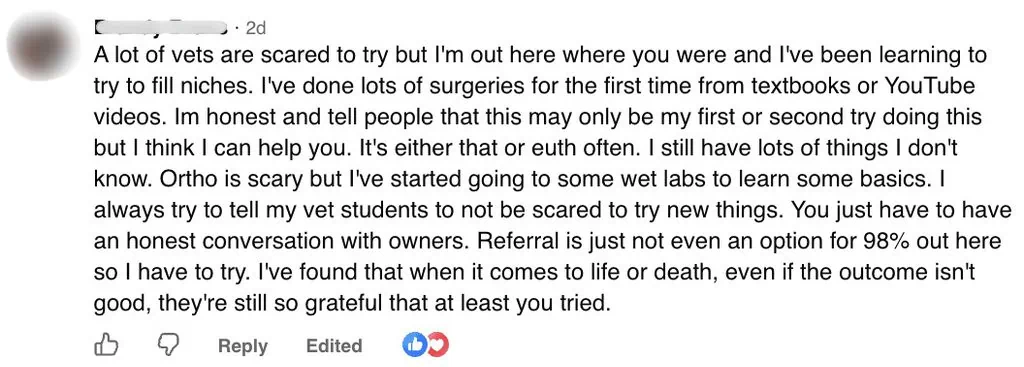
BE, veterinarian – on honesty with owners when stretching skill in rural practice.
Building veterinary clinical skills is not only about adding techniques. It is about building a reliable inner map: what I can own today, what I can own with support, and what belongs elsewhere. Confidence grows when that map is practised in real cases, not only reviewed in slides.
My own line sits in a fairly simple place. I stretch when a case calls on underlying skills I already have, even in an unfamiliar combination, and I refer when it moves outside my actual scope.
What sits underneath every decision is the horse in front of me and the client standing next to it. Communication carries most of the weight here.
When I’ve taken on a case or procedure I hadn’t managed before, telling the client mattered as much as the clinical plan itself. I’d explain that I hadn’t handled this particular presentation before, that I had the underlying knowledge behind it, and that I’d researched the specifics in front of us.
Referral wasn’t available to that client, for whatever reason, and once they understood that, I’d commit to giving them my best effort toward the best outcome, with no guarantees attached. That honesty is what allowed me to stretch responsibly.
Has Veterinary Medicine Become Too Quick to Refer?
Referral is essential medicine. Specialists exist for a reason. Complex imaging, advanced surgery, intensive care, and rare disease workups are often best handled in a setting built for them. Clients deserve honesty when a case outruns what first-opinion practice can safely offer.
And still, referral can become a confidence substitute. When the cost of a difficult outcome feels enormous – anxiety about complaints or litigation, social media scrutiny, practice policy, insurance culture, or simply the fear of being the last person who touched the case – it is understandable that “refer early” becomes the default. Understanding is not the same as being free of consequences.
If we never stretch inside a supervised or mentored range, skills atrophy. Rural and equine clients lose access when every borderline case leaves the community. Ambulatory practice starts to feel impossible to sustain. If we always stretch without a plan, we risk patient harm, clinician burnout, and decisions that are hard to defend.
So the question is not “Are we brave enough?” It is “Are we practising professional judgment?” Knowing when to refer is a clinical skill. Knowing when *not* to refer yet – because you have a competent plan, appropriate support, and a clear escalation threshold – is also a clinical skill.
Veterinary referral culture should protect horses. It should not quietly train first-opinion veterinarians out of the very cases they were educated to begin.
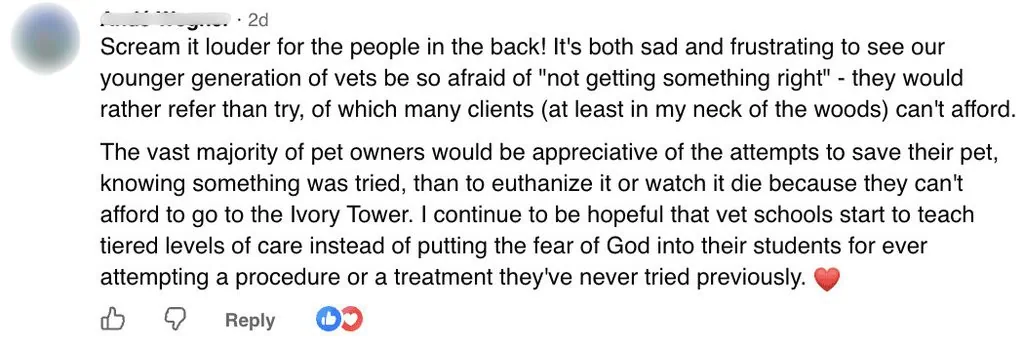
AW, veterinarian – on referral defaults when clients cannot afford specialty care, and teaching tiered levels of care.
Why Equine and Rural Practice Are Different
This debate becomes concrete the moment you leave a dense referral corridor.
In equine and rural practice, the specialist may be hours away. After-hours options are limited. Owner economics matter: “just refer” is not always available or affordable, even when everyone agrees a referral would be ideal. The horse in front of you still needs a next step today.
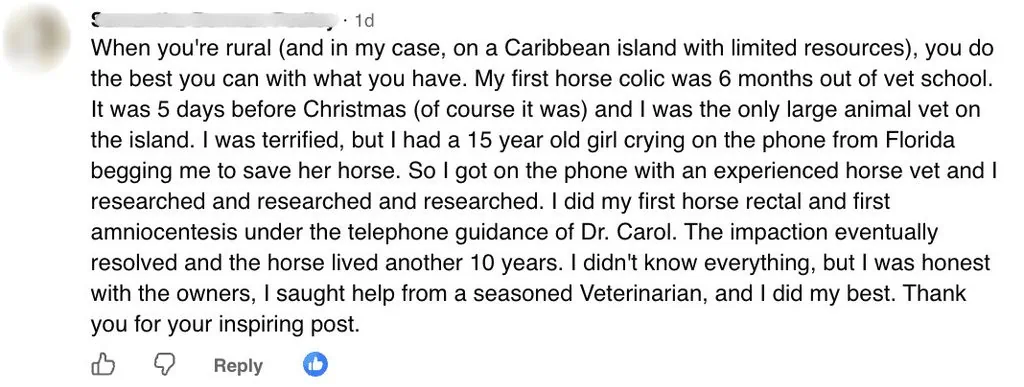
SDP, veterinarian – first horse colic six months out, rural/island practice, telephone mentorship.
Mixed and ambulatory veterinarians also carry breadth that referral hospitals can afford to narrow. One day may ask for dentistry judgment, ophthalmology triage, lameness workup thinking, and medicine reasoning. Not as a specialist in all of them, but as a first-opinion clinician who can start well, communicate clearly, and escalate wisely.
That is why confidence gaps hit differently here. They do not only live inside the veterinarian. They land on horses, clients, and communities that depend on a capable local GP. It is also why practical, case-based equine veterinarian continuing education and strong equine vet mentorship are not niceties in our corner of the profession. They are part of how access to care stays real.
When we talk about veterinary clinical confidence in equine practice, we are talking about whether first-opinion clinicians can keep doing the work the horse needs, close to home, with clear eyes about limits.
The Role of Mentorship After Veterinary School
Graduation ends formal supervision. Confidence does not arrive with the diploma. What many of us needed next was not another lecture stack. We needed guided exposure: case talk-throughs before and after the call, “watch then do then teach,” and a culture where asking early is treated as professionalism rather than weakness.
Good mentorship is a temporary scaffold, not hovering. It expands scope gradually. It names uncertainty out loud.
It helps a newer clinician rehearse the sentence that keeps patients safe: Here is what I can own; here is what I need help with; here is our escalation plan.
Practices that invest in that kind of veterinary mentorship are better placed to retain clinicians and protect patients, because people grow inside a net instead of guessing alone.
Mentorship also does not have to mean one heroic senior vet carrying everyone. It can be a practice system: scheduled case rounds, paired visits, external clinical coaches, peer networks, and structured pathways into hands-on CE.
Equine dentistry, ophthalmology, and lameness work are good examples of areas where many of us feel the gap between “I studied this” and “I have done enough of this with eyes on me.” Programs and communities that mix teaching with real case reasoning can sit alongside in-clinic mentorship rather than replacing it.
Can Continuing Education Close the Confidence Gap?
Not all continuing education closes the same gap.
Passive webinars can refresh knowledge. They rarely rebuild the feeling of “I can start this case on Monday.” Wet labs and hands-on teaching help close the “I’ve never done this” gap. Longitudinal, case-based, revisitable teaching helps close the “I don’t know how to think this through” gap.
The strongest path for most clinicians is hybrid: practical CE, mentorship, and deliberate case selection in day-to-day practice.
That means knowing your limits and having a plan to expand them. Confidence is cumulative. It grows when you revisit the same pattern family enough times that the barn-side pause shortens. Not because you became fearless, but because your map got clearer.
This is where structured equine CE belongs in the conversation, softly and honestly. At The Equine Practice Company, we built case-based, expert-led training for real-world first-opinion work – including the Practitioner’s Program, plus focused pathways in lameness, dentistry and ophthalmology. Designed to be both practical and clinically applicable, not just another theory lesson.
Those programs are one route among several. Mentorship, wet labs, hospital externships, and local specialist relationships all matter. What I care about is the infrastructure of confidence: practical teaching you can return to when the case is sitting in the trailer.
If you want a broader look at how online and hybrid CE can support that kind of learning, we have also written about best online and hybrid CE platforms for equine veterinarians. The point is not a brand. The point is choosing education that helps you reason cases, not only collect hours.
What Experienced Veterinarians Wish They Had Known After Graduation
Ask enough experienced clinicians what they wish they had known, and the themes tend to rhyme – even when the stories differ.
Uncertainty is normal. Naming it is professional. The first stretch of any procedure or workup pattern feels different from the textbook, and that does not mean you chose the wrong career. Asking early almost always beats apologising later.
A personal “phone-a-friend” network is not a crutch; it is part of safe practice. And confidence is cumulative. It is not a fixed personality trait you either received at graduation or forever lacked.
I wish more of us had been told that new to me can be spoken out loud without collapsing trust, if it is paired with a clear plan. Clients can usually handle honesty wrapped in competence. What they struggle with is false certainty or frozen silence.
Those lessons are why I am protective of newer colleagues and still demanding of our systems. Empathy without a growth path becomes a holding pattern. A growth path without empathy becomes sink-or-swim. Our profession needs both.
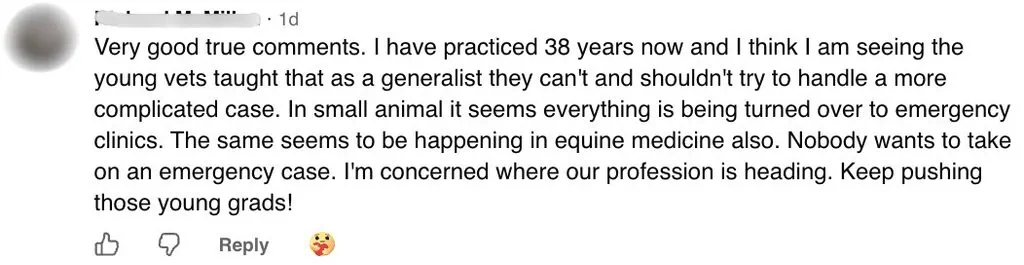
RM, veterinarian (38 years), on generalists, equine emergencies, and confidence after graduation.
Conclusion: A Missing Bridge, Not Missing Courage
Maybe we are not teaching young veterinarians to fear the cases they were trained to handle. Maybe we are under-building the bridge from graduation to independent veterinary clinical confidence – the mentorship, guided repetitions, practical CE, and culture that separate “new to me” from “unsafe.”
If that is true, the call is not for braver graduates. It is for better scaffolds: practices that mentor on purpose, clinicians who expand scope deliberately, and continuing education that helps people think and act on real cases.
Equine and rural medicine make the stakes obvious, because horses cannot wait for a debate to resolve itself in a comment thread.
If you are looking for structured, case-based support as one part of that bridge, explore the pathways at The Equine Practice Company that match the cases you actually see. Mentorship and wet labs still matter beside any online resource. The goal is the same everywhere: competent clinicians who can practise independently with clear judgment about when to refer.