How to Read Feed and Supplement Labels: What Every Veterinarian Needs to Know
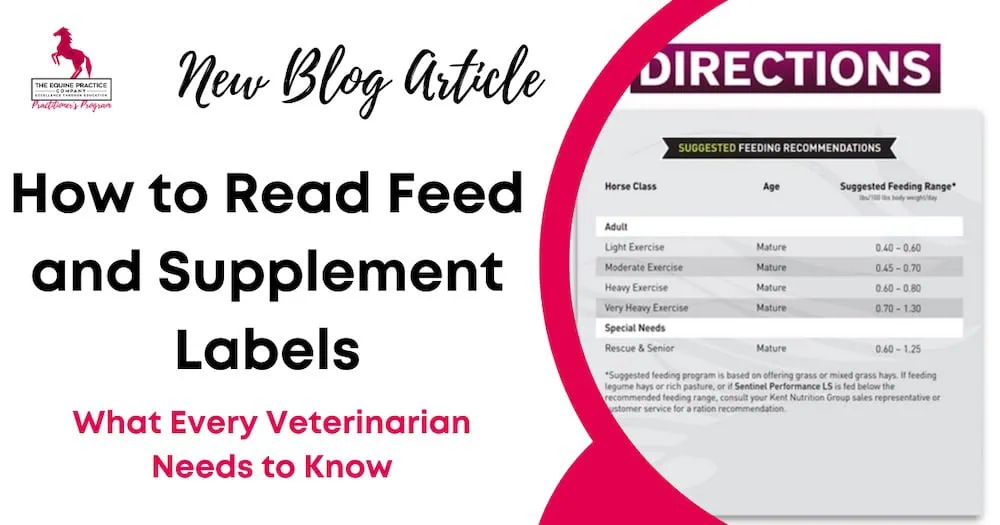
Feed and supplement labels are designed to inspire confidence. Unfortunately, they are also one of the most misunderstood and misleading sources of information in equine nutrition.
Veterinarians are increasingly asked to advise on feeds, balancers, supplements, probiotics, oils, electrolytes, and nutraceuticals – often based on a label claim, a brochure, or a website statement.
Yet many of these products do not deliver what their labels imply, and in some cases may contribute to nutritional imbalance rather than preventing it.
This article summarises key insights from How to Read Feed and Supplement Labels, a postgraduate equine nutrition training lecture by Dr Jenifer Stewart, and explains why label literacy is now a core clinical skill for veterinarians.
Feed Labels Are Regulated – But Only to a Point
Most veterinarians assume feed labels are strictly regulated. While that is partially true, regulations vary widely between countries:
- Australia: APVMA
- Europe: EU regulations (generally stricter and better enforced)
- United States: FDA and USDA
- New Zealand: MPI and FeedSafe
All aim to protect animal welfare and consumer confidence – but what is required to appear on a label differs, and many clinically important nutrients are not required to be listed at all.
Critically, regulations do not apply to:
- Company brochures
- Marketing materials
- Website content
This is where much of the most misleading information appears.

“Guaranteed Analysis” Does Not Mean “Nutritionally Adequate”
One of the most common assumptions is that a guaranteed analysis ensures a feed meets the needs of the horse it claims to support.
In reality:
- Sugar and starch may not be listed
- Individual ingredient amounts are rarely disclosed
- Feeding rates are often “guides only”
- Essential nutrients may be well below requirements at recommended intakes
Dr Stewart presents multiple real-world examples where feeds marketed as:
- Complete nutrition
- Ideal for breeding stock
- Balanced for growth
provide less than half the required levels of vitamin E, lysine, biotin, or key trace minerals at label feeding rates.
Starch, Sugar, and Processing: The Missing Context
Many labels omit starch and sugar entirely – despite their relevance to:
- Insulin dysregulation
- EMS
- Laminitis risk
- Growth and musculoskeletal development
Even when ingredients are listed, processing methods matter. Extrusion, cooking, rolling, and grinding all affect:
- Glycaemic response
- Insulinaemic response
- Hindgut fermentation
Feeds marketed as cool, low energy, or safe may still deliver very high starch loads, particularly when based on barley, wheat, corn, or mill by-products.
Marketing Language vs. Nutritional Reality
Dr Stewart highlights a recurring theme: marketing terms are often meaningless or misleading.
Common examples include:
- “Cool feed”
- “Low GI” (without published studies)
- “Grain-free” (using high-starch by-products instead)
- “Complete feed” (with no defined standard)
Some labels manipulate units (mg vs µg), percentages, or reference values to inflate perceived nutrient content, while others cite scientific references that are:
- In vitro only
- Based on other species
- Cherry-picked or misapplied
For veterinary professionals, this creates a growing challenge when owners arrive convinced a product is evidence-based – when it isn’t.

Supplements: Probiotics, Joint Products, and Electrolytes
Probiotics and Gut Health
Despite widespread use, current evidence shows:
- Significant variability between products
- Poor quality control and labelling accuracy
- Limited in-vivo evidence of efficacy
- Occasional detection of undesirable or resistant organisms
The equine microbiome remains complex and poorly defined, and no reliable “dysbiosis compass” currently exists.
Joint and Nutraceutical Supplements
Systematic reviews indicate:
- Limited evidence for efficacy in naturally occurring osteoarthritis
- Benefits rarely exceed those of a well-balanced diet
- Many products under-dose key ingredients
Electrolytes
Most horses require primarily:
- Sodium
- Chloride
Many commercial electrolyte products under-deliver effective doses, include unnecessary sugars, or rely on human data that does not translate to equine physiology.
What Should Veterinarians Look for Instead?
Dr Stewart recommends a practical, sceptical approach:
- Start with diet analysis
- Focus on commonly deficient nutrients (vitamin E, lysine, biotin)
- Understand maximum tolerable limits as well as RDIs
- Evaluate ingredient quality and bioavailability
- Question claims that rely on emotion rather than evidence
In many cases, simpler formulations outperform complex ones.
Watch a Short Preview of the Full Lecture
A 5–10 minute preview of this lecture is available, where Dr Stewart:
- Walks through real label examples
- Explains how misleading claims are constructed
- Demonstrates how veterinarians can quickly assess feeds in practice
Access the Full Lecture – and 200+ More
How to Read Feed and Supplement Labels is part of the Practitioner’s Program, a postgraduate education library created specifically for veterinary practitioners.
Inside the program, you’ll find:
- ✅ Full access to this complete lecture
- ✅ 200+ on-demand veterinary training videos
- ✅ Advanced education across equine medicine, nutrition, surgery, dentistry, reproduction, anaesthesia, and more
- ✅ Content taught by recognised international specialists
- ✅ Annual members receive the 2026 Annual (see below)
You can explore the full library with a $1 trial.
👉 Join the Practitioner’s Program to access the full lecture