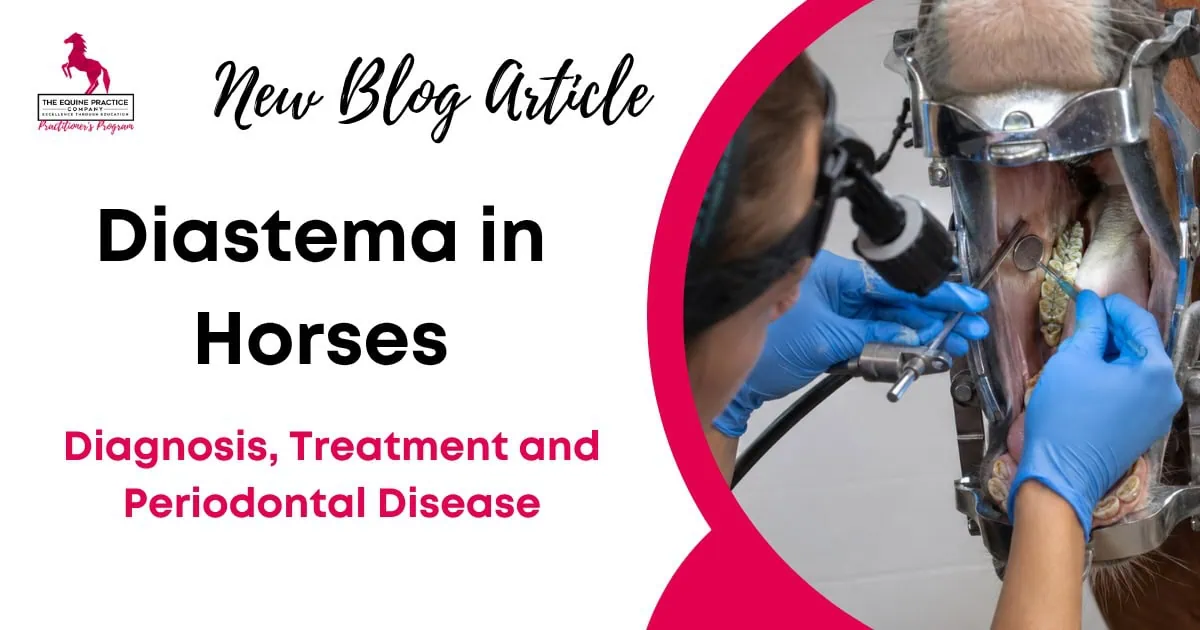
Diastema in Horses: Diagnosis, Treatment and Periodontal Disease
A small gap between two cheek teeth can become a significant clinical problem when it traps feed and begins affecting the surrounding periodontal tissues.
Diastemata in horses are spaces between adjacent teeth. Some cause relatively little clinical disease, while others allow feed to become impacted between the cheek teeth, contributing to gingival inflammation, periodontal pocketing and progressive damage to the tissues supporting the tooth.
The important finding is therefore not simply that a diastema is present.
When I identify a diastema during an equine dental examination, I want to know:
- Is feed becoming trapped?
- What is the configuration of the diastema?
- Are the surrounding periodontal tissues affected?
- Is there evidence that disease is progressing?
- Does this horse require treatment, monitoring or further investigation?
This distinction matters because diastemata are strongly associated with periodontal disease in horses. A first-opinion study of 932 horses found a significant association between the presence of diastemata and periodontal disease.
In this article, I’ll focus specifically on how to recognise and assess diastemata in horses, the relationship between feed impaction and periodontal disease, the clinical significance of different diastema configurations and the treatment decisions that may need to be considered.
For a broader discussion of periodontal pocketing, attachment loss, tooth mobility and extraction decisions, read our guide to equine periodontal disease.
What Is a Diastema in Horses?
A diastema is a space between adjacent teeth. In the equine cheek teeth, these spaces can become clinically important when they allow feed to become trapped between the teeth and against the gingival margin.
Not every diastema will cause the same degree of disease.
Some remain relatively open and allow feed to clear more easily. Others create a narrow opening at the occlusal surface with a wider space deeper between the teeth, allowing feed to become impacted and retained.
The clinical importance of a diastema therefore depends on more than its presence alone.
When assessing a diastema, I want to consider:
- its location
- its shape and width
- whether feed is becoming impacted
- the condition of the surrounding gingiva
- whether periodontal pockets are present
- whether adjacent teeth are affected
- whether the problem appears stable or progressive
This is why a diastema should not simply be recorded as a gap between two teeth.
It should be assessed as a potential source of feed impaction and secondary periodontal disease.
Why Diastemata Cause Feed Impaction and Periodontal Disease
The clinical significance of a diastema comes from what happens when feed becomes trapped between adjacent cheek teeth.
In some horses, the shape of the interdental space allows fibrous feed material to become packed between the teeth during mastication. If that material cannot clear effectively, it can remain in contact with the gingiva and surrounding periodontal tissues.
Over time, retained feed can contribute to:
- gingival inflammation
- periodontal pocket formation
- loss of periodontal attachment
- damage to the supporting alveolar bone
- increasing tooth mobility in more advanced cases
The important point is that the diastema itself is not always the disease.
The problem is the combination of the interdental space, recurrent feed impaction and the periodontal response that follows.
This is why simply removing the packed feed once may not be enough. If the shape of the diastema continues to trap material, the same cycle can recur.
When I find feed packing between cheek teeth, I therefore want to determine whether I am looking at an isolated finding or an anatomical configuration that is repeatedly exposing the periodontium to further disease.
Why Equine Diastemata Are Easy to Miss
Diastemata can be easy to overlook because the clinical significance is not always obvious from a quick examination of the occlusal surface.
A small interdental space may initially appear insignificant, particularly if there is only a small amount of feed present. But once feed is removed, the shape of the space and the condition of the surrounding gingiva may tell a very different story.
This is why a complete equine dental examination should include careful assessment of the interdental spaces rather than focusing only on sharp enamel points, hooks, waves or other occlusal abnormalities.
When I am assessing a horse for possible diastemata, I want to look for:
- retained feed between adjacent cheek teeth
- gingival inflammation or recession
- periodontal pocketing
- abnormal interdental spacing
- odour associated with retained feed
- discomfort associated with the affected area
- changes affecting the teeth on either side of the space
Good sedation, illumination and visualisation with a mirror or oroscope are important because some diastemata, particularly those further caudally, can be difficult to assess properly without a systematic examination.
The important habit is not simply to notice the gap.
It is to ask whether that gap is creating a clinically significant problem.
How to Assess a Diastema During an Equine Dental Exam
Finding a space between two cheek teeth is only the beginning. The next step is to determine whether the diastema is clinically significant and what effect it is having on the surrounding tissues.
I approach this systematically.
1. Remove the Impacted Feed
If feed is packed within the interdental space, remove it carefully so that you can properly visualise the diastema and surrounding gingiva.
Do not simply remove the feed and move on.
Once the space is clear, look at what was underneath it. Gingival inflammation, recession, periodontal pocketing or other tissue changes may be much more apparent once the impacted material has been removed.
2. Assess the Shape of the Diastema
Look at the configuration of the interdental space rather than simply recording that a gap exists.
Is the space relatively open at the occlusal surface, or does it have a narrower opening that may allow feed to enter and become trapped deeper within the interdental space?
This distinction can influence both the severity of feed impaction and the treatment options you consider.
3. Assess the Surrounding Periodontal Tissues
Examine the gingiva and use a periodontal probe where appropriate to assess pocketing around the affected teeth.
Look for inflammation, recession, bleeding, retained feed and other evidence that the diastema is affecting the supporting tissues.
If periodontal disease is present, record the location and extent of the abnormalities rather than simply documenting “diastema”.
4. Assess the Adjacent Teeth
A diastema should not be considered in isolation.
Examine the teeth on either side of the space for mobility, abnormal wear, displacement or other abnormalities that may be contributing to the problem or influencing your treatment decision.
5. Record What You Find
Document the location of the diastema, its configuration, the presence of feed packing and any associated periodontal findings.
A structured approach to equine dental diagnosis makes it much easier to compare these findings at subsequent examinations and determine whether the problem is stable, improving or progressing.
6. Decide Whether Further Investigation Is Needed
The oral examination may give you enough information to manage some cases, while others will require further investigation before a treatment decision can be made.
Where there is significant periodontal disease, tooth mobility, suspected deeper pathology or uncertainty about the structures surrounding the affected teeth, additional diagnostic imaging may be appropriate.
Open vs Closed Diastema in Horses: Why the Difference Matters
Not all diastemata have the same configuration, and the shape of the interdental space can influence how readily feed enters and whether it can escape.
Closed Valve Diastema
A closed valve diastema has a narrow opening at the occlusal surface with a wider interdental space beneath it.
This configuration can allow fibrous feed material to enter the space during mastication and then become trapped below the narrower opening.
When feed repeatedly accumulates, the surrounding gingiva and periodontal tissues can become inflamed and damaged.
The important clinical question is not simply whether the diastema can be classified as closed. It is whether that particular diastema is causing recurrent feed impaction and clinically significant periodontal disease.
Open Diastema
An open diastema has a wider communication at the occlusal surface.
This may allow feed material to clear more readily than it would from a narrow, valve-like space, but an open diastema should not automatically be considered clinically insignificant.
Feed packing and periodontal disease can still occur, so the surrounding tissues need to be examined rather than making a treatment decision from the shape of the space alone.
Configuration Is Only Part of the Decision
Classifying a diastema as open or closed helps describe what you are seeing, but it does not by itself determine treatment.
I want to consider the configuration alongside the amount and recurrence of feed impaction, the extent of periodontal disease, abnormalities affecting adjacent teeth and whether the horse appears to be developing progressive disease.
Those findings determine whether the diastema can be monitored, requires local management or whether a more advanced treatment should be considered.
Treatment of Diastema in Horses: What Are the Options?
Treatment should be based on the cause of the feed impaction, the configuration of the diastema and the extent of associated periodontal disease.
The objective is not simply to remove trapped feed once. It is to reduce the likelihood of recurrent impaction where possible and protect the surrounding periodontal tissues.
1. Remove Impacted Feed and Assess the Site
Impacted feed should be removed carefully so that the interdental space and surrounding tissues can be examined properly.
Once the site is clean, assess the gingiva, periodontal pocketing, adjacent teeth and the configuration of the diastema.
This gives you a much better basis for deciding whether the case requires monitoring, local treatment or a more advanced intervention.
2. Manage Associated Periodontal Disease
Where periodontal inflammation or pocketing is present, the periodontal component of the case also needs to be addressed.
Cleaning and debridement may form part of treatment, but management should be tailored to the individual horse and the severity of the disease.
If the periodontal changes are significant, it is important to document them and establish an appropriate recheck interval rather than assuming the problem has resolved once the feed has been removed.
3. Consider Whether Diastema Widening Is Appropriate
In selected cases, widening a narrow diastema may be considered to improve clearance of feed and reduce recurrent impaction.
This is not a treatment that should be applied automatically to every closed or narrow diastema.
The decision depends on the configuration of the space, the severity and recurrence of feed packing, the condition of the surrounding periodontal tissues, the anatomy of the adjacent teeth and the clinician’s experience with the procedure.
Where widening is considered, the risks of removing dental tissue and damaging adjacent structures need to be weighed against the potential benefit of improving feed clearance.
4. Address Clinically Relevant Occlusal Factors
Abnormal wear or occlusal relationships may contribute to the way forces are distributed across the affected teeth.
Where clinically relevant, carefully planned occlusal adjustment may form part of the treatment plan.
The aim is not to create a cosmetically even arcade. It is to make only those adjustments that are justified by the clinical findings.
5. Recheck the Diastema
Diastema cases should be reassessed at an interval appropriate to the severity of the disease and the treatment performed.
At recheck, assess:
- whether feed has repacked
- whether periodontal inflammation is improving
- whether pocket depth or attachment loss is progressing
- whether the adjacent teeth remain stable
- whether further treatment is required
Some cases may improve with relatively simple management, while others require repeated treatment or a change in approach.
6. Know When Extraction May Be Required
Extraction may need to be considered where there is advanced periodontal destruction, progressive tooth mobility, severe damage to the supporting tissues or disease that cannot be controlled adequately with conservative treatment.
The decision should be based on the complete clinical picture rather than on the presence of a diastema alone.
Common Mistakes When Managing Diastemata in Horses
Diastemata can look deceptively simple. The mistake is assuming that finding and removing impacted feed is the end of the diagnosis.
1. Treating Every Diastema the Same
The presence of a gap between two teeth does not automatically tell you how clinically significant it is or what treatment it requires.
Assess the configuration of the diastema, the amount of feed impaction, the condition of the periodontal tissues and the adjacent teeth before deciding what to do.
2. Removing the Feed and Moving On
Clearing impacted feed may provide immediate relief and allow you to examine the site, but it does not explain why the feed became trapped.
If the underlying configuration continues to retain feed, repacking may occur and periodontal disease can continue to progress.
3. Focusing on the Diastema but Ignoring the Periodontium
Once you identify a diastema, examine the tissues around it.
Gingival inflammation, periodontal pocketing, attachment loss and tooth mobility can substantially change the significance of the finding and the treatment decision.
4. Assuming Every Closed Diastema Needs Widening
Diastema widening can be useful in selected cases, but classification as a closed diastema should not automatically determine treatment.
Consider the severity and recurrence of feed impaction, periodontal damage, adjacent tooth anatomy and the risks and benefits of intervention before proceeding.
5. Failing to Recheck
Treatment does not finish when the horse leaves after the initial appointment.
Reassessment allows you to determine whether feed is continuing to pack, whether the periodontal tissues are improving and whether your original treatment plan is working.
6. Failing to Explain the Problem to the Owner
An owner may see a small gap between two teeth and struggle to understand why it requires further investigation or treatment.
Showing them the impacted feed, explaining the periodontal changes you have identified and outlining what may happen if the problem progresses can make the treatment recommendation much easier to understand.
Good equine dentistry client communication is particularly important when a case will require repeated treatment, rechecks or a more advanced procedure.
A Practical Approach to Diastemata in Horses
When you identify a diastema during an equine dental examination, do not make the treatment decision from the presence of the gap alone.
Work through the case systematically:
- Remove any impacted feed so you can properly visualise the interdental space and surrounding tissues.
- Assess the configuration of the diastema and consider whether its shape is contributing to recurrent feed retention.
- Examine the periodontium for gingival inflammation, pocketing, attachment loss and other evidence of associated disease.
- Assess the adjacent teeth for mobility, displacement, abnormal wear or other abnormalities that may influence the case.
- Document what you find so that changes can be compared at subsequent examinations.
- Decide whether intervention is necessary based on the complete clinical picture rather than simply classifying the diastema as open or closed.
- Establish an appropriate recheck when monitoring or treatment is required.
The question I want veterinarians to ask is not:
“Does this horse have a diastema?”
It is:
“Is this diastema causing disease, and if it is, what is the most appropriate way to manage it?”
That shift in thinking turns an incidental dental finding into a clinical assessment.
Building Confidence in Diagnosing and Managing Equine Diastemata
Diastemata are a good example of why equine dentistry needs to go beyond identifying sharp enamel points and performing routine occlusal adjustment.
A small interdental space may be clinically insignificant in one horse and associated with recurrent feed impaction and significant periodontal disease in another.
The difference comes from examining the whole problem.
Assess the configuration of the diastema, remove impacted feed, examine the surrounding periodontal tissues, evaluate the adjacent teeth and document what you find. Then make the treatment decision based on the individual horse rather than the appearance of the gap alone.
The aim is not to treat every diastema.
It is to recognise the ones that matter and intervene appropriately before associated dental disease becomes more difficult to manage.
Continue Your Equine Dentistry Training
Diastemata are just one of the dental abnormalities where recognising what you are looking at is only the first step. The more difficult question is deciding whether the finding is clinically significant and what, if anything, you should do about it.
If you want to develop a more systematic approach to dental examination, diagnosis and treatment planning, our Equine Dentistry Program provides practical equine dentistry training specifically for veterinarians.
The goal is to help you recognise clinically significant dental disease, make better-informed treatment decisions and know when a case requires a different approach.
Frequently Asked Questions About Diastema in Horses
What is a diastema in horses?
A diastema is a space between adjacent teeth. In horses, diastemata between the cheek teeth can become clinically significant when they allow feed to become impacted against the gingiva and surrounding periodontal tissues.
What causes diastemata in horses?
Diastemata can develop for different reasons, including the position and angulation of adjacent teeth, changes in the dental arcade and abnormalities affecting normal dental wear. The cause and clinical significance should be assessed in the individual horse rather than assuming all diastemata develop in the same way.
What is a closed valve diastema in horses?
A closed valve diastema has a relatively narrow opening at the occlusal surface with a wider interdental space beneath it. This configuration can allow feed to enter the space and become trapped, potentially contributing to inflammation and periodontal disease.
What is an open diastema in horses?
An open diastema has a wider communication at the occlusal surface. Feed may clear more readily from some open diastemata, but they should still be examined for feed impaction and associated periodontal disease rather than automatically being considered insignificant.
Do all diastemata in horses need treatment?
No. The presence of a diastema alone does not determine whether treatment is required. The decision should take into account feed impaction, the configuration of the space, the condition of the surrounding periodontal tissues, the adjacent teeth and evidence of progressive disease.
How are diastemata in horses treated?
Treatment depends on the individual case. Management may include removal of impacted feed, treatment of associated periodontal disease, correction of clinically relevant occlusal abnormalities and, in selected cases, widening of a narrow diastema to improve feed clearance. More advanced disease may require additional treatment or extraction.
When should a diastema in a horse be rechecked?
The recheck interval should be based on the severity of feed impaction, associated periodontal disease and the treatment performed. At re-examination, assess whether feed has repacked, whether the periodontal tissues are improving and whether further treatment is required.
When should an equine diastema case be referred?
Referral or consultation with a veterinarian experienced in advanced equine dentistry should be considered when the diagnosis is uncertain, periodontal disease is extensive, advanced treatment or extraction may be required, or the practitioner does not have the equipment or experience needed to manage the case confidently.