
Could Wearable Technology Help Equine Veterinarians Detect Problems Earlier?
Wearable technology is no longer just a human performance trend.
Across equine sport, racing, breeding, rehabilitation and welfare monitoring, wearable sensors are beginning to generate data that may help veterinarians identify subtle changes earlier, monitor horses more objectively and support better clinical decision-making.
But the important distinction is this:
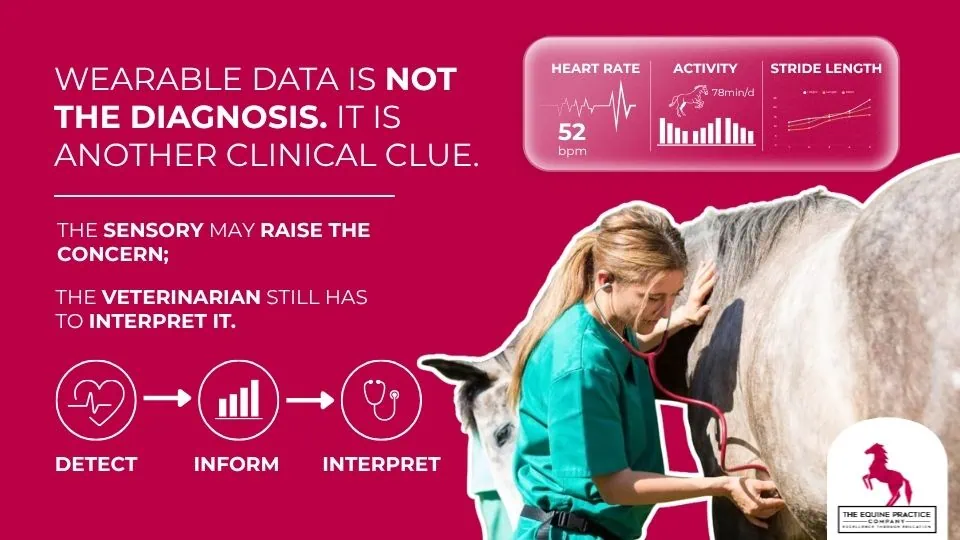
Wearable technology is not the diagnosis.
A sensor cannot replace a veterinary examination. It cannot interpret a horse’s history, palpate a limb, perform flexion tests, assess pain, review imaging, or weigh the many clinical and management factors that influence decision-making.
What it may do, however, is raise better questions earlier.
For equine veterinarians, the key question is no longer whether wearable technology can generate data. It is whether that data can be integrated into clinical workflows in a way that improves outcomes without creating additional workload, liability, or unnecessary interventions.
That is where the conversation becomes clinically relevant.
A current example: wearable sensors in Thoroughbred racehorses
In April 2026, the American Association of Equine Practitioners released findings from the AAEP Wearable Biometric Sensor Research Project, a yearlong prospective study evaluating whether wearable sensor technology could help detect impending musculoskeletal injuries in Thoroughbred racehorses.
The study followed two-year-old Thoroughbreds as they entered training, using sensors to capture data during high-speed exercise sessions, or breezes.
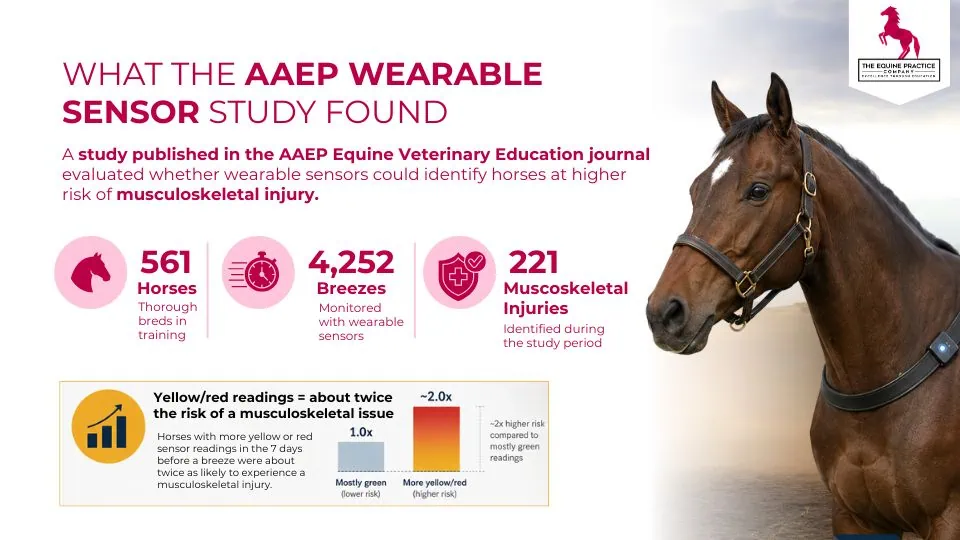
According to the reported findings, usable data were collected from 561 horses across 4,252 breezes between February and December 2025. In total, 221 musculoskeletal injuries were reported, including 142 bone injuries and 79 soft tissue injuries.
Each participating company used proprietary algorithms to assign a green, yellow or red outcome after a breeze. Horses that received a yellow or red sensor reading were reported to be about twice as likely to sustain a musculoskeletal issue compared with horses receiving green readings.
The risk of a documented musculoskeletal issue also increased progressively in horses that accumulated multiple yellow or red designations.
That is a clinically interesting finding.
Not because it proves that sensors can prevent injury on their own, but because it suggests these tools may provide another layer of information before an injury becomes obvious.
Dr Sara Langsam, AAEP project coordinator for the study and chair of the AAEP Racing Committee, emphasised that the study was not intended to validate wearable sensors as a race-day scratching tool.
Rather, the goal was to assess whether sensors could provide more information about a horse’s physical condition before the horse is entered to race.
That distinction matters.
For veterinarians, the value of this technology is unlikely to be in a red, yellow or green label alone.
The value is in whether the data helps early identification of horses that warrant closer clinical assessment, more careful monitoring, altered training, further diagnostics, or a more cautious return-to-work plan.
The sensor may raise the concern but the veterinarian still has to interpret it.
Why subtle change is so difficult to detect
Equine veterinarians already know how difficult early injury detection can be.
Horses compensate. They adapt. They may show only subtle changes in gait, behaviour, recovery, willingness to work, or performance before a problem becomes clinically obvious.
In busy training yards, competition settings, breeding farms and large equine facilities, those early changes may be difficult to detect consistently by observation alone.
This is not a criticism of veterinarians, trainers, riders or owners. It is simply the reality of equine practice.
A horse may be “not quite right” before it is clearly lame. A horse may show altered movement patterns before a lesion is confirmed.
A horse may change activity levels or display low-grade pain behaviours before anyone sees a dramatic clinical sign.
Wearable technology is being explored because it offers the possibility of continuous or repeated data collection outside the artificial setting of a one-off examination.
That could be especially useful when the question is not simply, “Is this horse lame today?” but rather:
- Has this horse changed from its own baseline?
- Is this horse recovering normally?
- Is this horse bearing weight differently?
- Is this horse doing too much, too soon?
- Has this horse’s activity, rest, stride pattern or behaviour changed in a way that deserves attention?
Wearable data may provide more clinically useful information when there are unclear or conflicting answers to these questions.
What wearable sensors can measure
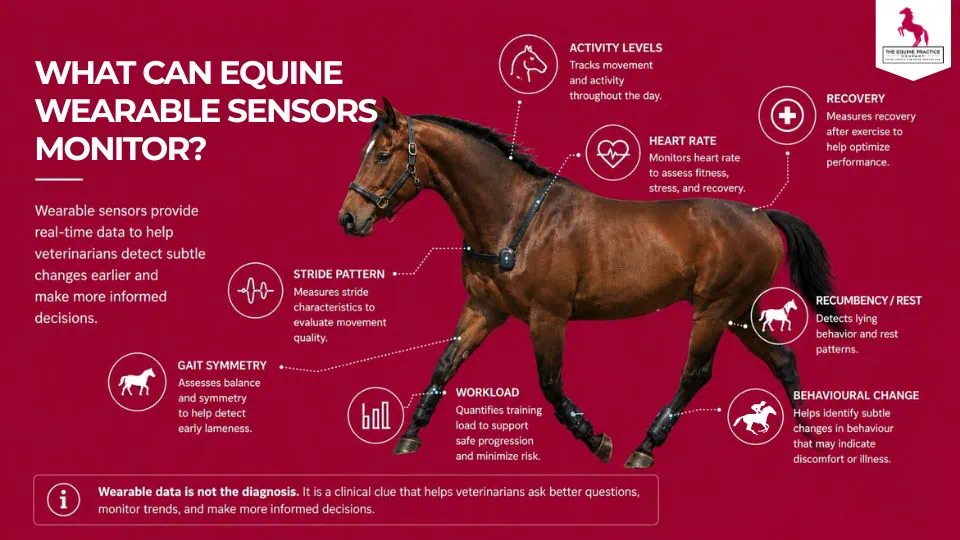
Most equine wearable technologies are not measuring “injury” directly.
They are measuring variables that may be associated with movement, performance, physiology or behaviour.
Depending on the system, this may include acceleration, angular velocity, stride characteristics, gait symmetry, GPS speed and distance, heart rate, heart rate variability, activity levels, recumbency, sleep-related behaviour, temperature, or other physiological and behavioural markers.
Inertial measurement units, or IMUs, are particularly relevant to gait analysis. These devices typically use accelerometers and gyroscopes to measure acceleration forces and angular velocities.
A 2023 review of inertial sensor technologies in equine gait analysis described IMUs as wearable sensors that can provide non-invasive monitoring of equine gait during walk, trot or canter in field conditions.
That field applicability is one of the reasons this technology is attractive.
Force plates, high-speed cameras and sophisticated motion-analysis systems can be extremely valuable, but they are not always practical for repeated use in normal clinical, training, or field environments.
Wearable sensors may offer a more accessible way to monitor change over time, particularly when trends are more meaningful than a single snapshot.
Clinical integration: turning data into actionable information
One of the biggest barriers to adoption of new practices is not technology itself. It is time.
Most equine veterinarians do not need more raw data. They need systems that convert thousands of data points into clinically actionable information.
This is where modern wearable platforms are evolving rapidly.
Rather than presenting every stride, heartbeat or movement event, many systems use automated triage algorithms designed to identify deviations from expected patterns and escalate only clinically significant changes.
The goal is to reduce “signal noise” and ensure veterinarians are reviewing exceptions rather than continuously monitoring dashboards.
Baseline establishment and the equine “digital twin”
Perhaps the most important concept in wearable monitoring is baseline establishment.
A horse’s gait, workload tolerance, recovery profile and behavioural patterns are highly individual. Comparing one horse against a population average may be less useful than comparing that horse against itself.
Many wearable systems therefore focus on establishing a baseline during a period of known soundness and normal performance. Over time, the platform develops a longitudinal profile that functions as a practical form of digital twin.
When future deviations occur, alerts are generated relative to that horse’s historical norms rather than solely against population-level thresholds.
This approach may help explain why longitudinal monitoring could ultimately prove more valuable than isolated assessments.
A subtle asymmetry that appears insignificant during a single examination may become clinically meaningful when viewed as part of a 90-day trend showing progressive deterioration.
Threshold customisation and notification fatigue
Veterinarians are already familiar with alarm fatigue in other areas of medicine.
If wearable systems generate excessive alerts, clinicians may begin ignoring them.
For this reason, future adoption will likely depend on configurable thresholds that allow practices to define what constitutes a clinically meaningful deviation.
Examples may include:
- asymmetry exceeding a predefined percentage over multiple exercise sessions
- repeated yellow-risk classifications over a specified period
- significant reductions in activity during rehabilitation
- abnormal recovery metrics following exercise
- behavioural changes sustained over several days
The objective is not to identify every variation. It is to identify changes that justify clinical attention.
Longitudinal data versus snapshot examinations
Traditional lameness examinations remain indispensable.
However, they represent a single point in time.
Wearable monitoring introduces a fundamentally different type of information: trend data.
A horse may appear clinically acceptable during a scheduled examination while simultaneously demonstrating a gradual decline in stride symmetry over several weeks.
Conversely, a transient asymmetry observed during an examination may prove clinically insignificant when viewed against months of stable sensor data.
The future value of wearables may therefore lie less in replacing examinations and more in providing context around them.

Injury risk: from catastrophic events to earlier intervention
The most urgent area of wearable sensor research is the identification of horses at higher risk of serious or catastrophic musculoskeletal injury.
A JAVMA study published in 2025 examined whether Thoroughbreds identified as high risk by inertial measurement unit sensors suffered fatal musculoskeletal injury at a higher rate than other racehorses.
The study reported that horses with the highest risk score had a 44.6 times greater probability of fatal injury compared with horses assigned the lowest risk score.
That number is striking, but it must be interpreted carefully.
It does not mean that a sensor diagnoses a fatal injury before it happens. It does suggest that sensor-derived movement data may identify patterns associated with substantially increased risk.
Another study using accelerometers to identify catastrophic musculoskeletal injury risk concluded that, when worn by Thoroughbreds during racing or breezing, IMU sensors could identify horses at high risk, allowing for veterinary intervention and the potential avoidance of such injuries.
The clinical implication is not that technology should make the decision. The implication is that technology may help identify the horses that require more veterinary attention.
In practical terms, that could mean a more detailed lameness examination, diagnostic analgesia, advanced imaging where indicated, modified training, rest, reassessment, or a more cautious approach before the horse is asked to perform at high intensity again.
For equine veterinarians, this is where wearable technology becomes less about gadgets and more about risk stratification.
It may help answer the question:
Which horses need our attention before the problem becomes catastrophic?
Objective gait monitoring and lameness assessment
Lameness evaluation will always require a veterinarian’s clinical judgement.
However, wearable sensors may offer useful objective information, particularly when changes are subtle, intermittent, or difficult to reproduce in a single examination.
The 2023 review of inertial sensor technologies in equine gait analysis summarised the role of IMUs in providing objective gait information, including their use in field conditions.
More recent applied research has explored machine-learning approaches using a single IMU sensor.
One 2025 study reported that a single-sensor system using a convolutional neural network achieved 90% session-level accuracy for differentiating sound and lame horses under real-world conditions.
That type of work is still developing, and individual systems need validation before clinical adoption.
Importantly, objective gait monitoring may also strengthen communication with owners and trainers.
When subtle abnormalities are difficult to visualise, longitudinal sensor data may provide objective evidence supporting recommendations for further diagnostics, workload modification or rehabilitation.
In some cases, this may improve compliance with veterinary recommendations and facilitate earlier intervention.
Rehabilitation and return-to-work decisions
Rehabilitation is one of the most promising areas for wearable technology in general equine practice.
Many rehabilitation decisions depend on balancing tissue healing, controlled loading, owner compliance, and progressive return to exercise with patients that don’t understand why their exercise is being restricted. Too little loading may delay adaptation. Too much loading, too soon, may increase the risk of reinjury.
In reality, veterinarians often have to rely on owner reports, rider reports, exercise diaries and periodic reassessments. Wearables may eventually allow more accurate monitoring of what a horse is actually doing between veterinary visits.
This could include:
- daily activity
- time spent walking
- speed and distance
- changes in stride pattern
- asymmetry trends
- rest and recumbency
- adherence to prescribed exercise plans
For horses recovering from tendon, ligament, joint, back or bone-related problems, that information may help veterinarians adjust rehabilitation plans earlier and with greater confidence.
This is not about automating rehabilitation.
It is about improving visibility.
A sensor may show that the horse is moving more than expected, recovering more slowly than anticipated, or showing a recurring movement change when workload increases. The veterinarian can then decide whether that finding is clinically meaningful.
The economic reality: can wearable monitoring support practice growth?
For wearable technology to gain widespread adoption, it must make economic sense for veterinary practices.
Reviewing longitudinal data requires professional time. If veterinarians are expected to analyse trends, communicate findings, and make clinical recommendations, those activities must be recognised as professional services.
Several potential business models are emerging:
- subscription-based remote monitoring programmes
- rehabilitation monitoring packages
- performance surveillance programmes for high-value athletes
- post-operative monitoring services
- periodic data review consultations
Wearable data may also function as a diagnostic lead-in.
One of the challenges in equine practice is justifying advanced imaging when clinical signs are subtle. Objective trend data showing progressive asymmetry or declining performance metrics may help support recommendations for radiography, ultrasonography, scintigraphy, CT or MRI.
From a clinical perspective, this may facilitate earlier diagnosis.
From a business perspective, it may improve utilisation of advanced diagnostic services while providing stronger evidence-based justification for owners.
The goal should never be to generate diagnostics unnecessarily.
Rather, it is to identify horses that genuinely warrant further investigation before pathology becomes advanced.
Colic, pain behaviour, and earlier owner alerts
Wearable technology may also have applications beyond lameness and performance.
A 2024 Equine Veterinary Journal study investigated automatic early detection of induced colic in horses using accelerometer devices. The study reported cross-validation accuracy of 91.2% for detecting colic and 93.8% for differentiating between two levels of colic severity.
This is an important welfare direction.
Colic is often time-sensitive, and early owner recognition is not always reliable, especially overnight or in large facilities.
If accelerometer-based systems can identify changes in behaviour associated with abdominal pain, they may eventually support earlier alerts and earlier veterinary involvement.
As with injury detection, the risk is overinterpretation.
A device cannot determine the cause of abdominal pain. It cannot assess cardiovascular status, mucous membranes, gastric reflux, intestinal distension, rectal findings, or the need for surgery.
But it may alert someone that the horse is behaving abnormally sooner than they otherwise would have noticed, although there is much more to learn to ensure there isn’t overinterpretation of this information in such a broad use case like colic, where there are many inciting causes and many varying outcomes.
Foaling monitoring and reproductive care
Foaling detection is another area where wearable sensors have been used for some time, and more sophisticated devices are now being investigated.
A 2023 study evaluated a tail-attached device using surface temperature and roll angle for foaling detection, reflecting the broader interest in sensor-based foaling alerts.
Earlier work using accelerometer-based systems also reported that pre-foaling behaviour in mares could be detected using wearable sensors.
For veterinarians involved in stud medicine or broodmare management, this technology may become useful where timely observation is critical but constant human monitoring is difficult.
Once again, the technology should be viewed as an alert system rather than a clinical decision-maker.
The sensor may notify the team that a mare needs attention. The veterinarian or experienced stud staff still need to assess the mare, the foal, the progression of labour and whether intervention is required.
Sleep, recumbency and welfare monitoring
Wearables may also help identify welfare concerns that are not obvious during routine checks.
A study of geriatric horses and horses with chronic orthopaedic disease used wearable automated sensor technology to assess recumbency, locomotion and standing time budgets.
The authors concluded that wearable sensor technology could be used to identify horses with low recumbency times that may be at risk of REM sleep deficiency.
This has practical relevance for older horses, horses with chronic lameness, horses with orthopaedic pain, and horses that may avoid lying down because getting up is difficult or uncomfortable.
In these cases, the question is not simply whether the horse is lame.
The more meaningful question may be:
Is this horse resting enough to maintain good welfare?
Wearable data may help veterinarians and owners identify chronic management problems earlier, especially when changes occur gradually.
Cardiovascular monitoring, recovery and performance
Wearable technologies are also being explored for heart rate and heart rate variability monitoring.
A 2023 validation study of an equine smart textile system found that the system was reliable for assessment of heart rate and heart rate variability in horses at rest and during submaximal exercise.
This may have future relevance for monitoring recovery, fitness, stress, autonomic response, arrhythmia screening, or return-to-work decisions in certain cases.
However, this area also requires caution. Heart rate and heart rate variability can be affected by many factors, including fitness, environment, excitement, pain, disease, handling, temperature, workload and measurement quality. Veterinarians still need to build out metrics to understand the baseline surrounding these measurements as they have never been collected in such a continuous manner before.
In these applications, the first step will be building out average and expected values for newly available data, and only then can clinical interpretation matter.
Practical realities: durability and field performance
Equine veterinarians are understandably sceptical of technology that performs well in controlled studies but poorly in real-world environments.
Any wearable system intended for routine use must tolerate mud, sweat, rain, vibration, transport, rolling behaviour and repeated handling.
Questions that deserve closer scrutiny include:
- What ingress protection (IP) ratings do commercially available systems achieve?
- How resistant are sensors to impact and environmental contamination?
- How frequently do devices require charging or maintenance?
- What happens when connectivity is lost?
- How sensitive are algorithms to imperfect sensor placement?
These questions are particularly relevant because field conditions rarely allow ideal positioning.
Future validation studies should not only assess accuracy under controlled conditions but also evaluate performance under realistic management conditions where sensors may shift, become contaminated or experience intermittent signal loss.
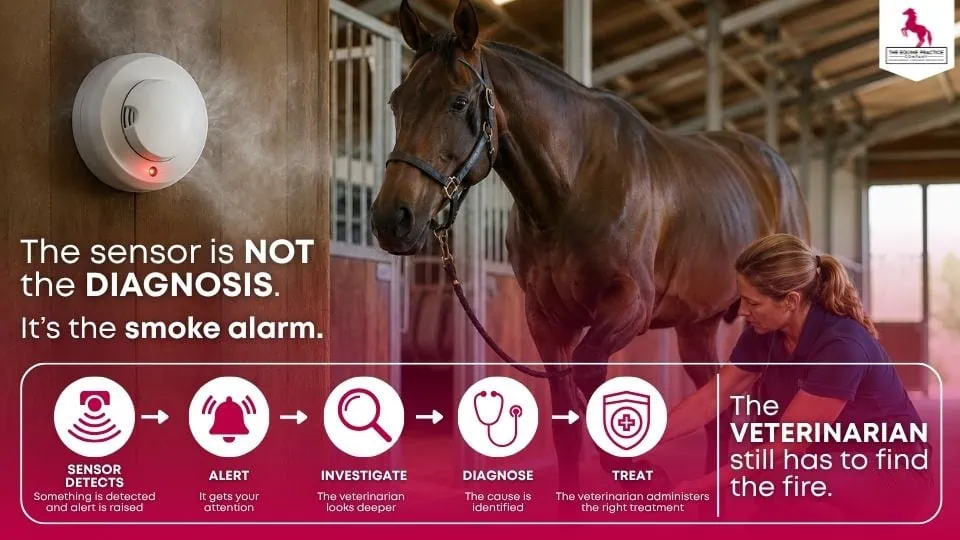
The legal and ethical challenge: defining the duty of care
One of the least discussed aspects of wearable monitoring is liability.
The smoke alarm analogy is useful, but it raises an important question:
Who is responsible for responding when the alarm activates?
If a wearable platform generates an alert on a Saturday evening, is the veterinarian expected to review it immediately? What if the owner receives the alert but does not act? What if the monitoring company receives the notification first?
These questions are also only relevant if clinical or actual importance of these alerts is established, and these questions become increasingly important as remote monitoring expands.
Veterinary practices considering wearable technologies should establish clear standard operating procedures that define:
- who receives alerts
- who is responsible for monitoring them
- expected response times
- escalation pathways
- owner responsibilities
- documentation requirements
Contracts between the clinic, owner and technology provider may become increasingly important.
Without clearly defined responsibilities, wearable monitoring risks creating ambiguity around professional obligations and response expectations.
As telemedicine and remote monitoring frameworks continue to evolve, veterinarians should remain attentive to guidance from licensing boards, professional associations and insurers regarding remote monitoring liability.
The risk: data without context
For all the promise of wearable technology, equine veterinarians should remain cautious.
There are several important limitations:
- false positives may trigger unnecessary concern
- false negatives may create false reassurance
- algorithms may be proprietary and difficult to scrutinise
- sensor placement and fit can affect data quality
- different systems may measure different variables
- signal interference or poor-quality data can affect interpretation
- population-level models may not apply equally to every horse
- owners or trainers may overinterpret device outputs without veterinary input
False positives deserve particular attention.
In racing environments, an inaccurate alert could potentially contribute to unnecessary diagnostic expenditure, altered training schedules or even race-day scratching decisions. Such outcomes carry both financial and emotional consequences for owners and trainers.
The AAEP also emphasised the need for further prospective assessment and refinement of sensitivity and specificity before wearable biometric sensors are considered for broader implementation in Thoroughbred racing.
That is exactly the right message.
Wearable technology needs validation, transparency and clinically meaningful thresholds. It also needs integration into veterinary workflows in a way that supports, rather than confuses, decision-making.
A red flag should not automatically mean panic.
A green flag should not automatically mean safety.
The data should prompt the next clinical question.
What this means for equine veterinarians
The future of equine wearable technology is not about replacing veterinarians.
It is about giving veterinarians better data.
Used appropriately, wearables may help equine veterinarians:
- detect subtle changes earlier
- identify horses that need closer examination
- monitor rehabilitation more objectively
- assess response to treatment over time
- support return-to-work decisions

References
- American Association of Equine Practitioners. AAEP Research Study Demonstrates Wearable Biometric Sensors Show Exciting Potential for Injury Detection in Racehorses. Published April 21, 2026.
- Won C. Wearable biometric sensors show promise as horse injury detection system. AVMA News. Published May 18, 2026.
- Crecan CM, Morar IA, Sonea CG, et al. Inertial Sensor Technologies-Their Role in Equine Gait Analysis, a Review. Sensors. 2023;23(14):6301.
- Mc Sweeney D, et al. Thoroughbreds deemed to be most at risk by inertial measurement unit sensors suffered a fatal musculoskeletal injury at a higher rate than other racehorses. Journal of the American Veterinary Medical Association. 2025.
- Mc Sweeney D, et al. The use of accelerometers to identify risk for catastrophic musculoskeletal injury in Thoroughbred racehorses. PubMed record.
- Eerdekens A, Papas M, Damiaans B, Martens L, Govaere J, Joseph W, Deruyck M. Automatic early detection of induced colic in horses using accelerometer devices. Equine Veterinary Journal. 2024;56(6):1229–1242.
- Aoki T, Yamakoshi T, Kondo N, Ishii M. Detection of foaling using a tail-attached device with a multimodal sensor in mares. PLOS ONE. 2023.
- Kelemen Z, Grimm H, Long M, Auer U, Jenner F. Recumbency as an Equine Welfare Indicator in Geriatric Horses and Horses with Chronic Orthopaedic Disease. Animals. 2021;11(11):3189.
- McCrae P, Spong H, et al. Validation of an Equine Smart Textile System for Heart Rate Variability: A Preliminary Study. Animals. 2023;13(3):512.
- Aoki T, et al. Prediction of Nocturnal Foaling Using Ventral Tail Base Surface Temperature Recorded by a Wearable Device Attached to the Mare’s Tail. Animals. 2026;16(2):199.