Equine Practice Pricing: Why Most Owners Are Probably Undercharging
If you own an equine veterinary practice, I’d like to ask you a question.
Have you ever finished a long day, looked back at everything you achieved, and quietly wondered whether the financial reward really reflected the value you provided?
Perhaps you’d already seen eight or ten horses, driven hundreds of kilometres, dealt with an emergency, answered countless phone calls, spoken to worried owners and somehow still found time to complete your paperwork before heading home.
You know you’ve worked hard. Your clients appreciate what you’ve done. The horses received excellent care. Yet there is still that lingering feeling that the numbers don’t quite add up.
For many equine practice owners, this is one of the most frustrating aspects of running a business. The diary is full, the team is busy, and the phone rarely stops ringing, yet profitability often feels disappointing.
It can leave you questioning whether the only way to improve your income is to work even longer hours, see more horses or fit one more emergency call into an already overloaded day.
In reality, that is rarely the answer.
One of the biggest misconceptions in equine practice ownership is that profitability comes from seeing more horses. While growing revenue is certainly important, many busy practices still struggle financially because the issue isn’t workload. It’s that the business isn’t consistently being paid for the value it already provides.
Most equine veterinarians don’t deliberately undercharge. In fact, it’s usually the opposite. We care deeply about our clients and their horses, we want to be fair, and we genuinely don’t want cost to become a barrier to good veterinary care.
Over time, however, those good intentions can slowly erode the financial health of the practice. Fees don’t always keep pace with rising costs, small discounts become routine, travel time isn’t fully recovered, and little extras that should be charged for quietly disappear from the invoice.
None of those decisions seem significant on their own. Collectively, they can make the difference between a practice that simply survives and one that gives its owner the financial freedom, confidence and work-life balance they set out to achieve.
The encouraging news is that pricing is one of the easiest areas of an equine practice to improve. Small, thoughtful changes can have a significant impact on profitability without seeing another horse, employing another veterinarian or working another weekend.
Effective equine practice pricing should cover clinical time, travel, team support, medications and consumables, equipment, overheads and future reinvestment while still producing a sustainable profit margin. If any of those costs are missing, a full diary can still produce disappointing financial results.
Before we explore why this happens, let’s look at what equine practice owners around the world told us when we asked them about one of the most important questions in business.
How Does Your Practice Compare?
At the time of this analysis, more than 200 equine practice owners had completed the assessment. Participation was voluntary, so the results should be viewed as an industry snapshot rather than a statistically representative survey of every equine veterinary practice. Data was analysed in August 2026.
As part of our Equine Practice Growth Assessment, we asked equine practice owners one simple question:
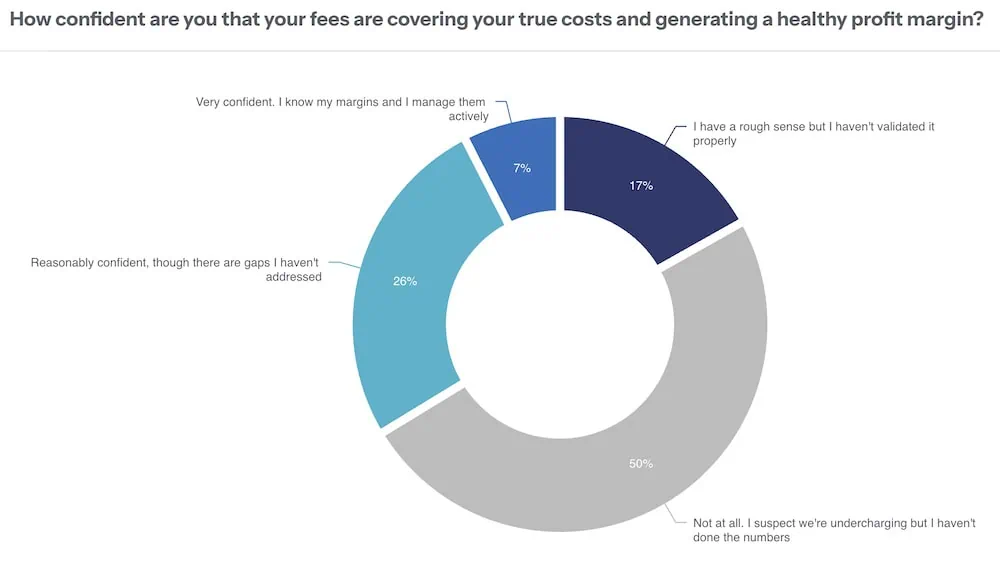
“How confident are you that your fees are covering your true costs and generating a healthy profit margin?”
The responses were both fascinating and reassuring.
Only 7% of the equine practice owners who completed the assessment said they were very confident that their fees were covering their costs and generating a healthy profit margin.
Even more interesting was the largest group of respondents. Half admitted they suspected they were undercharging, but hadn’t actually analysed the numbers to know for certain.
Think about that for a moment.
These aren’t new graduates trying to navigate their first few years in practice. These are experienced equine veterinarians who own businesses, employ staff, manage vehicles, purchase equipment and carry all the responsibility that comes with running a practice.
Yet many still aren’t completely confident that their pricing reflects the true cost of delivering the care they provide every day. That uncertainty matters because confidence influences every pricing decision you make.
If you’re not completely confident in your fees, every quote feels a little uncomfortable. Every fee increase feels risky. Every invoice becomes a moment where you wonder what the client is going to think, rather than whether you’ve fairly charged for your time, expertise and the value you’ve delivered.
The reality is that most equine veterinarians don’t intentionally undercharge. More often than not, they simply haven’t had the opportunity to step back and properly evaluate whether their pricing still reflects today’s costs, today’s expectations and the type of practice they’re trying to build.
And that’s completely understandable.
Veterinary school teaches us how to diagnose disease, perform surgery and care for horses. Very few of us receive any formal education in pricing strategy, financial management or the psychology of charging confidently for professional services.
As a result, many practice owners make pricing decisions based on instinct rather than information. They charge what they’ve always charged, they compare themselves to neighbouring practices, or they avoid increasing fees because they don’t want to upset loyal clients.
Unfortunately, none of those approaches answer the most important question of all.
Is your pricing allowing your practice to remain healthy, sustainable and profitable for the long term?
Before we answer that question, it’s worth looking at how most equine practices actually decide what to charge. The answer might surprise you.
Most Equine Practices Don’t Have a Pricing Strategy
Our next question in the Equine Practice Growth Assessment explored something equally important.
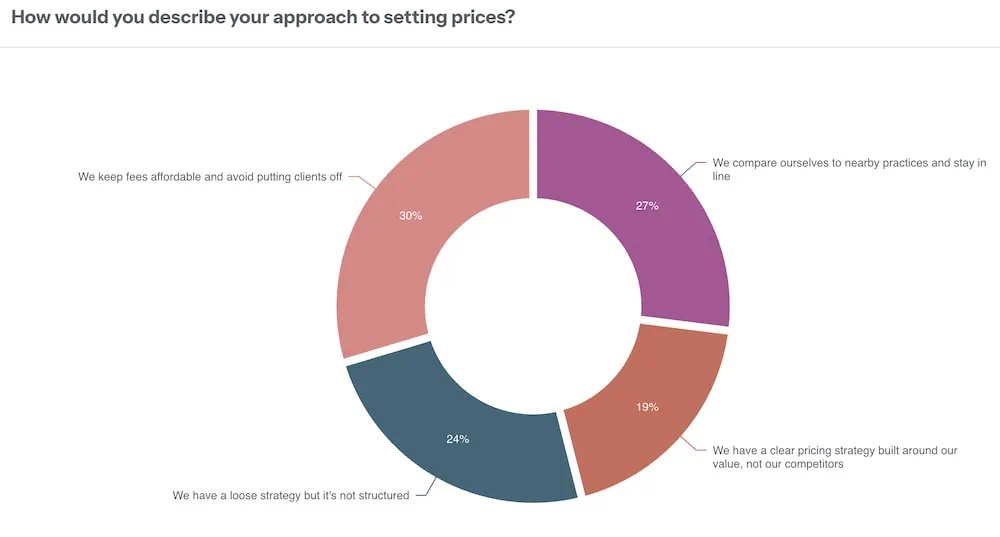
“How do you currently decide what to charge for your services?”
One of the biggest surprises wasn’t that practices charged different fees. It was how they arrived at those fees.
Almost one-third of practice owners told us they deliberately tried to keep their prices affordable because they didn’t want to put clients off. Another large group said they regularly compared their fees with neighbouring practices and adjusted their prices accordingly.
Only a relatively small number described having a structured pricing strategy based on the true cost of delivering their services and the value they provide.
That tells us something important. For many equine practice owners, pricing isn’t really a strategy at all. It’s a reaction.
A reaction to what nearby practices are charging.
A reaction to concerns about losing clients.
A reaction to rising costs.
A reaction to difficult conversations they’ve had in the past.
None of those are necessarily wrong, but they shouldn’t be the foundation of your pricing decisions.
The reality is that no two equine practices are the same. One practice may operate from a fully equipped hospital with significant staffing, equipment and facility costs. Another may be an ambulatory practice covering hundreds of kilometres each week. Some practices provide emergency services around the clock, while others have deliberately chosen not to.
Even practices that appear similar on the surface often have completely different overheads, different client demographics and different long-term goals.
So why would they all charge the same fees? One of the biggest mistakes we see is practice owners looking at a competitor’s price list and assuming that’s what they should charge too.
But unless you understand their costs, their profitability, their business model and the lifestyle they’re trying to create, you’re making one of the most important business decisions based on incomplete information.
This concept is not unique to equine practice. An article published by AAHA Trends describes one veterinary hospital’s use of tiered consultation fees based on time and complexity. The underlying principle is simple: not every appointment consumes the same amount of professional time and team resources.
It’s about charging an amount that allows your practice to deliver exceptional veterinary care, invest in your team, replace equipment when it needs replacing, continue learning and, importantly, reward you fairly for the expertise and responsibility that comes with being an equine veterinarian.
When pricing is built around those principles, something interesting happens. Fee increases become easier. Conversations with clients become more confident.
And the business becomes significantly more sustainable because every decision is guided by a strategy rather than emotion.
How to Review Your Equine Practice Pricing
Copying another practice’s fees may appear to provide a useful starting point, but it tells you nothing about whether those prices will support your own business.
Every practice has different staffing costs, travel distances, equipment, facilities, caseloads and expectations. A sustainable fee must therefore begin with the true cost of delivering the service within your practice.
For each of your most frequently performed services, consider:
- Direct clinical costs: Medications, consumables, laboratory charges and outsourced services.
- Veterinarian time: Preparation, travel, examination, treatment, medical records, client communication and follow-up.
- Team time: Reception, veterinary technicians or nurses, stock preparation, cleaning, billing and administration.
- Practice overheads: Vehicles, fuel, equipment, insurance, software, premises, compliance, merchant fees and continuing education.
- Availability and capacity: Emergency coverage, disrupted schedules, cancellations and the cost of maintaining an after-hours service.
- Reinvestment and profit: Replacing equipment, developing the team, building financial reserves and rewarding the owner fairly for the risk and responsibility involved.
A simple starting framework is:
Sustainable fee = direct costs + labour + allocated overheads + an allowance for reinvestment and profit
This is not a universal pricing formula. The appropriate fee will depend on your practice, region, service model and clients.
Begin by reviewing your ten most frequently performed or highest-value services. These might include routine examinations, dental procedures, lameness investigations, diagnostic imaging, travel and emergency call-outs.
For each service, ask:
- Are we charging for all the time involved, including records and follow-up?
- Are medications, consumables and laboratory charges being captured consistently?
- Is travel being charged in a clear and sustainable way?
- Does a complicated case consume more time and team resources than the standard fee recognises?
- Are discounts being given deliberately, or have they simply become routine?
- Does this service contribute enough to support the practice after every cost is considered?
The objective is not to increase every price automatically. It is to understand what each service costs, what value it provides and whether the current fee supports the long-term health of the practice.
When Did You Last Review Your Fees?
The final pricing question we asked practice owners was perhaps the most revealing of all.
“When did you last review your pricing?”
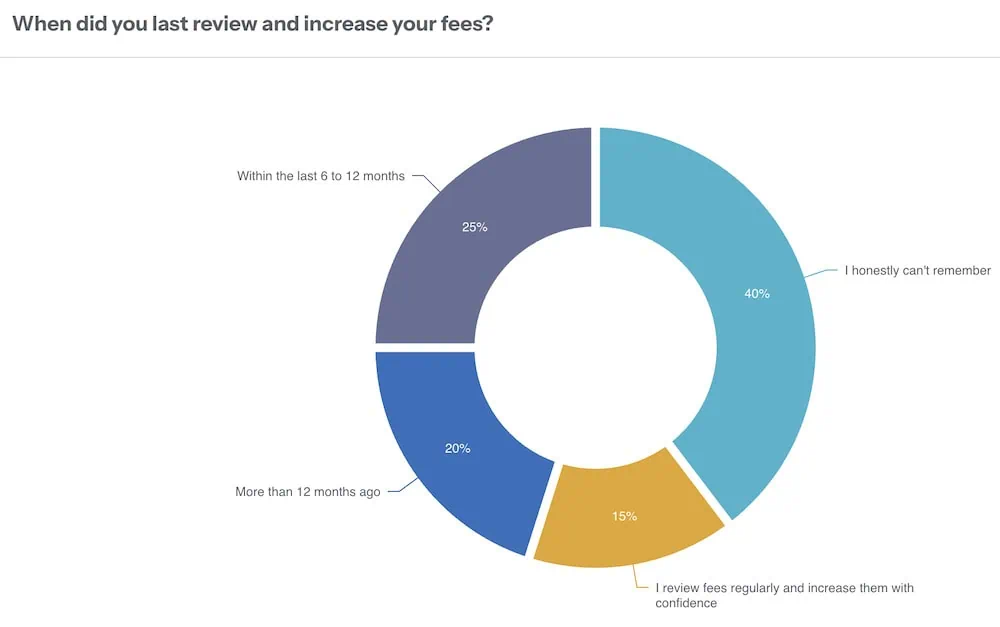
Almost 40% of practice owners answered with the words:
“Honestly… I can’t remember.”
Only a relatively small number said they reviewed their fees regularly, while many admitted it had been years since they had taken a structured look at their pricing. That shouldn’t be seen as a criticism. It’s simply the reality of running a busy equine practice.
Most owners don’t sit down at the beginning of the year and decide not to review their fees. Life simply gets in the way. Emergencies take priority, staff need support, vehicles need servicing, invoices need chasing and another busy season arrives before you’ve had a chance to stop and look at the bigger picture.
Before you know it, two or three years have passed. During that same period, however, almost everything else has become more expensive.
Fuel costs have increased.
Insurance premiums have gone up.
Wages have risen.
Medical equipment costs more.
Laboratory fees have changed.
Continuing education, software subscriptions and vehicle maintenance all continue to increase.
If your pricing hasn’t changed at the same pace, someone has been absorbing those additional costs. In almost every case, that someone is the practice owner.
What US Veterinary Inflation Tells Practice Owners
In the United States, the Consumer Price Index for veterinary services was 54.1% higher in July 2026 than the 2019 average. Over the same period, the Consumer Price Index covering all goods and services increased by approximately 30.6%.
The annual increase in veterinary service prices had slowed to 4.73% by July 2026, and the index decreased by 0.20% between June and July. That does not mean veterinary prices have returned to previous levels. It means the rate of increase is slowing after several years of substantial price growth.
These figures measure the prices paid by US consumers for veterinary services generally. They are not specific to equine practice and do not measure the operating costs of an individual veterinary business.
They provide useful industry context, but they should not be used as a formula for setting fees. Every practice must still examine its own wages, vehicles, travel, equipment, consumables, insurance, software and other operating expenses.
The figures also help explain why pricing conversations can feel increasingly difficult. Clients experience today’s much higher price level, while practices must continue covering their own costs. Regular pricing reviews allow practices to make smaller, considered adjustments rather than waiting several years and being forced into a much larger increase.
One of the simplest habits we’ve seen in consistently profitable practices is that pricing reviews become part of the business calendar rather than something that’s only considered when cashflow becomes tight.
That doesn’t necessarily mean increasing every fee every year. It means regularly asking sensible business questions.
Are our emergency call-out fees still appropriate?
Are we charging appropriately for our travel time?
Have the costs of consumables changed?
Are there services we’re providing today that aren’t reflected in our pricing schedule?
Most importantly…
Does our current pricing still support the type of practice we want to build over the next five or ten years? Pricing shouldn’t be something you think about only when profits are falling.
The importance of regularly reviewing pricing strategies has also been discussed by the British Veterinary Association’s In Practice journal, which emphasises that pricing should align with operating costs, business sustainability and client expectations rather than simply matching competitors.
It should be reviewed regularly, just like your clinical protocols, your equipment and your continuing education.
After all, every one of those things influences the quality of care you provide. Your pricing should ensure your practice remains strong enough to continue delivering that level of care for many years to come.
A Five-Minute Pricing Challenge
Before you move on, ask yourself these three questions.
☐ When did I last review my fee schedule?
☐ If fuel increased by another 10% tomorrow, would my current pricing absorb it?
☐ Am I completely confident that every service we provide is priced appropriately for the value, expertise and responsibility involved?
If any of those questions make you pause, you’re not alone. They’re exactly the conversations we have with practice owners during a Practice Growth Review, and they’re often where the biggest opportunities to improve profitability are discovered.
Pricing Isn’t About Charging More. It’s About Charging Fairly.
If there’s one thing I’d like you to take away from this article, it’s that pricing isn’t about becoming the most expensive equine practice in your area.
It’s about building a practice that is financially healthy enough to continue delivering exceptional veterinary care for many years to come.
When pricing is right, everyone benefits. Your clients receive consistent, high-quality care from a practice that can continue investing in equipment, continuing education and its team.
Your staff work in a business that can reward and retain good people. Most importantly, you create a practice that supports you, rather than one that depends on you constantly working longer hours just to stay afloat.
Improving your pricing doesn’t have to mean dramatic fee increases. The important thing is measuring whether your pricing decisions are actually improving the financial health of your business.
That’s why every practice owner should understand the key performance indicators that matter most. Read our guide to Equine Practice KPIs to learn which numbers you should be tracking each month.
More often than not, it’s the result of regularly reviewing your fees, understanding your costs, charging consistently for the work you’re already doing and having the confidence to recognise the value of your professional expertise.
Small improvements, applied consistently over time, often have a far greater impact than simply trying to see another horse each day. That’s why pricing should never be viewed in isolation.
It works alongside good leadership, effective systems, financial measurement and a clear strategy for the future. Together, those foundations create practices that are not only more profitable, but also more enjoyable to own.
One of the unexpected benefits of reviewing your pricing is that it can also improve your quality of life. A financially healthier practice places less pressure on the owner to constantly work longer hours simply to maintain cashflow.
If creating more balance is one of your goals, you may also enjoy our article on Work-Life Balance for Equine Veterinarians: How Practice Owners Get Their Life Back.
Ready to Review Your Pricing?
Completing the Equine Practice Growth Assessment was an excellent first step. Now it’s time to turn those insights into action. Every practice is different. Some practices are losing profit because their pricing hasn’t kept pace with rising costs.
Others have never developed a clear pricing strategy. Some simply haven’t reviewed their fees for years.
During your complimentary 20-minute Practice Growth Review, we’ll help you identify where the greatest opportunities exist within your own practice.
Together we’ll:
- Review your Practice Growth Assessment.
- Discuss the pricing challenges unique to your practice.
- Identify practical opportunities to improve profitability without simply working longer hours.
- Answer any questions you have about building a more sustainable equine practice.
There is absolutely no obligation. Our goal is simply to help you understand what your assessment is telling you and provide some practical next steps.
Book your complimentary Practice Growth Review →
Frequently Asked Questions
How do I know if my equine practice is undercharging?
There isn’t a single number that tells you whether your practice is undercharging. Instead, look for warning signs.
If your practice is consistently busy but profitability remains disappointing, you regularly discount your services, or you haven’t reviewed your fees for several years, there’s a good chance your pricing no longer reflects the true cost of delivering veterinary care.
The first step is to review your pricing alongside your costs, rather than comparing yourself with neighbouring practices.
Will increasing my fees cause me to lose clients?
Any fee change carries some risk, particularly when increases are large, sudden or poorly explained.
Practices can reduce that risk by reviewing fees regularly, making smaller adjustments where appropriate, providing clear estimates and explaining what is included in each service. The team should also understand the reasons for the change so clients receive a consistent explanation.
After changing fees, monitor treatment acceptance, cancellations, complaints, overdue accounts and the performance of the affected services. If those measures deteriorate, investigate which fees or communications may be causing the problem rather than assuming every price is too high.
How often should an equine practice review its pricing?
Your pricing should be reviewed at least once each year as part of your normal business planning.
That doesn’t necessarily mean increasing every fee annually, but it does mean checking whether your pricing still reflects rising costs, inflation, staff wages, fuel, equipment and the level of service your practice provides.
Practices that review their fees regularly are generally in a much stronger position than those that only review pricing when cashflow becomes tight.
Should I charge the same as other equine practices in my area?
Not necessarily. Every equine practice has different operating costs, business goals, client demographics and service offerings.
Using a competitor’s fee schedule as your primary pricing strategy can lead to undercharging if your costs are higher or your services provide greater value. Your pricing should reflect the cost of running your own practice sustainably, not simply match what another clinic charges.
What is the quickest way to improve profitability without seeing more horses?
For many equine practices, the fastest improvements come from reviewing pricing, capturing missed charges, improving billing consistency and regularly measuring key business numbers.
Small improvements across several areas often have a much greater impact than simply adding more appointments to an already full diary.
How much should an equine veterinarian charge?
There is no universal fee schedule suitable for every equine practice. The appropriate amount depends on the veterinarian’s time, travel, staffing, equipment, direct clinical costs, overheads, region, service model and the complexity of the case.
Your fees should be based primarily on the economics of your own practice rather than another veterinarian’s price list.
What should be included when calculating equine veterinary fees?
Include medications, consumables, laboratory charges, veterinarian and team time, travel, vehicles, equipment, insurance, software, administration, premises, compliance and future reinvestment.
Remember to include the time spent preparing for the visit, completing medical records and communicating with the client afterwards. These less visible activities are frequently overlooked when services are priced.