The State of Equine Veterinary Practice 2026
Industry Survey Reveals the Biggest Threat Facing Equine Veterinary Practices Isn’t Clinical
Owning an equine veterinary practice has never been easy, but it has become considerably more complicated.
Most of us entered this profession because we enjoy solving clinical problems, helping horses and building lasting relationships with clients. Very few imagined that one day we would also become responsible for recruitment, leadership, pricing, human resources, cash flow, marketing, compliance, business systems and strategic planning.
Yet that is exactly what practice ownership has become.
On any given day, an equine practice owner might examine a colic case before breakfast, investigate a lameness later that morning, spend lunch dealing with a staffing issue, review overdue accounts during the afternoon, answer questions from a new graduate between appointments, and then head back out after dinner for an emergency call-out.
Clinical medicine remains at the heart of what we do, but it is no longer the only job we have.
Over the past decade, I’ve had conversations with hundreds of equine practice owners at conferences, workshops and continuing education meetings around the world. What has always struck me is that those conversations rarely begin with medicine.
Instead, they revolve around finding veterinarians, keeping good staff, wondering whether fees are keeping pace with rising costs, feeling permanently interrupted, struggling to switch off, and asking the same quiet question:
“Why does the practice seem busier every year without feeling any easier to run?”
These aren’t isolated frustrations. They reflect a profession that has evolved rapidly while expecting practice owners to wear more hats than ever before.
Why We Created This Industry Benchmark
Rather than relying on assumptions or anecdotes, we wanted to understand what was really happening inside independent equine veterinary practices. That led to the development of The Equine Veterinary Practice Scorecard.
The Scorecard doesn’t simply measure financial performance. It explores the broader realities of practice ownership, including leadership, business systems, owner dependence, pricing confidence, financial management, growth strategy and wellbeing.
More than 300 equine practice owners completed the assessment, creating one of the largest business benchmarking datasets currently available for independent equine veterinary practice.
Importantly, this should be viewed as a large industry benchmark rather than a statistically representative survey of every equine practice. Even so, the consistency of the responses provides an unusually clear picture of the challenges many owners are facing.
One of the strengths of the data is the breadth of experience represented. Most respondents were practice owners or principals, the majority worked in exclusively equine practices, and over half were solo veterinarians. That makes these findings highly relevant to the realities of independent equine practice, where owners often carry multiple responsibilities every day.

Perhaps more importantly, these results mirror the conversations we hear every week from practice owners. The numbers simply give those conversations a voice.
The Biggest Finding Wasn’t Profitability
Before analysing the responses, it would have been easy to assume the biggest concern would be profitability. Others may have predicted recruitment. Some would have expected client expectations or increasing regulation.
Each of those issues certainly appeared throughout the responses, but none of them emerged as the defining challenge. Instead, something far more interesting became apparent. The problems equine practice owners described rarely existed in isolation.
Practices struggling with profitability were often the same practices struggling with delegation. Owners who found it difficult to take time away from the business were frequently the same people who lacked documented systems.
Those who felt overwhelmed often admitted they had little protected time to work on the future of the practice. Financial uncertainty, weak systems, reactive leadership, poor work-life balance and slow growth weren’t separate problems. They appeared repeatedly within the same businesses.
The data doesn’t prove that one issue causes another, but it strongly suggests that these challenges tend to occur together. As we reviewed the responses, one thread appeared to connect almost every section of the Scorecard. That thread was owner dependence.
What We Found
Across the Scorecard, several findings stood out immediately:
- Nearly half of respondents said their practice would largely grind to a halt without them.
- Only a very small minority believed their practice could genuinely operate independently.
- Most owners expected significant disruption if they stepped away for two weeks.
- Nearly two-thirds admitted they spent little or no meaningful time working on the business.
- Almost two-thirds lacked confidence that their pricing was generating healthy profit margins.
- Four in ten described themselves as feeling trapped or overwhelmed.
- Almost three-quarters admitted they had no written growth plan or were growing reactively.
Individually, each of those statistics is interesting.
Collectively, they tell a much bigger story.
This Isn’t Just Our Survey
One of the reasons these findings deserve attention is that they align with what is happening across the wider profession.
Recent BEVA research found equine veterinarians reported a median working week of more than 52 hours before out-of-hours work was even considered, while 70% said they were frequently or constantly “chasing their tail.”
Work-life balance, family commitments and workload featured prominently among the reasons veterinarians considered leaving their roles. Similar themes have also been identified through AAEP sustainability initiatives, which increasingly focus on leadership, workplace culture and creating practices that are sustainable for both owners and associates.
That external research doesn’t explain our findings. It reinforces them.
The challenges identified through the Scorecard are not unique to one country or one type of practice. They reflect broader pressures affecting equine veterinary practice internationally.
The difference is that our Scorecard allows us to see how those pressures are showing up inside the day-to-day reality of independent practice ownership.
And that reality points towards one defining challenge. Not pricing. Not recruitment. Not even profitability.
It points towards practices that have gradually become dependent on one person.
Understanding how that happens, and why it quietly limits almost every aspect of a practice, is where the story really begins. The first place to start is owner dependence.
The Hidden Cost of Being Indispensable
If there was one finding from the Equine Veterinary Practice Scorecard that connected almost every other result, it was owner dependence. On the surface, being indispensable can almost feel like a compliment.
Clients ask specifically for you. Your team relies on your judgement. Difficult cases always seem to find their way back to your phone, and when something unexpected happens, everyone naturally turns to the owner.
That level of trust is something most practice owners are proud of. After all, many equine practices have been built through years of hard work, personal sacrifice and an unwavering commitment to delivering excellent veterinary care.
The difficulty is that what begins as commitment can gradually become dependency. It rarely happens overnight.
In the early years of a practice, it makes perfect sense for the owner to make every important decision. There are simply too few people to share the responsibility. As the business grows, however, those responsibilities are rarely handed over. Instead, they accumulate.
The owner continues making the clinical decisions, reviewing invoices, managing staff, solving client complaints, ordering equipment, dealing with payroll questions, mentoring younger veterinarians and answering the endless stream of operational issues that arise every day.
Eventually, almost every significant decision still flows through one person. Many owners simply accept this as part of practice ownership. Our findings suggest it has become one of the biggest barriers to building a sustainable equine veterinary practice.
What We Found
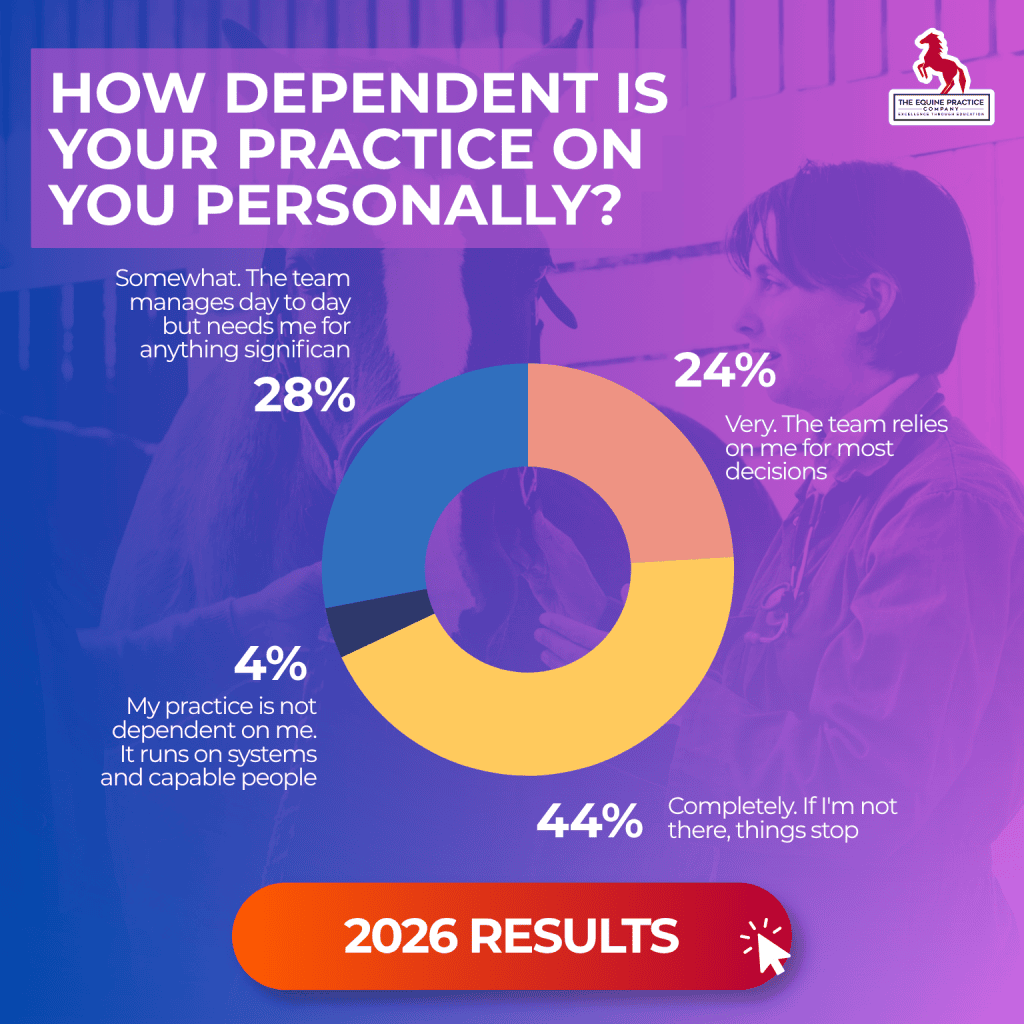
When we asked equine practice owners how dependent their practice was on them personally, the responses were striking.
- 45% said their practice would largely grind to a halt without them.
- 23% said their team relied on them for most important decisions.
- 27% believed the day-to-day work would continue, but they were still needed for anything significant.
- Only 4% believed their practice could genuinely function independently without them.
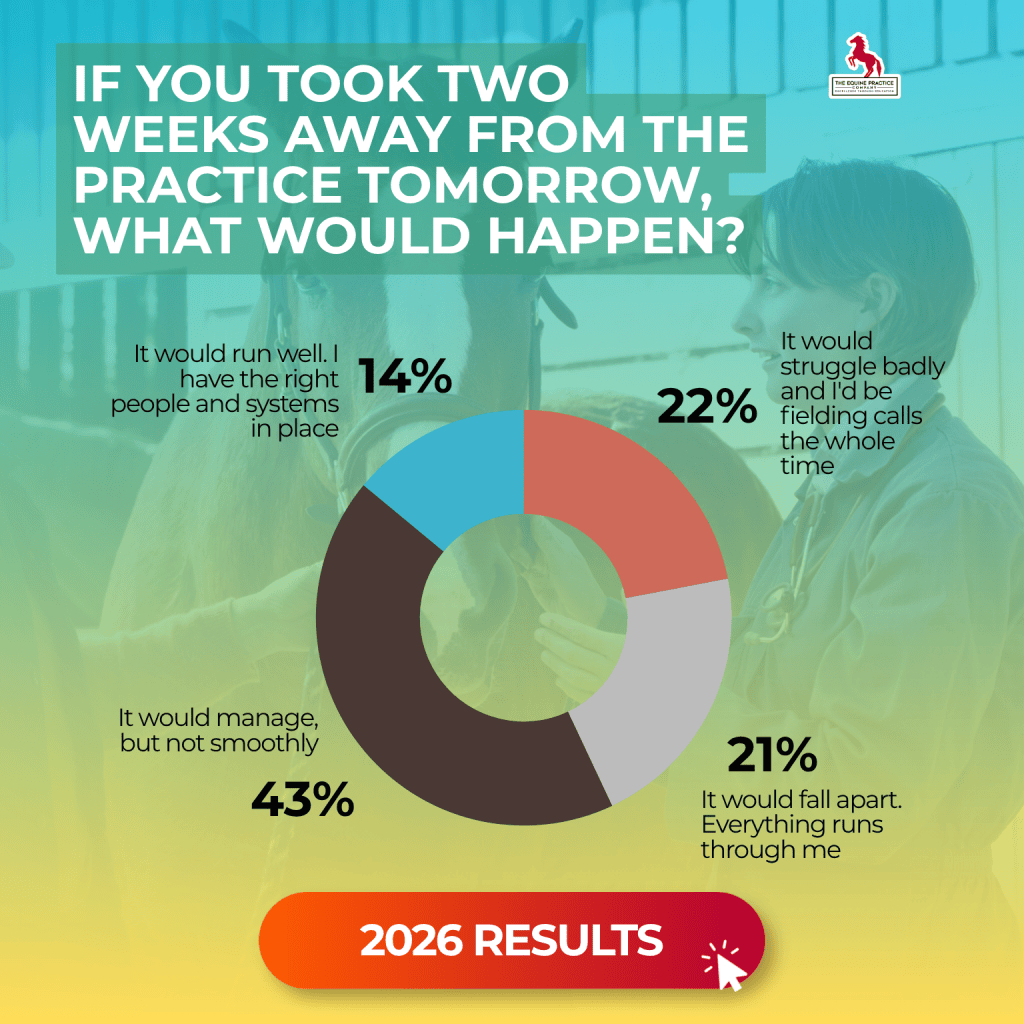
We then asked a second question.
“If you took two weeks away from the practice tomorrow, what would happen?”
Again, the results told a remarkably similar story.
Only 14% believed their practice would continue running smoothly.
The remaining respondents expected everything from constant interruptions and regular phone calls through to significant operational disruption or complete breakdown.
For anyone who has owned an equine practice, these numbers probably aren’t surprising. They’re simply putting percentages around something many owners already know.
Why This Happens So Gradually
Very few practice owners intentionally build a business that depends entirely on them. Most simply become victims of their own success.
As the practice grows, the owner becomes more experienced, more knowledgeable and more trusted.
Staff naturally ask them more questions because they have the answers. Clients request them because they have established relationships. Complex decisions return to them because they have handled similar situations before.
Each individual decision feels reasonable. The problem is what happens when those thousands of individual decisions accumulate over years. Eventually, the owner becomes the central point through which almost everything passes.
The business keeps growing, but the owner never escapes the operational centre of it. Ironically, the harder they work to keep everything under control, the more indispensable they become.
The Holiday Test
One of the simplest ways to measure owner dependence is to ask a very straightforward question.
Can you genuinely disappear for two weeks?
Not physically leave the practice while continuing to answer emails. Not spend your holiday taking phone calls between family meals. Not reassure yourself that “it’s only a couple of quick questions.” Can you actually disconnect?
For many equine practice owners, the honest answer is no.
The holiday still happens.
The laptop comes with you.
The phone never really stops.
Clinical questions continue to arrive. Staffing issues still need decisions. Clients still ask to speak directly to you.
You may be away from the practice, but mentally you’re still at work. That isn’t a holiday. It’s simply working from another location.
When Knowledge Lives Inside People’s Heads
Owner dependence isn’t created simply because owners work hard. It usually develops because critical knowledge never becomes part of the business itself. The Scorecard explored how well practices documented their core systems and procedures.
The findings were revealing.
- 32% said most important knowledge still lived inside people’s heads.
- 33% had some written procedures, but they were inconsistent or out of date.
- 28% had reasonable documentation that still needed improvement.
- Only 6% described their systems as well documented, consistently followed and regularly reviewed.

Those figures help explain why so many owners struggle to delegate confidently.
If there is no documented process for onboarding a new client, managing an emergency call-out, ordering medications, preparing a practice vehicle or processing an insurance claim, every new team member eventually has to ask someone.
That someone is usually the owner. Without documented systems, experience remains trapped inside individuals instead of becoming part of the practice itself.
The consequence isn’t simply inefficiency. It slows onboarding, creates inconsistency, makes delegation more difficult and increases the pressure on experienced team members every time someone joins or leaves the practice.
This Isn’t Just An Equine Practice Problem
Our findings also make sense when viewed alongside broader industry research.
AAEP has recognised that many equine practices are small businesses, with a large proportion consisting of one or two veterinarians. That structure naturally creates greater reliance on individual clinicians than would be expected in larger hospitals.
Likewise, the recent equine veterinary workforce research has highlighted delegation, leadership and sustainable practice design as essential components of retaining veterinarians and improving career longevity.
That research doesn’t prove owner dependence. Our Scorecard already demonstrates that. What it does show is that the structural conditions exist across the profession for owner dependence to develop if practices aren’t intentionally designed to avoid it.
Owner Dependence Is Usually a Symptom
Perhaps the most important lesson from this section isn’t that equine practice owners are working too hard. Most of us have always worked hard. Long hours, after-hours emergencies and taking responsibility for difficult decisions have always been part of the profession. Hard work has never been the problem.
The deeper issue is that owner dependence is rarely the problem itself. More often, it is the visible symptom of something happening underneath the surface of the business.
Practices become heavily dependent on their owners because important systems have never been documented. Responsibilities remain unclear or are never genuinely delegated. Leadership development is postponed because the owner continues making every significant decision.
Over time, knowledge becomes concentrated in one person instead of becoming embedded within the practice itself.
That creates a cycle that becomes increasingly difficult to break. The more decisions that return to the owner, the less time they have to build the systems that would prevent those decisions returning in the future. Every busy week reinforces the same pattern, making the owner even more central to the operation of the practice.
The encouraging aspect of this finding is that none of these issues are permanent. They don’t require a different personality, a larger practice or significantly more revenue. They don’t even require seeing more horses.
They require a deliberate shift from building a business that depends on one person’s experience to building a business that captures and shares that experience across the entire team.
When that begins to happen, something interesting changes.
The owner doesn’t become less valuable to the practice. In many ways, they become more valuable because they are no longer consumed by solving every operational problem.
Instead, they gain the time and capacity to mentor younger veterinarians, strengthen client relationships, develop new services, improve the culture of the practice and think strategically about where the business should be in three, five or even ten years’ time.
That is the real goal.
The objective is not to remove the owner from the practice. It is to remove the unnecessary dependence on the owner for every decision, every problem and every interruption.
Ultimately, that is the difference between owning a practice and carrying one.
Our Scorecard suggests that too many equine practice owners are still carrying their businesses on their shoulders every single day. The obvious question, then, is why working even harder rarely changes that situation. That is exactly what we explore in the next section.
Why Hard Work Isn’t Producing Better Results
If there is one characteristic that almost every equine practice owner shares, it is a willingness to work hard.
Long hours have almost become a badge of honour within our profession. Early starts, late finishes, interrupted weekends and emergency call-outs are simply accepted as part of the job.
Most practice owners are exceptionally resilient people who have spent years developing the clinical skills required to deal with complex and often unpredictable situations.
When new challenges arise, our instinct is usually the same. We work a little harder, put in a few more hours and push through until things settle down.
The problem is that running a business doesn’t always respond to effort in the same way that clinical medicine does.
Working harder might allow you to see more horses this week, complete more paperwork or answer more client calls. It rarely creates a stronger business.
Beyond a certain point, it often achieves the opposite. As the owner’s workload increases, the time available for leadership, planning and strategic decision-making steadily disappears.
The practice becomes increasingly efficient at solving today’s problems while becoming progressively less prepared for tomorrow’s opportunities.
That pattern emerged clearly throughout the Scorecard.
What We Found
When we asked owners how much of their working week was spent working on the business rather than in it, the responses were remarkably consistent.
- 17% admitted they had virtually no capacity to step back from day-to-day operations.
- 47% said business development and strategic planning received very little attention.
- 26% believed they spent a reasonable amount of time working on the business but knew they could do more.
- Only 10% protected regular, non-negotiable time to focus on improving the practice rather than simply running it.

Taken together, that means almost two-thirds of respondents acknowledged that strategic planning received little or no meaningful attention.
For many practice owners, that statistic probably feels uncomfortably familiar.
There is always another emergency to attend, another client to call back, another invoice to review or another staffing issue demanding immediate attention. By the time the day finally finishes, there is very little energy left to think about where the business is actually heading.
Working Hard Isn’t the Same as Leading
One of the biggest misconceptions in practice ownership is that leadership naturally develops alongside clinical experience.
In reality, they are two very different skill sets.
The qualities that make someone an outstanding veterinarian don’t automatically prepare them to build systems, develop people, manage finances or create long-term strategy. Those are business skills, and very few of us receive any formal training in them during veterinary school.
As a result, many practice owners find themselves learning leadership through trial and error while simultaneously trying to run an increasingly complex business.
There is nothing unusual about that. In fact, it is probably the norm. The challenge is that leadership requires something many owners simply don’t have. Time. Not time to answer emails. Not time between appointments. Not ten minutes while driving to the next farm. It requires uninterrupted time to think.
Time to look beyond today’s emergencies and ask whether the way the practice operates today is still the best way for it to operate tomorrow.
The Projects That Never Seem to Get Finished
Ask almost any equine practice owner what they planned to improve this year and you’ll usually hear a remarkably similar list.
- Updating protocols.
- Reviewing pricing.
- Improving induction for new team members.
- Introducing better practice software.
- Developing leadership within the team.
- Documenting procedures.
- Building better reporting systems.
None of these projects are particularly difficult.
The problem is that none of them feel as urgent as today’s clinical caseload.
- Every week they are pushed into next week.
- Every month they become the next month.
Eventually, another year passes and the same projects remain unfinished. It isn’t because owners lack motivation. It’s because they lack protected thinking time.
Accountability Doesn’t Stop at Clinical Standards
Another area we explored through the Scorecard was accountability.
As veterinarians, we work within a profession built around accountability. Clinical decisions are discussed with colleagues. Continuing education keeps us current. Difficult cases are reviewed and professional standards are continually reinforced.
Business ownership is very different. Many practice owners make every significant business decision entirely alone. Our findings reflected exactly that.
- 41% reported having nobody who regularly held them accountable for business progress.
- 20% relied on informal conversations with an accountant, spouse or family member.
- 24% had some form of loose accountability but nothing structured.
- Only 14% had a formal accountability system that regularly challenged progress and kept them focused on long-term priorities.
That may explain why so many owners spend twelve months working incredibly hard without feeling as though the business has fundamentally changed.
Without accountability, urgent tasks naturally replace important ones.
This Isn’t Just What We Found
Interestingly, recent veterinary leadership research points in exactly the same direction.
A 2025 review of veterinary management concluded that management and leadership capability remain among the least developed areas of veterinary practice, despite becoming increasingly important as practices grow.
Other research has shown that strong leadership is closely associated with improved wellbeing, staff retention and healthier workplace culture. In other words, leadership isn’t simply about managing people well. It directly influences the long-term sustainability of the practice itself.
Again, that research doesn’t replace what we found through the Scorecard. It helps explain why our findings make so much sense.
Why Busyness Creates More Busyness
Perhaps the biggest lesson from this section is that the limiting factor in most equine practices isn’t effort. It is focus. Very few owners need to work harder. Most are already working close to their capacity. What many practices need instead is protected time to improve the business itself.
The practices that continue moving forward aren’t necessarily owned by veterinarians who work the longest hours. More often, they are led by owners who deliberately create time to think, plan and improve the systems around them.
They understand that spending half a day reviewing workflows, mentoring a team member or analysing financial performance isn’t time away from work.
It is some of the most valuable work they can do. That shift in thinking changes everything. Instead of reacting to whatever happens today, the owner begins shaping what the practice will become tomorrow.
And once that begins to happen, another important change follows. The conversation moves beyond simply being busy and starts focusing on whether all that hard work is actually producing a financially stronger business.
Because as our next section reveals, being busy and being profitable are often two very different things
The Profit Problem Most Owners Never See
Conversations about profitability can sometimes feel uncomfortable within the veterinary profession.
Most of us didn’t become equine veterinarians because we wanted to maximise profit. We chose this profession because we enjoy helping horses, supporting clients and solving challenging clinical problems. As a result, discussions about pricing, margins and financial performance can often feel secondary to the medicine itself.
There is sometimes an unspoken belief that if we simply provide excellent veterinary care and work hard enough, the financial side of the business will eventually take care of itself.
Unfortunately, practice ownership rarely works that way.
Some of the busiest equine practices are also some of the most financially stretched. Full appointment books, growing turnover and increasingly long working days don’t automatically translate into healthy profitability.
Without a clear understanding of costs, pricing and financial performance, it is entirely possible to work harder every year while making very little progress financially. That is exactly what our Scorecard began to uncover.
What We Found
One of the most revealing findings wasn’t that practices were definitely undercharging. It was that many owners simply weren’t confident whether they were undercharging or not.
When we asked respondents how confident they were that their fees covered their true costs while generating healthy profit margins, the results painted a concerning picture.
- 63% admitted they either suspected they were undercharging or had only a vague understanding of their true profit margins.
- 29% felt reasonably confident but acknowledged there were still gaps in their understanding.
- Only 8% said they were very confident that their pricing accurately reflected the true economics of the practice.
That distinction is incredibly important. This isn’t simply a pricing problem. It’s a confidence problem.
Busy Doesn’t Always Mean Profitable
Most equine practice owners have a reasonable idea of what the practice invoices each month. Far fewer know exactly which services generate healthy margins, where profitability is leaking away or whether increasing turnover is actually improving the financial strength of the business.
Without that knowledge, every financial decision becomes more difficult. Fee increases are delayed because they feel uncomfortable. New equipment is purchased without fully understanding the expected return.
Additional staff are employed because the practice feels busy, rather than because the numbers clearly support the decision. Over time, important financial decisions become driven by instinct rather than information.
That uncertainty creates unnecessary stress. Not because owners lack financial ability, but because very few veterinarians have ever been taught how to interpret the numbers behind their own businesses.
Measuring the Wrong Numbers
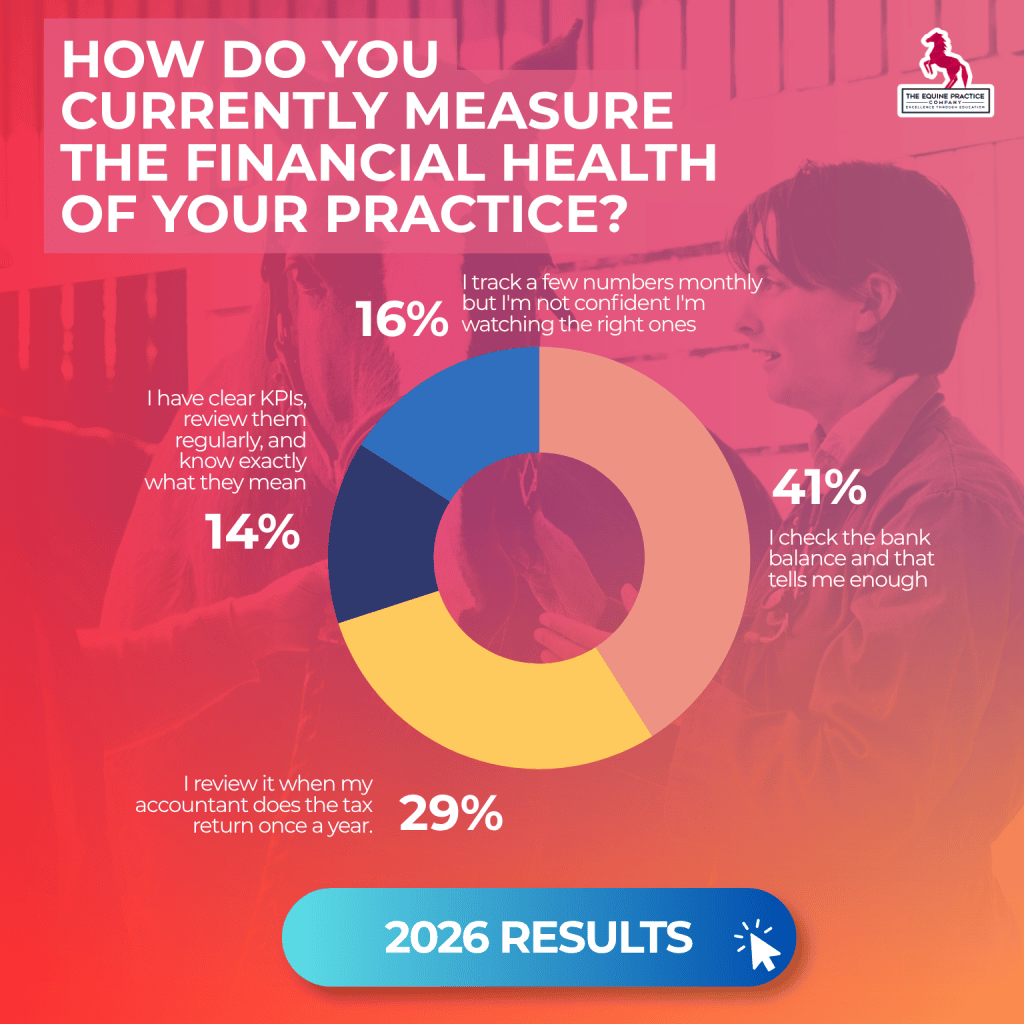
The Scorecard also explored how practice owners currently measure the financial health of their business.
The results suggest many practices are still relying on indicators that provide only part of the picture.
- 30% primarily judged financial performance by the balance in the bank account.
- 13% relied largely on annual meetings with their accountant.
- 40% tracked some monthly figures but admitted they lacked confidence in what those numbers were actually telling them.
- Only 17% reported having clearly defined key performance indicators that they understood and reviewed regularly.
Imagine approaching a complicated colic case with only half the clinical information available. None of us would feel comfortable making important treatment decisions without understanding the whole picture.
Yet many practice owners are expected to make significant business decisions every day without having the same level of confidence in the financial information available to them.
When viewed from that perspective, it’s hardly surprising that financial uncertainty is so common.
The Revenue That’s Quietly Slipping Away
One of the most relatable questions in the entire Scorecard explored missed charges and undercharging.
Almost every experienced practice owner has had that uncomfortable feeling that something probably wasn’t invoiced.
- An additional medication.
- A lengthy telephone conversation.
- Extra time spent managing a difficult emergency.
- A revisit that was never entered correctly.
Individually, those omissions rarely seem significant. Collectively, they can quietly erode profitability month after month. Our respondents recognised exactly that.
- 25% believed they were regularly losing significant revenue through missed charges.
- 56% suspected it happened occasionally but had never attempted to quantify the impact.
- Only 15% believed their systems captured almost everything accurately.
- Just 5% described their charging processes as consistently tight and reliable.
What’s particularly interesting is that most owners already suspect revenue leakage exists. The problem is that very few know how much it is actually costing them. You can’t improve what you can’t measure.
Raising Fees Isn’t the Whole Story
There is another misconception that deserves attention. Whenever profitability is discussed, the conversation quickly turns towards increasing prices. Our findings suggest the issue is much more nuanced than that.
In fact, 51% of respondents had reviewed and increased their fees within the previous six to twelve months. Another 15% described themselves as reviewing fees confidently and regularly.
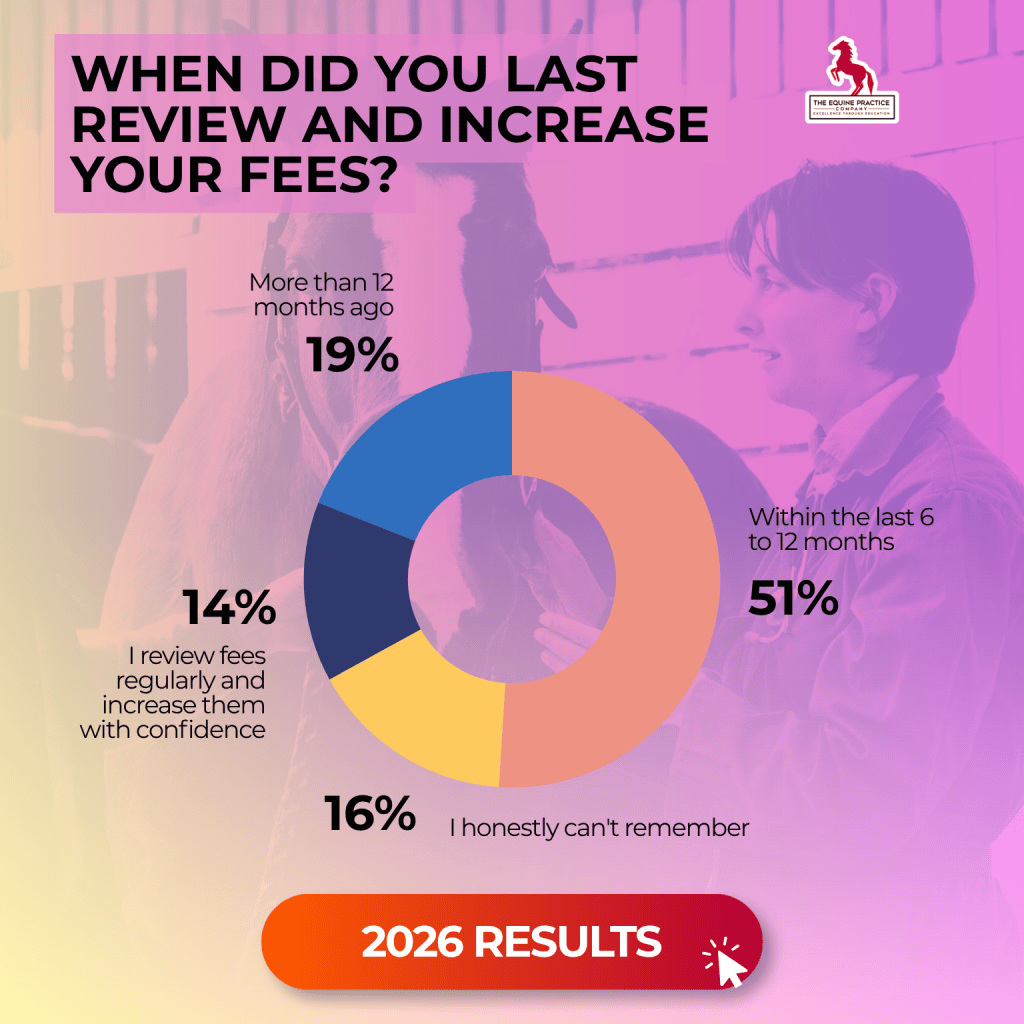
Clearly, many practices are adjusting their pricing. The challenge is that fee increases alone aren’t creating financial confidence.
When we asked owners how they actually set their prices, only 17% reported having a clearly defined value-based pricing strategy. The majority admitted they either followed nearby practices, adjusted fees informally or deliberately kept prices lower because they worried about losing clients.
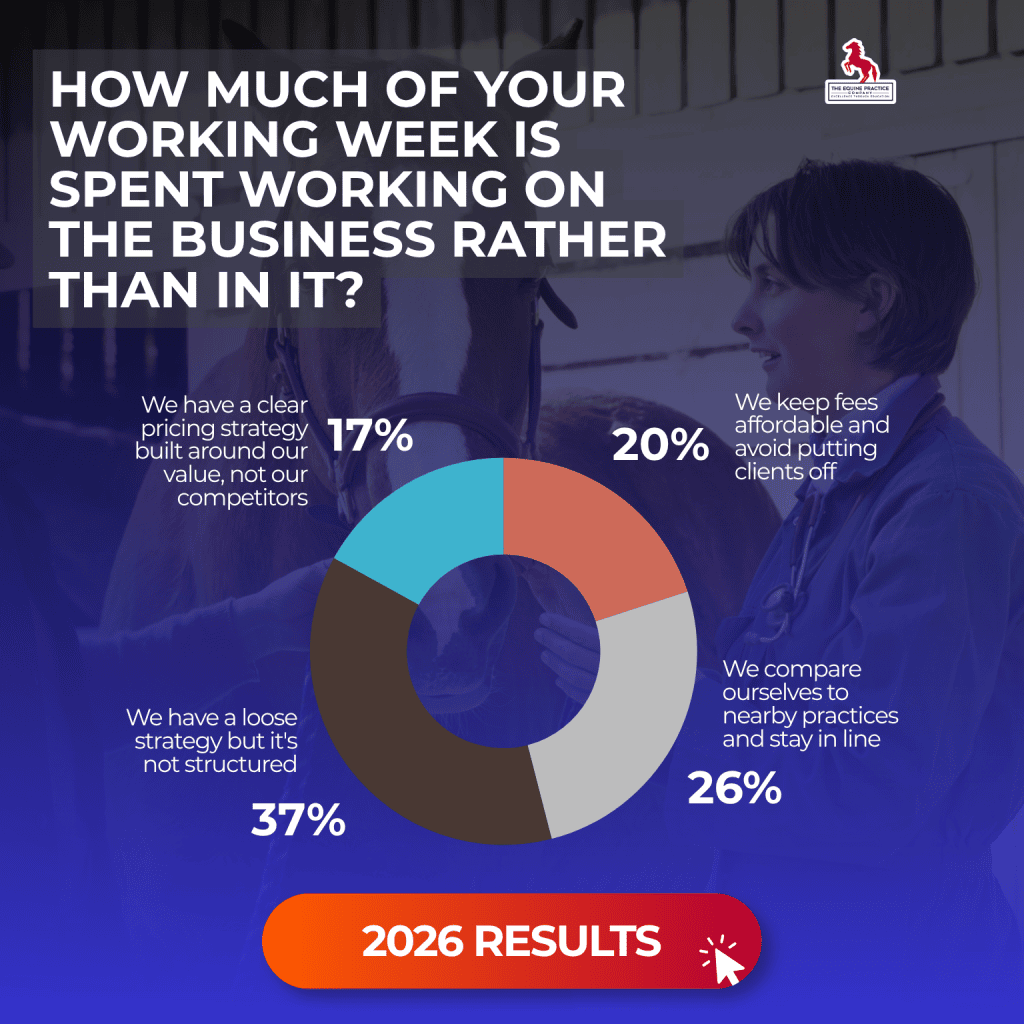
That is a very different conversation. This isn’t about encouraging practices to charge more. It’s about helping owners understand why they charge what they charge.
This Isn’t Just What We Found
Interestingly, AAEP reaches a remarkably similar conclusion. Its guidance on practice economics encourages owners to understand the true costs of delivering veterinary services, improve billing systems and avoid relying solely on nearby competitors when setting fees.
Fee comparisons have value, but they are only one piece of the puzzle. Sustainable pricing begins with understanding your own business first. That aligns almost perfectly with what our respondents told us.
The practices struggling financially weren’t necessarily those charging the least. They were often the practices with the least confidence in the numbers behind their decisions.
Financial Confidence Changes Everything
Perhaps the biggest lesson from this section is that profitability begins long before a fee increase. It begins with understanding.
Owners who understand their numbers rarely make financial decisions based purely on emotion. They know which services create value, where profitability is leaking, which investments make commercial sense and which areas of the business need attention first.
That knowledge creates confidence. Confidence changes conversations with clients.
- It changes investment decisions.
- It changes recruitment.
- It changes growth.
Most importantly, it allows owners to build practices that are financially sustainable enough to continue investing in their teams, their equipment and the level of veterinary care they want to provide.
Because at the end of the day, financial strength isn’t separate from clinical excellence. It is one of the foundations that allows clinical excellence to continue.
The next section of the Scorecard reveals what happens when those financial pressures, combined with owner dependence and constant busyness, begin affecting something even more important. The wellbeing of the practice owner.
When Success Starts Feeling Like Survival
Perhaps the most confronting findings from the Equine Veterinary Practice Scorecard had nothing to do with pricing, business systems or profitability. They had everything to do with how practice owners actually feel.
For many equine veterinarians, owning a practice was supposed to create greater freedom. It was an opportunity to build a workplace that reflected their own values, provide exceptional care, develop lasting client relationships and create a business that supported both their professional ambitions and their family life.
Yet somewhere along the way, many owners find themselves asking a question they never expected to ask.
“Is this really what I was working towards?”
It’s not a question that’s often discussed publicly.
Veterinarians are remarkably resilient people. We become accustomed to long hours, difficult decisions and carrying significant responsibility very early in our careers. We learn how to manage emergencies, support distressed clients and make complex clinical decisions under pressure.
Admitting that we’re struggling with the pressures of business ownership can feel much harder. That is exactly why this section of the Scorecard stood out so strongly.
What We Found
When we asked respondents which statement best described how they currently felt about their practice, the responses painted a picture that many owners will immediately recognise.
- 13% said they felt trapped by the practice they had built.
- 27% described themselves as overwhelmed and constantly firefighting.
- 45% felt they were making progress but still struggling to achieve the balance they wanted.
- Only 14% said they genuinely felt in control and that the practice was supporting the life they wanted to lead.

Those numbers deserve careful consideration. Collectively, they suggest that almost nine out of every ten practice owners are experiencing some level of ongoing pressure, frustration or imbalance. For a profession built around helping others, that’s a sobering finding.
Success Doesn’t Always Feel Like Success
From the outside, success often looks obvious.
- A growing team.
- New vehicles.
- A purpose-built facility.
- A full appointment book.
- A busy diary.
To everyone else, the practice appears to be thriving. But outward success doesn’t necessarily reflect what ownership actually feels like. A practice can be financially successful while its owner is exhausted.
It can be clinically respected while the owner feels unable to switch off. It can continue growing while quietly becoming more dependent on one individual every single year.
That is one of the realities of practice ownership that rarely gets discussed. People see the business. They don’t always see the responsibility that comes with it.
The Weight That Owners Carry
Every practice owner understands that there are some problems nobody else can solve.
- Staff disagreements.
- Cash flow concerns.
- Employment decisions.
- Difficult client complaints.
- Equipment failures.
- Unexpected legal issues.
The list is endless. None of those responsibilities disappear simply because the appointment book is full. Instead, they are added on top of an already demanding clinical workload. The owner finishes seeing horses for the day only to begin dealing with the business itself.
Over time, that constant responsibility becomes normal. The difficulty is that normal doesn’t necessarily mean sustainable.
When the practice relies heavily on one individual, there are very few opportunities to genuinely disconnect. Even weekends away can become interrupted by phone calls, text messages and emails because everyone still believes the owner has the answers.
When viewed alongside the earlier findings on owner dependence, this starts to make perfect sense. The emotional pressure isn’t occurring in isolation. It is connected to the way many practices are currently structured.
Looking Twelve Months Ahead
We also asked respondents a simple but revealing question.
“If nothing changes in your practice over the next twelve months, how does that make you feel?”
The responses were perhaps even more revealing than the previous question.
- 14% admitted they felt genuinely worried about where the practice was heading.
- 25% said they were frustrated but unsure where to begin making improvements.
- 46% felt mildly concerned that things could be better.
- Only 15% believed they were already on the right path.
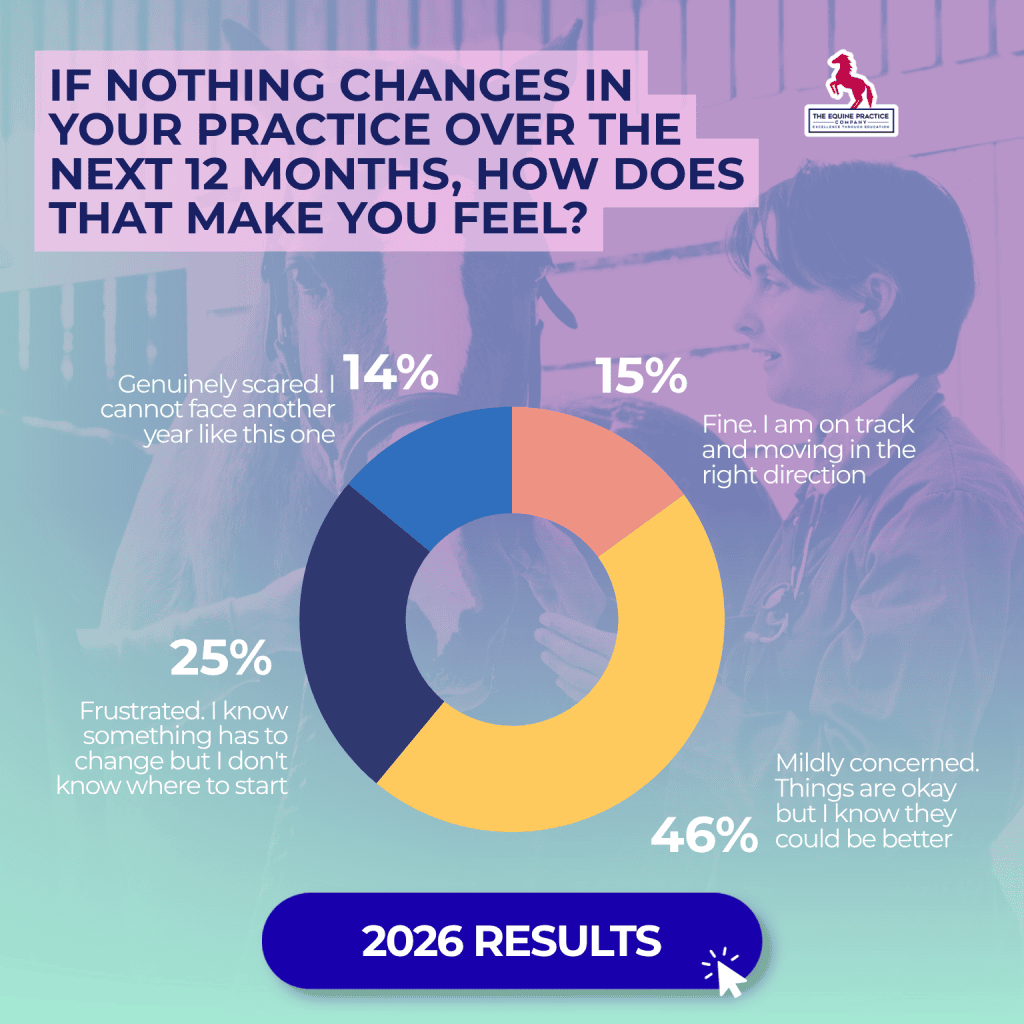
In other words, 85% of respondents expressed some degree of concern about repeating another year that looked very much like the last.
That statistic says far more than simply measuring stress. It tells us that many owners can already see the gap between the practice they currently have and the practice they originally hoped to build.
This Isn’t Just What We Found
Again, our findings closely reflect what is being reported across the wider equine veterinary profession.
Recent BEVA workforce research found that equine veterinarians reported a median working week of more than 52 hours before out-of-hours commitments were included, while 70% described themselves as frequently or constantly “chasing their tail.”
Work-life balance, workload and family life were among the most common reasons veterinarians considered leaving equine practice. Similar qualitative research from the United States has highlighted long hours, unpredictable emergency work and poor work-life balance as recurring themes among veterinarians who become dissatisfied with equine practice.
Those studies don’t explain every challenge identified in the Scorecard. What they do show is that our respondents are far from alone. These are pressures being experienced throughout the profession.
You’re Probably Not the Only One Feeling This Way
One of the unintended consequences of practice ownership is that it can feel surprisingly lonely. Most owners spend their days supporting staff, reassuring clients and making decisions for everyone else.
Very few have another equine practice owner sitting in the next office who truly understands the weight of those decisions.
As a result, it becomes easy to assume everyone else has somehow figured it out. That everyone else’s practice is running more smoothly. That everyone else is taking uninterrupted holidays.
That everyone else has solved the staffing problems, the financial pressures and the constant interruptions.
Our findings suggest something very different. Across practices of different sizes, different countries and different stages of ownership, the same themes appeared over and over again.
The challenges may look slightly different from one practice to another, but the underlying pressures are remarkably similar.
There is something strangely reassuring about that. Not because these challenges should be accepted, but because they are not signs of personal failure.
They are signs of an industry that has changed enormously while asking practice owners to become clinicians, employers, financial managers, leaders and business strategists all at the same time.
Building an Equine Practice That Supports Your Life
Perhaps that is the most important lesson from this entire section. Most equine veterinarians aren’t looking for an easier profession. They understand that emergency work, difficult cases and long days will always be part of equine practice.
What they are searching for is something different.
They want confidence that they can take a holiday without their phone ringing every hour. They want talented team members who can solve problems without every decision returning to the owner.
They want a business that supports the life they imagined when they first decided to own a practice, rather than one that quietly consumes it.
That is why owner dependence, leadership, financial confidence and business systems matter so much. They aren’t simply business concepts. They shape the daily experience of owning an equine practice.
And they determine whether success eventually feels like freedom or simply another form of survival. Fortunately, the final section of the Scorecard offers some encouraging news.
It shows that these challenges are not inevitable, and it highlights the practical characteristics that distinguish practices that continue moving forward from those that remain stuck in the same cycle year after year.
Why Good Veterinarian Practices Stop Growing
One of the more interesting findings from the Scorecard is that experience alone doesn’t necessarily produce a stronger business.
Our respondents included practice owners who had started their businesses within the past two years alongside others who had been leading practices for more than a decade. Yet many of the same challenges appeared regardless of how long they had owned the practice.
That observation is worth reflecting on.
Time certainly makes us better clinicians. Experience improves our judgement, our confidence and our ability to solve difficult medical problems. Business, however, doesn’t always work the same way.
If we continue solving today’s problems using the same approach year after year, the practice often becomes busier without becoming fundamentally better.
Growth eventually slows. Not because demand disappears. Not because the owner stops working hard. But because the business reaches the limits of the systems supporting it.
What We Found
When we asked respondents about their plans for the future, the results suggested that many practices were operating reactively rather than intentionally.
- 73% either had no written growth plan or described their approach to growth as largely reactive.
- Only 6% had a clearly documented growth plan supported by meaningful accountability.
- The remaining respondents fell somewhere between those two extremes.

That doesn’t suggest a lack of ambition. Quite the opposite. Almost every practice owner wants to improve their business. The challenge is finding the time to decide exactly what improvement should look like.
Without a clear destination, growth often becomes whatever happens to occur over the next twelve months rather than something that is deliberately designed.
Growth Doesn’t Just Mean Getting Bigger
One of the biggest misconceptions in practice ownership is that growth simply means employing more veterinarians, seeing more horses or opening another location.
Sometimes it does. Often it doesn’t.
For many owners, meaningful growth looks very different.
It means finally being able to take a holiday without constant interruptions.
It means finishing work in time to have dinner with family.
It means mentoring younger veterinarians instead of solving every problem yourself.
It means improving profitability without increasing clinical workload.
It means building a practice that becomes easier to lead rather than more exhausting every year.
Those are all forms of growth. In many ways, they are the forms of growth that matter most.
The Pattern We Kept Seeing
As we worked through the Scorecard responses, one pattern became increasingly difficult to ignore.
Practices rarely struggled with just one issue. Owner dependence appeared alongside poor systems. Poor systems appeared alongside limited strategic planning. Limited strategic planning appeared alongside financial uncertainty. Financial uncertainty appeared alongside overwhelm. None of those findings prove that one causes another.
However, they do suggest that these issues are deeply interconnected. Improving one area often creates positive changes elsewhere, while ignoring one weakness allows pressure to build across the rest of the practice.
That is perhaps the most valuable insight from the entire project. The challenges facing equine practice owners are not isolated problems requiring isolated solutions. They are different symptoms of the same underlying business structure.
Five Lessons Every Equine Practice Owner Can Apply
After reviewing hundreds of Scorecard responses, five practical lessons stand out above everything else.
First, reduce dependence on yourself before trying to grow the practice. Every system that removes unnecessary decisions from the owner’s desk creates capacity for more valuable work.
Second, protect time to work on the business. Strategic thinking rarely happens by accident. It needs to be scheduled with the same commitment as surgery or client appointments.
Third, understand the numbers behind your decisions. Confidence comes from clarity, not guesswork. The better you understand your financial performance, the easier every important decision becomes.
Fourth, document what only you know. Every procedure that exists only inside your head limits the future of the practice. Every procedure that becomes part of the business strengthens it.
Finally, define what success actually looks like. Bigger isn’t always better. The best practices aren’t necessarily the largest. More often, they are the practices that give owners greater control over their time, stronger financial security and the confidence that the business can continue succeeding without depending on one individual every minute of every day.
None of these lessons can be implemented overnight. But every one of them can begin this week.
Understanding the Challenges
When we first created the Equine Veterinary Practice Scorecard, our goal was simply to better understand the challenges facing independent equine veterinary practices. What emerged was something far more valuable.
The results showed that practice owners around the world are experiencing remarkably similar frustrations. They are working incredibly hard. They care deeply about their clients, their teams and the horses they treat. Yet many feel that despite all of that effort, the business itself isn’t becoming any easier to lead.
Perhaps the most reassuring finding is that these challenges are shared.
If your practice feels overly dependent on you…
If you struggle to find time to work on the business…
If you’re uncertain about your pricing…
If taking a proper holiday feels impossible…
If you sometimes wonder whether ownership was supposed to feel easier than this…
You’re certainly not alone. More importantly, none of these findings suggest that equine practice ownership is broken. They suggest that the profession has changed.
The expectations placed upon practice owners today are greater than they have ever been. Clinical excellence is still essential, but it is no longer enough on its own. Today’s practice owners are also expected to become leaders, business managers, financial decision-makers and mentors, often with very little formal training in any of those areas.
That is exactly why understanding the business side of practice has become just as important as understanding the medicine.
The encouraging news is that every challenge identified throughout this report is solvable.
- Systems can be improved.
- Leadership can be developed.
- Financial confidence can be built.
- Owner dependence can be reduced.
- Growth can become intentional rather than reactive.
None of those changes happen overnight, but every successful practice starts by understanding where it stands today. That is ultimately what the Equine Veterinary Practice Scorecard was designed to do.
It isn’t an exam. It isn’t about judging your practice against anyone else’s.
It is a benchmarking tool designed to help you understand where your greatest opportunities lie, compare your practice against hundreds of other equine veterinary businesses, and identify the next improvements that will have the biggest impact on your practice, your team and your own quality of life.
Because after analysing hundreds of responses, one conclusion stands above all the others. The future of equine veterinary practice won’t be determined solely by better medicine.
It will be determined by building better businesses that allow great veterinarians to continue doing what they do best for many years to come.
About This Industry Survey
This article is based on findings from The Equine Veterinary Practice Scorecard, one of the largest business benchmarking surveys conducted specifically for independent equine veterinary practices. More than 300 equine practice owners from around the world completed the detailed assessment, providing valuable insight into the business, leadership and operational challenges facing the profession today.
While the survey was not designed to be a statistically representative study of every equine practice, the consistency of the responses revealed remarkably clear patterns across countries, practice sizes and business models. The findings presented throughout this article are drawn directly from that collective experience.
Media, Podcasts & Industry Publications
If you are a podcast host, journalist, conference organiser, veterinary association or industry publication and would like to discuss the findings of this survey in more detail, we would be delighted to hear from you.
Dr. Olivia James is available for podcast interviews, conference presentations, webinars, guest articles and media commentary on the business of equine veterinary practice, including topics such as practice profitability, leadership, pricing, owner dependence, team development and long-term business sustainability.
Likewise, if you would like to reference, discuss or republish aspects of this industry benchmark in your own publication, please feel free to get in touch. Our goal is simple: to help more equine practice owners build stronger, more sustainable businesses and to encourage meaningful conversations about the future of the profession.