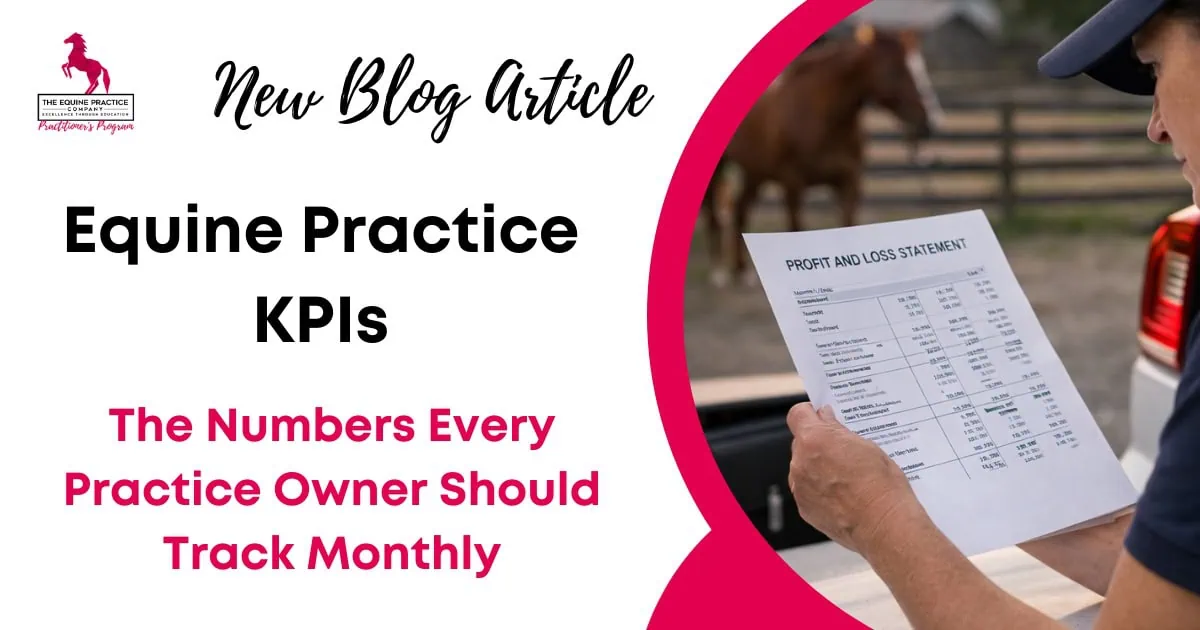
Equine Practice KPIs: The Numbers Every Practice Owner Should Track Monthly
If I could sit down with every veterinary practice owner and equine practice owner for just one conversation, there is one thing I would want them to understand early.
You do not need to work harder. You do not need to see more horses. And you do not need to carry that constant low-level anxiety about whether the practice is actually doing okay. What you need is clarity. And clarity comes from numbers.
Because equine practice ownership is incredibly emotional. We care deeply. We want to do the right thing. We want to help. But emotion is not a management strategy, and hope is not a business plan.
Most equine veterinarians and equine practice owners are running their practices based on gut feel. They feel relieved when there is cash in the bank. They feel stressed when the diary is quiet. They feel unsure when the accountant asks questions. They feel like they are constantly reacting.
But here is the truth, cash in the bank is not a KPI. It is a snapshot. It is not a strategy. And it does not tell you whether the business is healthy.
Imagine your practice has $80,000 sitting in the bank. At first glance, that may feel reassuring.
But what if $45,000 is needed for wages next week, another $20,000 is already committed to inventory, vehicle repayments and other expenses, and your revenue has actually been declining for the past three months?
Suddenly, that healthy-looking bank balance tells a very different story. Cash is important, but it does not tell you whether the business is becoming more profitable, more efficient or more sustainable.
That is what the right KPIs are designed to show you.
How Does Your Practice Compare?
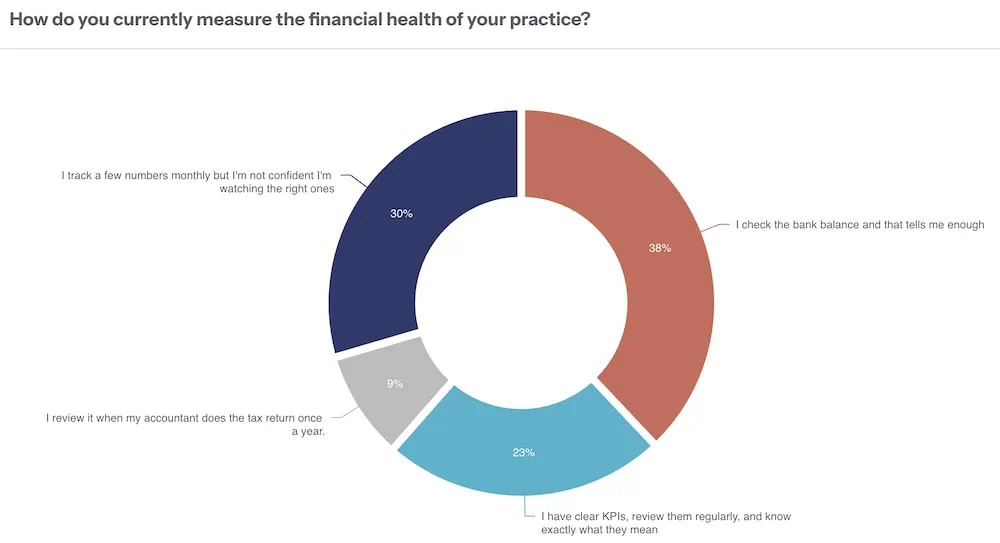
As part of our Equine Practice Growth Assessment, we asked equine practice owners how they currently measure the financial health of their practice.
Many owners told us they were relying on cash in the bank, occasional accountant reports, or a general feeling that the practice was doing okay.
Very few were consistently using a small set of business numbers to understand what was really happening each month.
Key Insights
Cash in the bank can tell you what is available today, but it cannot tell you whether your practice is becoming more profitable, more efficient, or more sustainable.
Without the right KPIs, a practice can feel busy and successful while quietly losing profit through undercharging, missed charges, poor scheduling, rising costs, or unpaid invoices.
That is why good financial management starts with visibility. You do not need dozens of reports. You need a small number of reliable measures that show whether the practice is moving in the right direction.

What Are KPIs, Really?
KPI simply means “Key Performance Indicator.” In plain language, it is a number that tells you whether the practice is moving in the right (or wrong) direction. It gives us proof of what is actually happening, rather than just a feeling.
The problem is that many practice owners think KPIs are complicated. They imagine corporate dashboards with hundreds of metrics, graphs, and spreadsheets that make them feel overwhelmed. But equine practice KPIs are not about complexity.
They are about focus. You do not need to track everything. You need to track the handful of numbers that actually drive the business. The numbers that tell the truth.
The numbers that allow you to make small adjustments early, instead of waiting until things become a crisis.
Why Most Equine Practice Owners Feel Financially Uncertain
One of the most common things I hear from equine vets is this:
“I’m busy, but I don’t feel secure.”
They are working flat out, yet still worrying about bills, equipment costs, staff wages, or quiet months. That uncertainty usually comes from one missing piece: they do not have visibility.
They do not know what the practice is actually doing financially until the end of the year, when the accountant tells them what happened after the fact.
But by then, it is too late. KPIs give you real-time feedback. They allow you to manage monthly, not annually. That is where freedom begins.
Could You Answer These Questions Today?
Before reading any further, stop for a moment and ask yourself these questions.
Without opening your accounting software…
Without calling your accountant…
Without looking at a spreadsheet…
Could you answer them confidently?
- What was your practice’s profit margin last month?
- What was your average invoice value?
- What was your total revenue last month?
- How many outstanding invoices are currently unpaid?
- Has your profitability improved or declined over the past six months?
If those questions make you uncomfortable, you’re certainly not alone. Most equine practice owners don’t struggle because they aren’t working hard enough.
They struggle because they don’t have the visibility needed to make confident business decisions. That’s exactly what KPIs are designed to provide.
The Simple Truth: What You Measure Improves
In equine practice, we understand this instinctively with medicine. If you want to manage a colic case, you monitor heart rate, mucous membranes, pain level, gut sounds. You don’t just guess and hope.
Business is no different. If you want to improve profitability, sustainability, and work-life balance, you must monitor the vital signs of the practice. That is exactly what KPIs are.
The Critical Drivers That Matter Most in Equine Practice
Most practice owners don’t need dozens of reports or complicated spreadsheets. They simply need a small dashboard that answers the questions that matter most.
Your Monthly Practice Dashboard
At the beginning of each month, every equine practice owner should be able to answer these six questions.
Profitability
Are we making more profit than we were three months ago?
Average Invoice Value
Are we charging appropriately for the work we’re already doing?
Outstanding Debtors
How much money are we still waiting to collect?
Revenue
Is the practice growing, staying the same, or declining?
Missed Charges
Are we consistently billing for everything we do?
Owner Dependence
Is the practice becoming less reliant on me, or does everything still depend on me?
If you can answer those six questions every month, you’ll make better decisions than someone who tracks fifty different metrics but never acts on them. The goal isn’t to collect more data.
The goal is to have enough information to improve the business with confidence. One of the most important KPIs is profitability. Profit is not what is left over by accident. It is what is designed intentionally. If you do not know your true profit margin, you are operating blind.
Profitability should never be viewed in isolation. It’s influenced by your pricing strategy, your systems, your team’s efficiency and the quality of the decisions you make every month. That’s why KPIs don’t just tell you what is happening in your practice, they help you understand why it’s happening.
Another key number is your average transaction value. Many equine practices are extremely busy, but the revenue per visit does not reflect the true value of the work being done. Small improvements here can create massive financial change without seeing a single extra horse.
Missed charges are another hidden KPI. Most veterinarians are so focused on patient care that they forget line items, undercharge, or feel uncomfortable billing appropriately. Tracking missed charges is not about becoming greedy. It is about ensuring the practice can survive.
Capacity is also critical. Being fully booked is not the same as being healthy. A KPI that reflects workload sustainability helps you find the sweet spot where you are thriving rather than hanging on by your fingernails.
Cashflow is another one. Equine practice can be seasonal, and payment delays are common. Understanding cashflow patterns prevents panic and allows planning.
And finally, one of the most underestimated KPIs is client quality. Not every client is worth keeping. A practice full of stressful, demanding, non-paying clients will drain the life out of ownership, no matter how busy you are.
The point is not to obsess over numbers. The point is to know the few numbers that steer the ship.
A Simple Dashboard Beats a Perfect Spreadsheet
Many practice owners never start tracking KPIs because they think they need the perfect system. They don’t. A simple monthly dashboard with a few critical drivers is enough to transform clarity. Imagine sitting down once a month and knowing, with confidence:
This is what we billed. This is what we kept. This is where profit is leaking. This is what needs adjusting next month. That is what business ownership should feel like.
Not anxiety. Not guessing. Not waiting until tax time.
KPIs Are Not About Pressure – They Are About Freedom
Some practice owners worry that tracking numbers will feel stressful. In reality, the opposite is true. The stress comes from not knowing. The stress comes from operating in the dark. KPIs create freedom because they replace uncertainty with clarity. And once you have clarity, decisions become simple.
Ready to Understand Your Numbers?
Completing the Equine Practice Growth Assessment was an excellent first step. Now it’s time to turn those insights into action.
Every practice has different strengths and different challenges. Some practices need to improve profitability. Others need stronger systems.
Some discover they’re undercharging, while others simply don’t have the right numbers to make confident business decisions.
That’s exactly what we’ll help you identify during your complimentary 20-minute Practice Growth Review.
During the call we’ll:
- Review your Practice Growth Assessment together.
- Identify the key numbers that matter most for your practice.
- Highlight one or two areas that could have the biggest impact on your business.
- Answer any questions you have about building a healthier, more sustainable equine practice.
There is absolutely no obligation. Our goal is simply to help you better understand what your assessment is telling you and provide some practical next steps.
Book your complimentary Practice Growth Review →
How Many KPIs Should an Equine Practice Track?
Most equine practice owners don’t need dozens of KPIs. In fact, tracking five to ten meaningful numbers consistently is far more valuable than collecting fifty metrics you’ll never use. The goal is clarity, not complexity.
Profit margin, transaction value, missed charges, workload sustainability, and cashflow clarity will take you further than any complicated spreadsheet.
And no, cash in the bank is not a KPI. It is simply a moment in time. The numbers behind it are what matter.
The goal is not to become obsessed with metrics. The goal is to stop guessing, stop reacting, and start leading your practice intentionally.