Equine Lameness Continuing Education: What Actually Improves Outcomes
There are few areas of equine practice that generate as much professional pressure as lameness.
Not because the principles are unknown – but because the stakes are high, the answers are rarely binary, and expectations from owners and trainers are often immediate. For many equine veterinarians, especially early in their careers, lameness cases are where confidence is most visible and decision-making feels most exposed.
This is why veterinarians searching for equine lameness continuing education are rarely looking for more techniques. They are looking for clarity – clarity about how to approach complex cases, how far to investigate, when to stop, and how to explain those decisions clearly and defensibly.
Why Lameness Education Feels Harder Than It Should
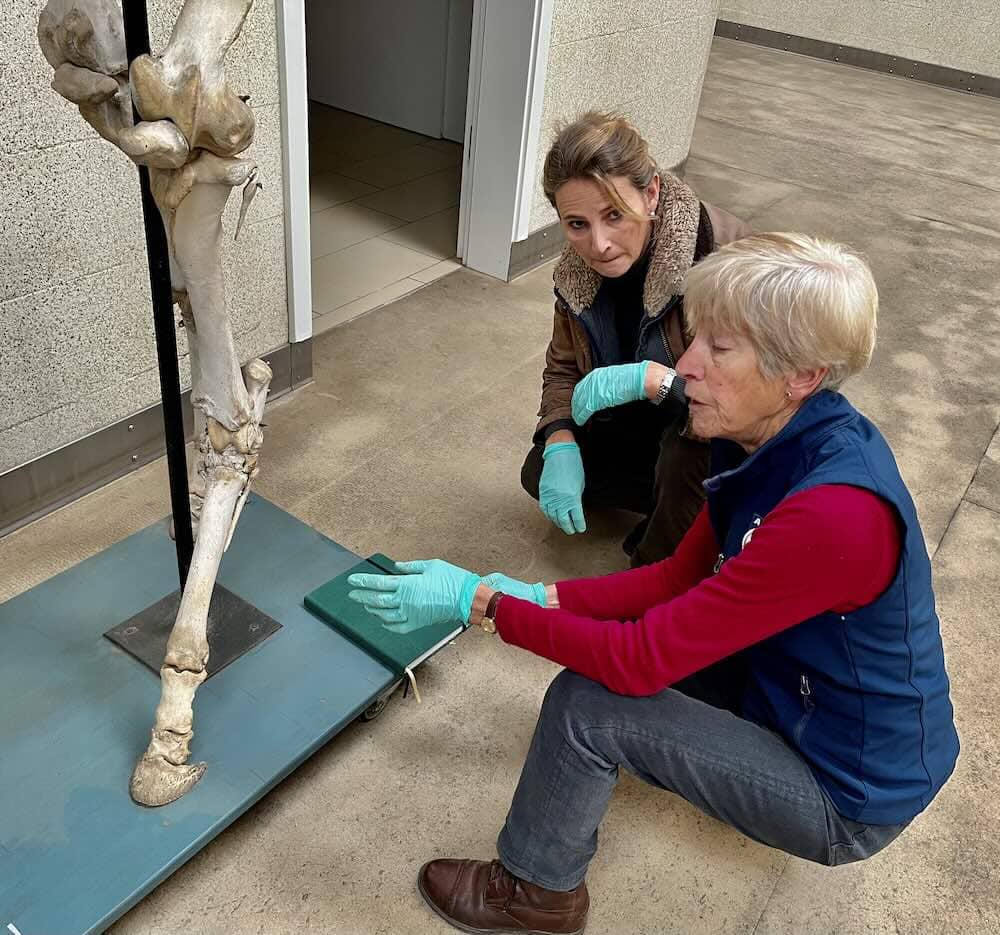
Most equine veterinarians graduate with a sound theoretical understanding of lameness. What often feels missing in practice is not knowledge, but integration.
Real-world lameness work rarely follows textbook order. Cases arrive with incomplete histories, time pressure, financial constraints, and performance expectations layered on top. Diagnostic tools are available – but choosing which to use, when, and why is where uncertainty creeps in.
For many veterinarians, this gap becomes apparent early.
“As an equine lameness novice, this course was immensely helpful in establishing a foundation of knowledge of lameness and gave me the confidence to expand the services I can offer to my clients.”
– Thomas Hollway

This is the space where good education can help – or hinder. When learning is misaligned with clinical reality, veterinarians often respond by seeking “advanced” training too early, hoping that more diagnostics will reduce doubt. In practice, advanced tools without strong clinical frameworks often increase cognitive load rather than reduce it.
Equine Lameness Continuing Education: What Actually Improves Outcomes
When evaluating equine lameness continuing education, the most important question is not how advanced the diagnostics are – but whether the education improves outcomes for both the horse and the veterinarian.
Across high-quality CE equijne programs, a few consistent principles emerge.
Clinical Reasoning Comes Before Diagnostics
Advanced diagnostics are only as useful as the reasoning that guides them.
Education that improves outcomes prioritises:
- Structured clinical examinations
- Clear diagnostic pathways
- Defined decision points – including when not to proceed further
This emphasis on reasoning over tools mirrors what many veterinarians experience in other complex areas of practice, including equine dentistry, where confidence depends just as much on knowing when not to intervene as it does on technical skill.
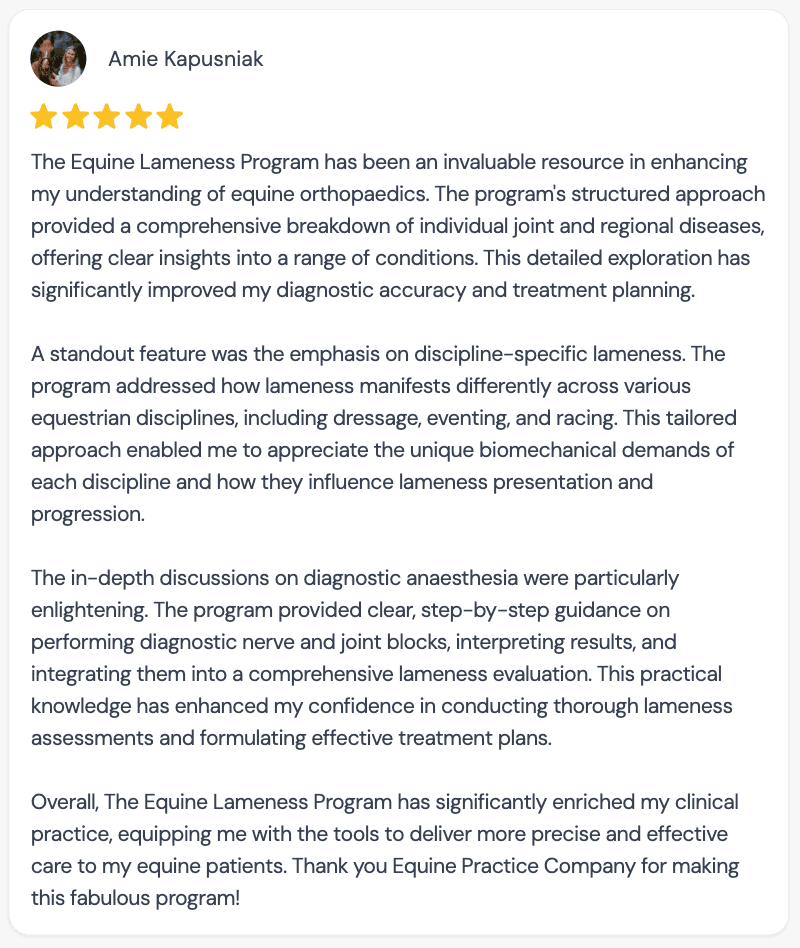
“The structured approach provided a comprehensive breakdown of individual joint and regional diseases… This has significantly improved my diagnostic accuracy and treatment planning.”
– Dr. Amie Kapusniak
Diagnostics as Tools, Not Solutions
Imaging, diagnostic analgesia, and gait analysis are powerful tools – but they are not substitutes for judgement. Education that frames diagnostics as confirmatory tools within a broader clinical narrative leads to better, more defensible outcomes than education that presents them as answers in isolation.

Online vs Hands-On Lameness Training: Understanding the Role of Each
One of the most common questions veterinarians ask is whether online lameness education is “enough”.
The answer is not either/or – it is when and how each format is used.
Where Online Lameness Education Excels
Online education is exceptionally effective for:
- Building diagnostic frameworks
- Understanding progression and stopping points
- Reviewing real cases with expert commentary
- Revisiting complex reasoning over time
In my own clinical work, the biggest challenges I see for equine veterinarians are rarely technical. They are about knowing how far to go, when to stop, and how to explain that decision clearly to a client.
Most mistakes I’ve seen early on come not from lack of effort, but from being pushed too quickly into complexity without enough clinical context.
Online learning can provide that context safely and repeatedly – without the pressure to perform.
For many veterinarians, this is why carefully chosen online and hybrid CE platforms have become an essential part of building lameness reasoning before progressing to hands-on training.
It also removes geographic and logistical barriers that disproportionately affect many practitioners.
“Now, all I have to do is turn on my computer to learn from Dr. Sue Dyson or other world-class veterinarians. If you factor in travel time and cost, this program is very reasonable.”
– Dr. Jim Woods.
Where Hands-On Training Fits
Hands-on lameness training becomes valuable once reasoning frameworks are established. Practical sessions should reinforce skills that are already understood, not introduce advanced techniques in isolation.
Continuing education cannot replace supervised clinical experience, and no course should encourage early-career veterinarians to perform procedures beyond their level of support or infrastructure.
This boundary is not a limitation – it is a marker of ethical, outcome-focused education.
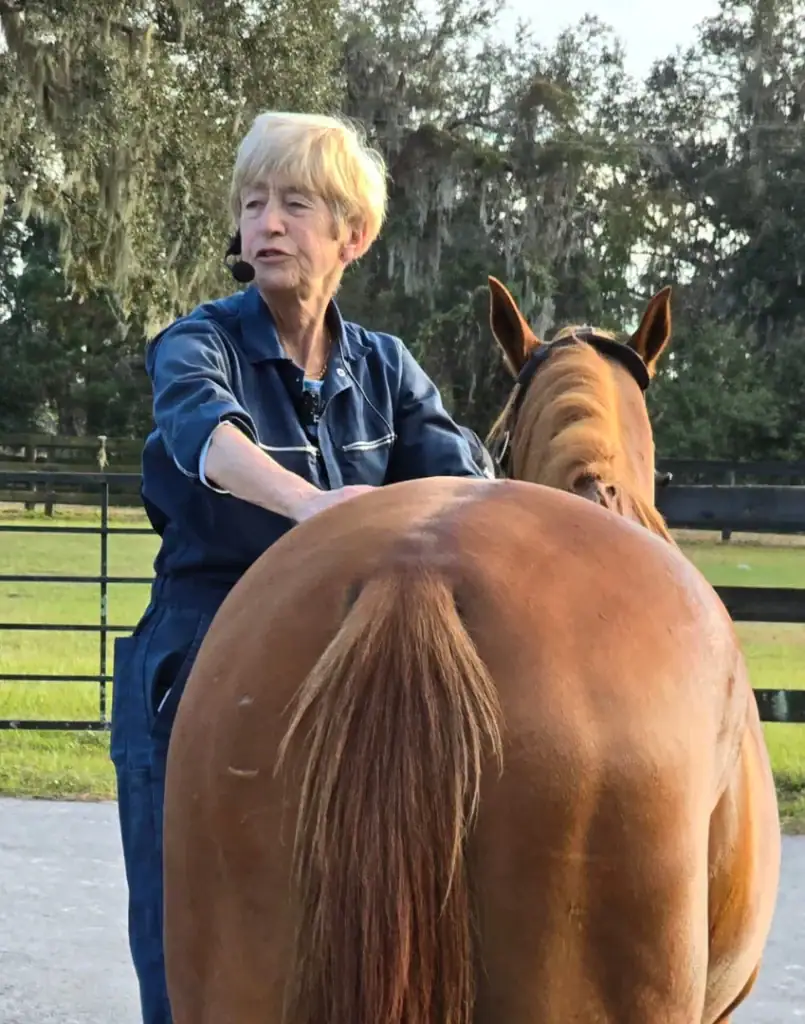
Mentorship, Case Discussion, and Pattern Recognition
Lameness diagnosis is as much about interpretation as it is about observation. Judgement develops through exposure to patterns, variation, and uncertainty – not algorithms alone.
What I see repeatedly is that veterinarians who invest early in understanding clinical reasoning progress faster and more safely than those who focus solely on acquiring techniques. This pattern has been consistent across graduates from many different backgrounds and practice environments.
Education that includes case discussion and expert commentary allows veterinarians to see how experienced clinicians think, not just what they do.
“Watching videos and then listening to how Dr. Dyson works up cases is like being in the room with her. She shows you how to approach different lameness issues.”
– Heather Burkhardt, DVM
This type of learning normalises uncertainty and accelerates judgement development – particularly in complex lameness cases.
When Education Changes What You Can Offer
One of the clearest indicators that lameness education is effective is a shift in how veterinarians view their role in a case.
Not more intervention – but more meaningful contribution.
“I used to find lameness cases unrewarding. Even though I could identify the region involved, I felt I had nothing to offer the owner. The videos with Dr. Sue Dyson have changed that – now I have something to offer.”
– Dr. Randy Hayward
This change reflects growth in judgement, not just knowledge.
A Sustainable Approach to Lameness Education
Over time, the veterinarians who manage lameness cases most confidently are rarely those who chased advanced diagnostics early. They are those who invested in foundational reasoning, revisited core principles, and allowed complexity to layer naturally as experience grew.
This observation informed the design of the Lameness Program and the In-Person Lameness Workshop at The Equine Practice Company.
Rather than offering isolated lameness courses, these programs are designed to support veterinarians longitudinally – allowing diagnostic understanding to mature alongside real clinical exposure.
Looking Ahead: What Lameness Education Should Protect
The goal of early-career continuing education should not be speed or specialisation, but the development of sound judgement that protects both the veterinarian and the horse over the course of a long career.
When equine lameness continuing education is chosen with intention, it becomes a tool for professional confidence — not pressure or comparison.
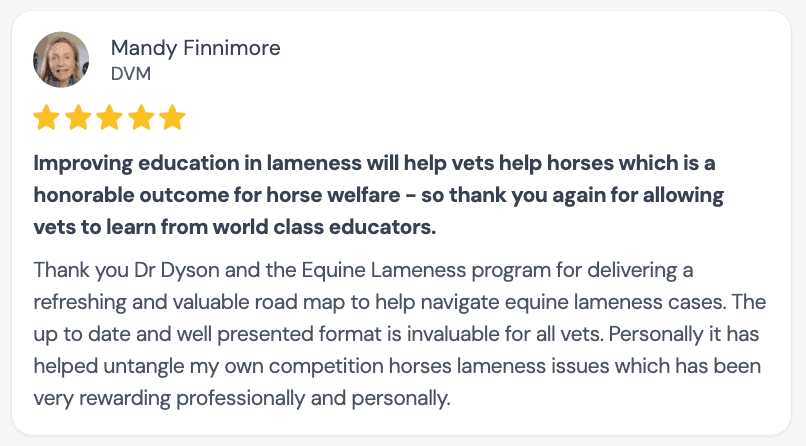
“Improving education in lameness will help vets help horses – which is a noble outcome for horse welfare.”
– Mandy Finnimore, DVM
Frequently Asked Questions: Equine Lameness Continuing Education
What should equine lameness continuing education actually improve first: diagnostics or decision-making?
High-quality equine lameness continuing education like the Lameness Program offered by The Equine Practice Company will improve clinical decision-making before diagnostic complexity. Veterinarians achieve better outcomes when they understand how to structure an examination, actually understand the anatomy they are palpating, choose appropriate next steps, and justify stopping points – rather than relying on increasingly advanced diagnostics without clear clinical reasoning.
Why do many equine veterinarians feel less confident with lameness cases despite formal training?
Most veterinarians leave university with theoretical knowledge of lameness, but limited exposure to real-world case variation, uncertainty, and constraint-based decision-making. Confidence improves when education focuses on how experienced clinicians integrate findings, communicate uncertainty, and adapt plans to each horse and client.
Can online equine lameness education genuinely improve diagnostic accuracy?
Yes. Online equine lameness education offered by The Equine Practice Company is particularly effective at improving diagnostic accuracy when it emphasises pattern recognition, case-based reasoning, and expert commentary. These elements allow veterinarians to revisit complex cases repeatedly and refine judgement without clinical time pressure.
When does advanced lameness training become appropriate in a veterinarian’s career?
Advanced lameness training is most appropriate after foundational reasoning skills are established and when adequate supervision, equipment, and referral pathways are available. Education like the Lameness Program offered by The Equine Practice Company will introduce you to advanced techniques when you are ready to advance your career.
How does equine lameness CE help veterinarians communicate more clearly with owners and trainers?
Effective lameness CE like The Equine Practice Company lameness program can improve a veterinarian’s ability to explain diagnostic reasoning, uncertainty, and limitations clearly. This transparency builds trust, reduces pressure to over-investigate, and helps manage expectations when outcomes are not definitive.
Why do case discussions matter more than protocols in lameness education?
Lameness cases rarely follow rigid protocols. The case discussions inside The Equine Practice Company exposes veterinarians to variation, ambiguity, and real decision trade-offs, helping them develop judgement rather than reliance on algorithms. This is critical for managing complex or high-expectation cases, and is particularly effective at teaching pattern recognition to veterinarians (ie common things occur commonly).
How can lameness education change what a veterinarian offers in a consultation?
When lameness education improves reasoning rather than technique alone, veterinarians shift from feeling they have “nothing to offer” to providing meaningful interpretation, guidance, and planning, even when definitive diagnoses are not possible.
What signals that an equine lameness CE program is ethical and trustworthy?
Trustworthy lameness education clearly states its clinical boundaries, does not encourage unsupervised advanced procedures, and prioritises horse welfare and practitioner safety. Ethical programs like The Equine Practice Company training focuses on judgement development rather than speed or procedural expansion.