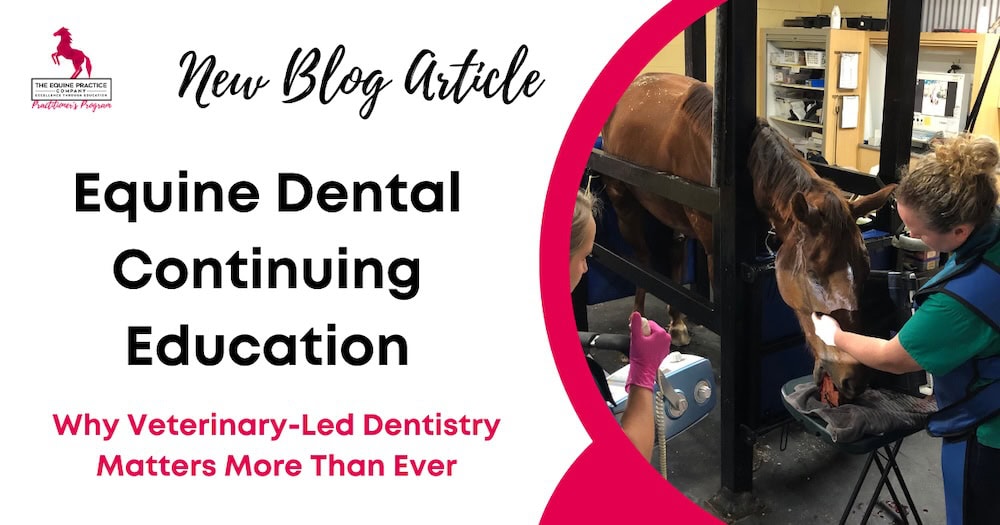
Equine Dental Continuing Education: Why Veterinary-Led Dentistry Matters More Than Ever
This article is written exclusively for veterinarians – equine-only clinicians, mixed practitioners, and recent graduates – who are questioning the current state of equine dentistry and wondering whether they should play a bigger role in it.
If you are a horse owner, dental technician, or non-veterinary professional, this article is not intended for you.
However, if you are looking for free, evidence-based education and resources specifically designed for non-veterinarians, check out Equine Vet Education – Free Resources
This article addresses common questions such as “equine dental continuing education,” “equine dentistry training for veterinarians,” and “how veterinarians develop confidence in equine dentistry,” from a strictly veterinary perspective.
Equine dentistry is at a crossroads – and veterinarians must lead the future
Equine dentistry sits at a critical intersection in modern veterinary medicine.
On one hand, we know more than ever before about:
- Dental pathology
- Periodontal disease
- Pain pathways
- Imaging
- The long-term welfare consequences of missed disease
On the other hand, much of equine dentistry in the field is still being approached as:
- Routine mechanical work
- A low-value add-on service
- Something learned informally or avoided altogether
This gap between what is possible and what is actually happening has consequences – for horses, for clients, and for the veterinary profession itself.
And at the centre of that gap is one uncomfortable truth:
We still need more veterinarians who are confident, trained, and willing to lead equine dentistry. It’s a horse welfare issue and our patients deserve this.

Why equine dental continuing education matters more than ever
Every horse you examine has a mouth. Every mouth has the potential for pain, disease, and dysfunction. Dental disease is the most common disease of the horse.
Yet dentistry remains one of the most under-taught, under-structured, and under-prioritised disciplines in veterinary education.
Most veterinarians graduate having received:
- A handful of lectures
- Minimal exposure to systematic oral examinations
- Little training in dental radiography
- Almost no experience with extractions or advanced pathology
What follows is predictable.
Dentistry becomes:
- Stressful
- Time-pressured
- Something you “get through” rather than master
- A service you provide cautiously, or not at all
Equine dental continuing education exists to close this gap – but only when it is purpose-built for veterinarians, not diluted to suit broader audiences.
This challenge is felt most acutely at a very specific point in a veterinarian’s career.
Why the 3–10 Year Mark Is the Ideal Time to Commit to Equine Dentistry
If you are three to ten years into your veterinary career, it may not feel like the right time to consider specialized training.
You may still be:
- Consolidating your general skills
- Finding your footing in practice
- Balancing confidence with caution
In reality, this stage of your career is one of the most powerful points at which to commit to equine dentistry training.
By three to ten years out, most veterinarians have reached a critical threshold:
- You have seen enough cases to recognise when something isn’t right
- You have experienced the discomfort of uncertainty – particularly in dentistry
- You understand the difference between theoretical knowledge and real-world decision-making
Crucially, you are still early enough to build habits properly, rather than unlearning years of fragmented approaches.
Equine dentistry rewards clinicians who develop a systematic, repeatable framework early. Those who do often find that dentistry becomes one of the most stable, confidence-building parts of their caseload – rather than a source of stress.
For many veterinarians, this is the moment when dentistry stops being something you “cope with” and starts becoming something you own.
The consequences of this training gap extend far beyond clinician confidence.
The welfare cost of under-trained equine dentistry
One of the hardest things to accept as a veterinarian is this:
Many horses are living with chronic oral pain that goes unrecognised – not because vets don’t care, but because pathology is being missed.
Dental disease is often:
- Subtle
- Progressive
- Hidden beneath sedation and speculums
- Masked by behaviour labelled as “training issues” or “age”
Without:
- A structured oral exam (a sedated patient, a clean mouth, speculum, bright focal light and a mirror or oroscope is essential, not optional)
- Appropriate imaging
- The confidence to interpret findings
Pathology is easily overlooked.
The welfare cost is enormous:
- Chronic pain
- Behavioural deterioration
- Performance decline
- Reduced quality of life in older horses
- A decline in animal welfare
Veterinarians are uniquely trained to recognise, diagnose, and manage disease. When we step away from dentistry, horses lose their most qualified advocates.
Why dentistry is still uncomfortable for so many veterinarians
In my work mentoring veterinarians globally, I hear the same themes repeatedly:
- “I feel like I might be missing something.”
- “I don’t trust what I’m seeing.”
- “I sedate well, but the exam still feels rushed.”
- “I’m not confident offering treatment options.”
This discomfort is not a personal failure. It is the result of fragmented education.
Dentistry has historically been taught:
- In isolation
- Without progression
- Without sufficient repetition
- Without mentorship
Confidence cannot grow in that environment.
Why Avoiding Dentistry Is Often the Greater Risk
One concern I hear repeatedly from early-career veterinarians is fear – fear of getting it wrong, fear of criticism, fear of stepping beyond perceived competence.
This fear is understandable.
Dentistry is visible.
Clients watch.
Outcomes matter.
However, avoiding dentistry does not eliminate risk – it often increases it.
Without structured training:
- Pathology is more likely to be missed
- Decision-making relies on guesswork
- Confidence remains fragile
- Stress accumulates rather than resolves
Structured equine dental continuing education reduces risk by:
- Providing clear diagnostic frameworks
- Supporting decision-making under pressure
- Normalising complexity rather than hiding it
- Offering mentorship rather than isolation
Dentistry is not an area where confidence magically appears. It is an area where confidence is earned through structure, repetition, and support.
For many veterinarians, stepping toward dentistry – with the right education – becomes one of the most professionally stabilising decisions they make.
What equine dental continuing education should actually do
True veterinary equine dental continuing education should not simply add knowledge.
It should change how you practice.
At its best, it should:
- Give you a repeatable oral examination framework
- Teach you how to see pathology, not just recognise it retrospectively
- Improve sedation and analgesia outcomes
- Reduce stress – for you, the horse, and the owner
- Allow you to explain findings with clarity and authority
This is what separates competence from confidence.
“How do you become an equine dentist?” – reframing the question
Veterinarians do not “become” equine dentists – equine dentistry is already part of veterinary practice. Confidence comes from structured postgraduate education, supervised experience, and repetition, not from adopting a new professional title.
One of the most common search terms globally is “how to become an equine dentist.”
This question reflects widespread confusion.
If you are a veterinarian, you do not need to “become” an equine dentist. You already are one. You have already undergone extensive training in anatomy, physiology, pathology, pharmacology, embryology and so much more over a minimum of 5 years of university level education. This is a far superior education than the short courses offered by lay dental providers (note that the term ‘dentist’ is a protected term, but often used illegally by lay dental providers).
The real question is:
How do you become a veterinarian who is trusted, referred to, and confident in equine dentistry?
That requires:
- Structured postgraduate training
- Exposure to real pathology
- A system you can rely on under pressure
- Mentorship from those who have walked the path before you
Dentistry is not a side skill. It is a clinical discipline – and one that deserves the same rigour as lameness, imaging, or surgery.

Why veterinary-led equine dentistry matters for the profession
When welfare outcomes suffer, public trust in the profession ultimately follows.
When veterinarians disengage from dentistry, several things happen:
- Standards fragment
- Lay providers fill the gap
- Medical oversight is lost
- Public understanding becomes confused
This is not about professional turf. It is about patient care.
Veterinary-led dentistry ensures:
- Disease is diagnosed, not guessed
- Pain is managed appropriately
- Complications are recognised early
- Horses receive evidence-based care
The future of equine dentistry must be veterinarian-driven, or it risks becoming disconnected from medicine entirely.
What Upskilling in Equine Dentistry Actually Looks Like in Practice
One of the greatest barriers preventing veterinarians from stepping into equine dentistry is a misconception about what “specialising” or even special training really means.
For most veterinarians, specialising in equine dentistry does not mean:
- Leaving your current practice
- Becoming referral-only overnight
- Giving up variety in your caseload
- Sitting exams immediately
In reality, for the majority of clinicians, equine dentistry specialisation looks like:
- Becoming the dentistry lead within your practice
- Being the veterinarian colleagues turn to for dental cases
- Retaining dentistry cases in-house rather than referring them out
- Gradually shifting the balance of your caseload over time
This evolution is usually incremental, not abrupt.
Many veterinarians continue to:
- Perform general equine work
- See lameness, medicine, and emergencies
- Build dentistry alongside other interests
Specialised training in dentistry is less about narrowing your scope and more about deepening one area of clinical excellence – often in a way that reduces on-call stress and increases professional satisfaction. It dovetails nicely into the busy breeding season and spring/fall vaccines, ensuring your patients are afforded the opportunity for multiple physical examinations throughout the year. This is more than just the oral examination. Veterinarians are the experts, and our patients are the ones who deserve this level of care, deserve the opportunity to be diagnosed, and deserve the opportunity to be treated.
There are not enough equine dentists – and that creates opportunity
From a workforce perspective, equine dentistry faces a shortage.
Across many regions:
- Referral centres are overloaded
- Experienced veterinary equine dentists are booked months in advance
- Practices struggle to keep dentistry in-house
- Younger vets hesitate to step into the space
This shortage creates opportunity for veterinarians willing to invest in proper training.
Dentistry offers:
- Repeatable, high-value cases
- Long-term client relationships
- A clear pathway to referral recognition
- Professional differentiation in crowded markets
For many veterinarians, dentistry becomes the cornerstone of a sustainable, rewarding career.
Why more veterinarians should consider specialising in equine dentistry, or undertaking specialised training.
Specialisation does not mean abandoning general practice.
For many vets, dentistry becomes:
- A focused area of interest
- A referral niche within mixed or equine practice
- A stepping stone toward membership or specialist pathways
Dentistry rewards:
- Attention to detail
- Clinical reasoning
- Manual skill
- Communication
It also provides something many vets crave: measurable impact.
When you diagnose disease accurately, treat it effectively, and see a horse improve – the professional satisfaction is profound.
A Realistic Career Pathway into Equine Dentistry
One of the most important things to understand about equine dentistry is that confidence does not arrive all at once – it is built deliberately, in stages.
A realistic veterinary dentistry pathway typically looks like this:
Stage 1: Mastering the Oral Examination
At this stage, the focus is on developing a repeatable, systematic oral exam and learning to recognise what is normal versus abnormal. Confidence begins to grow simply by knowing you are not missing obvious pathology.
Stage 2: Pathology Recognition and Imaging
As your eye develops, so does your ability to identify dental disease and understand when imaging is required. Radiographs begin to confirm – rather than confuse – your clinical suspicions.
Stage 3: Treatment Planning and Advanced Procedures
With a strong diagnostic foundation, treatment decisions become clearer. Extractions, advanced pathology, and referral-level cases become structured rather than intimidating.
Stage 4: Leadership, Referrals, and Mentorship
Over time, dentistry becomes an area where others seek your opinion. You begin to mentor colleagues, shape practice protocols, and build a professional identity grounded in competence rather than bravado.
This progression is not rushed – and it should not be. Dentistry rewards those who build depth methodically.
The business case for veterinary equine dentistry
While welfare must always come first, it would be naïve to ignore the economic realities of practice.
Well-delivered equine dentistry:
- Is time-efficient
- Has predictable case flow
- Commands appropriate fees
- Builds client trust rapidly
Veterinarians trained in dentistry often report:
- Increased case acceptance
- Reduced referrals out
- Improved client communication
- Greater professional confidence
Dentistry, when done properly, becomes one of the most reliable revenue streams in equine practice – without increasing hours worked.
Why I created a structured pathway in equine dentistry
I created our equine dentistry program because I recognised a pattern:
Talented, capable veterinarians were:
- Doubting themselves
- Avoiding dentistry cases
- Learning through trial and error
- Carrying unnecessary stress
I wanted to create the program I wish had existed when I graduated:
- Structured
- Progressive
- Evidence-based
- Designed for busy clinicians
- Grounded in real cases
This is not about shortcuts. It is about raising the standard.
The responsibility – and privilege – of upskilling
To upskill in equine dentistry is to accept responsibility:
- For patient welfare
- For professional standards
- For mentoring others
- For shaping the future of the discipline
But it is also a privilege.
Few areas of veterinary medicine allow you to:
- Combine diagnostics, medicine, and manual skill
- Build long-term client trust
- Influence welfare at scale
- Become genuinely irreplaceable in your community
Dentistry does.
The future of equine dentistry depends on veterinarians
If veterinarians do not lead equine dentistry:
- Standards will erode
- Welfare will suffer
- The profession will lose influence over care
If veterinarians step forward:
- Dentistry becomes medical again
- Horses receive better outcomes
- Practices become stronger
- Careers become more sustainable
The choice matters.
Take the next step in your equine dental continuing education
If you are a veterinarian who:
- Wants confidence, not guesswork
- Cares deeply about welfare
- Is ready to lead, not follow
- Sees dentistry as an opportunity, not a burden
Then structured equine dental continuing education is not optional – it is essential.
If this article has resonated with you, the next step is simply to explore what structured training could look like for you.
👉 Explore the Equine Dentistry Program
And if you are not a veterinarian, please access the free equine education resources designed specifically for you here: Equine Vet Education – Free Resources
Final reflection
Equine dentistry deserves better.
Horses deserve better.
Veterinarians deserve better training.
The future of equine dentistry belongs to those willing to step up, learn deeply, and lead with confidence.
Frequently Asked Questions About Equine Dental Continuing Education
What is equine dental continuing education for veterinarians?
Equine dental continuing education is postgraduate training designed specifically for veterinarians to improve diagnostic confidence, oral examination skills, imaging interpretation, treatment planning, and long-term clinical decision-making in equine dentistry.
Who is equine dental continuing education designed for?
Equine dental continuing education is designed for qualified veterinarians and veterinary students who want to improve their diagnostic confidence, clinical outcomes, and long-term competence in equine dentistry. It is not intended for horse owners or non-veterinary dental providers (‘lay dentists’).
Do I need to specialise formally to practise equine dentistry as a veterinarian?
No. Equine dentistry is already within the scope of veterinary practice. Formal specialisation is not required to practise dentistry; however, structured postgraduate education is essential to develop confidence, consistency, and safe clinical decision-making.
Is equine dentistry suitable for early-career veterinarians?
Yes. Many veterinarians find that the three to ten year post-graduation period is an ideal time to develop dentistry skills. At this stage, clinicians have enough case exposure to recognise gaps in confidence, while still being early enough to build strong, systematic habits.
What are the biggest gaps in undergraduate equine dentistry training?
Common gaps include limited exposure to:
- Systematic oral examinations
- Dental radiography
- Pathology recognition
- Treatment planning
- Extractions and advanced procedures
Postgraduate equine dental continuing education exists to address these gaps in a structured and clinically relevant way.
Why does equine dentistry still feel stressful for many veterinarians?
Dentistry is often stressful because it has historically been taught in a fragmented way, without progression or mentorship. Without a repeatable framework, veterinarians may feel uncertain about what they are seeing or whether pathology is being missed.
Is avoiding equine dentistry safer than practising it?
Avoiding dentistry does not eliminate risk. In fact, it can increase the likelihood of missed pathology, delayed diagnosis, and ongoing welfare issues. Structured education reduces risk by improving diagnostic frameworks, decision-making confidence, and clinical consistency.
What does upskilling in equine dentistry actually look like in practice?
For most veterinarians, specialising in equine dentistry means becoming the dentistry lead within their practice, managing more dental cases in-house, and gradually building a referral reputation. It does not usually involve leaving general practice or becoming referral-only immediately.
How long does it take to become confident in equine dentistry?
Confidence develops progressively. Many veterinarians move through stages that include mastering the oral exam, recognising pathology, interpreting imaging, and eventually managing advanced cases. This process takes time and should not be rushed.
Do I need to sit exams or gain certification to practise equine dentistry well?
There is no single global certification that defines competence in equine dentistry. What matters most is the quality of education, mentorship, and the ability to apply skills consistently and safely in practice.
Why is veterinary-led equine dentistry important for horse welfare?
Veterinarians are uniquely trained to diagnose disease, manage pain appropriately, and interpret imaging. Veterinary-led dentistry ensures dental disease is treated as a medical issue rather than a mechanical procedure, improving welfare outcomes for horses.
Can equine dentistry be combined with general equine practice?
Yes. Many veterinarians successfully combine dentistry with general equine practice, lameness work, and medicine. Dentistry often becomes a stable and rewarding component of a broader caseload rather than a replacement for it.
Is equine dentistry a sustainable long-term career focus?
For many veterinarians, equine dentistry offers long-term professional satisfaction due to its measurable impact on welfare, predictable caseload, and opportunity to build deep clinical expertise within a practice or referral network.