Diagnostic Innovations in EGUS: Shifting the Paradigm in Equine Gastric Health
For decades, the “gold standard” for managing Equine Gastric Ulcer Syndrome (EGUS) has been a combination of invasive gastroscopy and pharmaceutical intervention.
However, the clinical landscape is changing. Recent research from 2024 and 2025 is introducing a new era of non-invasive screening, precise treatment monitoring, and evidence-based nutritional management.
This post explores the most significant diagnostic and management innovations in EGUS, designed to help equine practitioners improve patient outcomes and professional efficiency.
1. The Saliva Breakthrough: Non-Invasive Screening
Gastroscopic evaluation is definitive but can be cost-prohibitive and stressful for the horse. The “holy grail” of current research is identifying reliable biomarkers that can screen for ulcers through simple saliva collection.
- Salivary IgA and IgG: A landmark 2024 study by Botía et al. validated assays for Immunoglobulins G and A in horse saliva. Researchers found that IgA levels significantly increased in the saliva of horses with confirmed EGUS. Furthermore, salivary IgA showed a moderate correlation with adenosine deaminase (ADA), suggesting its potential as a non-invasive screening tool for immune activation related to gastric stress.
- The Clinical Analytical Profile: Research published in Animals (2025) identified four key markers – IL1-F5, CA VI, serotransferrin, and albumin – that were significantly higher in horses with clinical EGUS compared to healthy controls. With a diagnostic accuracy (AUC) of ≥ 0.8, these biomarkers offer a promising starting point for identifying at-risk horses in field conditions.
2. Precise Monitoring: Knowing When Healing is Complete
One of the greatest challenges in EGUS management is determining when to stop pharmaceutical therapy without risking relapse.
- Liquid Proteomics: A 2024 proteomic study analyzed over 500 proteins to track the healing process. Following successful treatment with omeprazole, researchers identified significant shifts in 13 salivary proteins.
- Vimentin and Podocalyxin: An increase in vimentin (linked to wound healing) and a decrease in podocalyxin (associated with tissue damage) were noted as healing progressed. These markers could eventually allow veterinarians to “see” mucosal recovery at a molecular level, moving beyond the 28-day “set and forget” treatment model.
3. The “Fiber over Pharma” Shift in Management
While pharmaceuticals like omeprazole are essential for initial healing, long-term prevention is shifting toward strategic nutritional intervention.
- The Beet/Alfalfa/Oat Fiber Protocol: UK researchers recently evaluated a commercial feed additive containing beet pulp, alfalfa, and oat fiber. In horses where omeprazole was discontinued, those receiving the fiber supplement saw 0% recurrence of squamous ulcers (ESGD), whereas 60% of the control group relapsed.
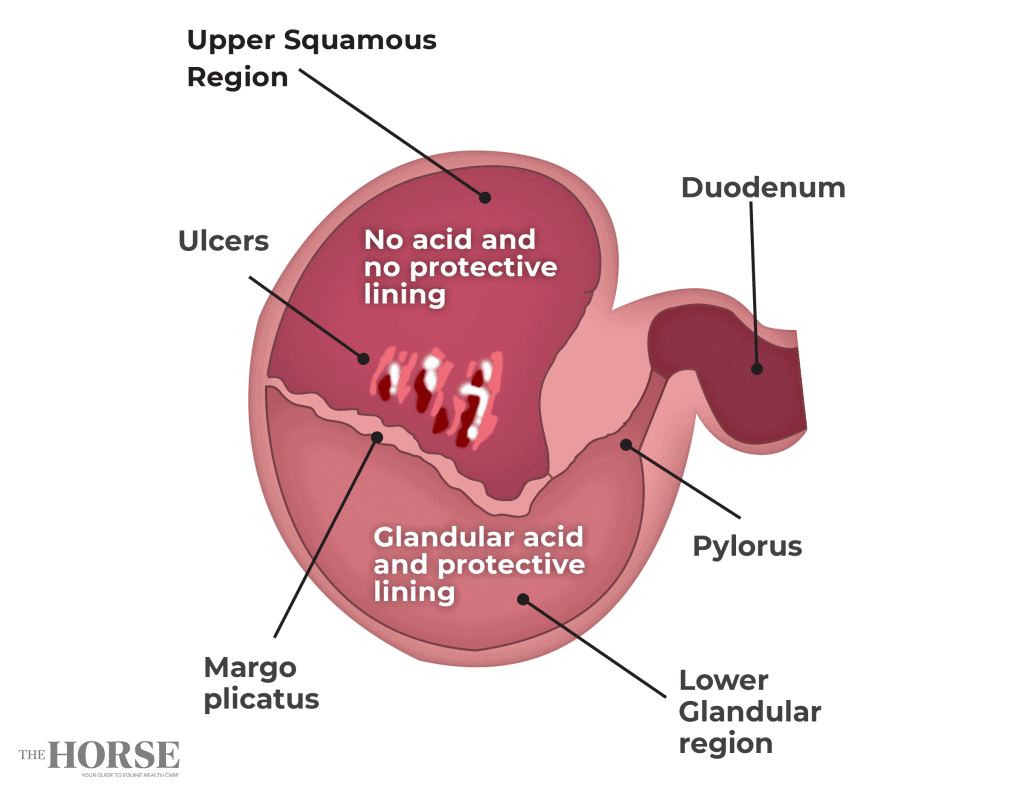
- The “Alfalfa Buffer”: Alfalfa’s high calcium and protein content provide a direct buffering effect within the stomach. Strategic use – such as feeding a small amount immediately before exercise – can restore pH stratification and protect the squamous mucosa from “acid splash”.
4. Innovative Mechanical Protection: Activated Charcoal
New treatment modalities are exploring adsorbents to protect the gastric lining. A 2024 experimental study in the Brazilian Journal of Veterinary Research demonstrated that activated charcoal can physically adhere to aglandular gastric lesions even after water lavage and histological processing.
This suggest charcoal could provide a low-cost mechanical barrier that adsorbs cell debris and prevents acid damage, warranting further clinical evaluation as a mucosal protectant.
Bridge the Gap to Hands-On Mastery
Ready to implement these findings into your clinical workup? The Practitioner’s Program portal provides the deep-dive video demonstrations and expert reasoning required to bridge the gap from research to reality.
Member Call to Action: Log in now to watch the following modules by Dr. Ben Sykes:
- Clinical Approach to EGUS: Prevention of Equine Squamous Glandular Disease (ESGD)
- Clinical Approach to EGUS: Prevention of Equine Gastric Glandular Disease (EGGD)
- Clinical Approach to Optimising Omeprazole Efficiency
https://courses.theequinepracticecompany.com/practitioners-program/These modules provide the framework for professional clinical decision-making that supports long-term gastric health and professional sustainability. If you’re yet a member, you can try for 5 Days for $1.

References:
- Botía M, et al. (2024). Changes in Immunoglobulins G and A in the Saliva and Serum of Horses with EGUS. Biology (Basel).
- MDPI Animals (2025). Assessment of Salivary Biomarkers of Gastric Ulcer in Horses from a Clinical Perspective.
- Menzies-Gow NJ, Shurlock T. (2024). The effect of feeding a commercial feedstuff on ESGD healing and recurrence. Journal of Equine Veterinary Science.
- Zibordi M, et al. (2024). Activated charcoal application in gastric ulceration areas in horses. Braz. J. Vet. Res. Anim. Sci.
- Muñoz-Prieto A, et al. (2024). Identification of New Biomarkers in Saliva and Serum for Treatment Monitoring of EGUS: A Liquid Proteomic Approach. Animals.
- Practitioner’s Program 2026 Annual. The Equine Practice Company.