New World Screwworm: What Equine Veterinarians Need To Know Now
A practical guide for recognising, reporting and responding to suspected New World screwworm in horses and mixed-species veterinary practice
The United States Department of Agriculture (USDA) has now confirmed 11 cases of New World screwworm (NWS) in animals within the United States, including 10 cases in Texas and one case in New Mexico.
The detections represent the first confirmed cases of this devastating parasite in the United States in decades and have prompted an immediate federal and state animal health response.
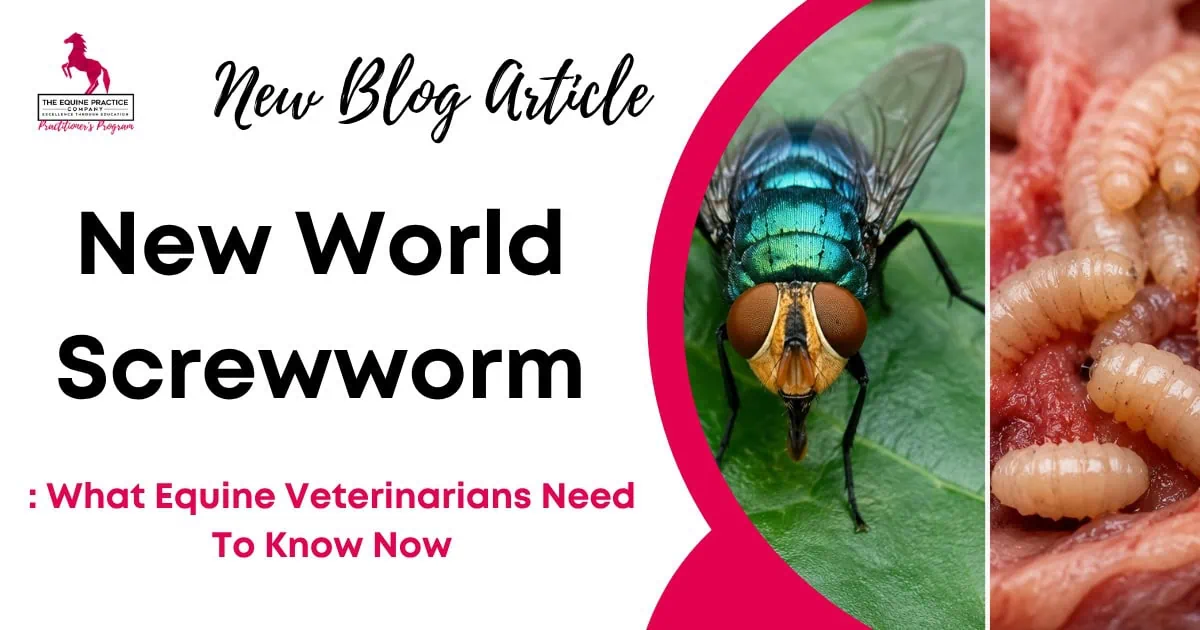
New World screwworm is a serious parasitic disease caused by the larvae of Cochliomyia hominivorax. Unlike many fly larvae that feed on dead tissue, screwworm larvae invade and consume living tissue, resulting in progressive wound enlargement, severe tissue damage, secondary infections, and, in some cases, death if left untreated.
In response to the detections, the USDA has established quarantine zones around affected areas to restrict the movement of susceptible animals and limit further spread.
Federal officials have also implemented eradication measures, including the release of sterile male screwworm flies, a proven technique designed to interrupt reproduction in wild populations and eliminate the pest.
For veterinarians, livestock producers, and animal owners, these cases serve as a timely reminder of the importance of early recognition, prompt reporting, wound management, and ongoing biosecurity vigilance as authorities work to contain and eradicate this significant animal health threat.
Should veterinarians and clients panic?
September 2026 update: FDA publishes notice of three animal-drug EUAs
On August 31, 2026, the FDA published formal notice in the Federal Register covering three Emergency Use Authorizations for animal drugs used in the New World screwworm response.
Two of these authorizations are directly relevant to equine veterinarians:
- Dectomax/Dectomax-CA1 (doramectin injection), sponsored by Zoetis: Authorised for the prevention of New World screwworm myiasis in horses one year of age and older. For horses, its authorised use is at the appearance of a wound or at the time of castration.
- Ivermectin Liquid for Horses (ivermectin oral solution), sponsored by Alberta Vet Labs: Authorised by prescription for the short-term prevention of New World screwworm myiasis when administered to newborn foals within 24 hours of birth or to horses of any age at the time of initial wound care.
Neither product is authorised to treat an existing New World screwworm infestation in horses. The FDA estimates that protection from Ivermectin Liquid for Horses lasts no more than 24 hours. The duration of protection provided by Dectomax beyond 24 hours remains unknown.
These authorisations are specific to the named product, species and indication. They are not blanket authorisations for routine ivermectin paste use or improvised prevention protocols.
Drug use must remain part of a wider response involving prompt wound care, fly control, surveillance, appropriate barrier protection and current direction from state and federal animal-health authorities.
This is not a reason for panic. It is a reason for clinical vigilance.
For many veterinarians in the United States, New World screwworm is something they may have learned about but never expected to see.
For equine veterinarians, this matters because horses are susceptible, horses travel, and horses get wounds. New World screwworm is not only a cattle issue. It can affect livestock, horses, pets, wildlife, birds on occasion, and, rarely, people.
The aim of this article is to give veterinarians a practical, field-ready guide to recognising, reporting and responding to suspected New World screwworm myiasis.
What is New World screwworm?
New World screwworm, Cochliomyia hominivorax, is a parasitic fly whose larvae feed on the living tissue of warm-blooded animals.
That detail is critical.
Many maggots found in wounds are secondary invaders that feed primarily on dead or necrotic tissue. New World screwworm larvae are different. They feed on living tissue, which allows the lesion to enlarge and deepen as the larvae continue to burrow.
This is why New World screwworm myiasis can be so painful, destructive and, if untreated, fatal.
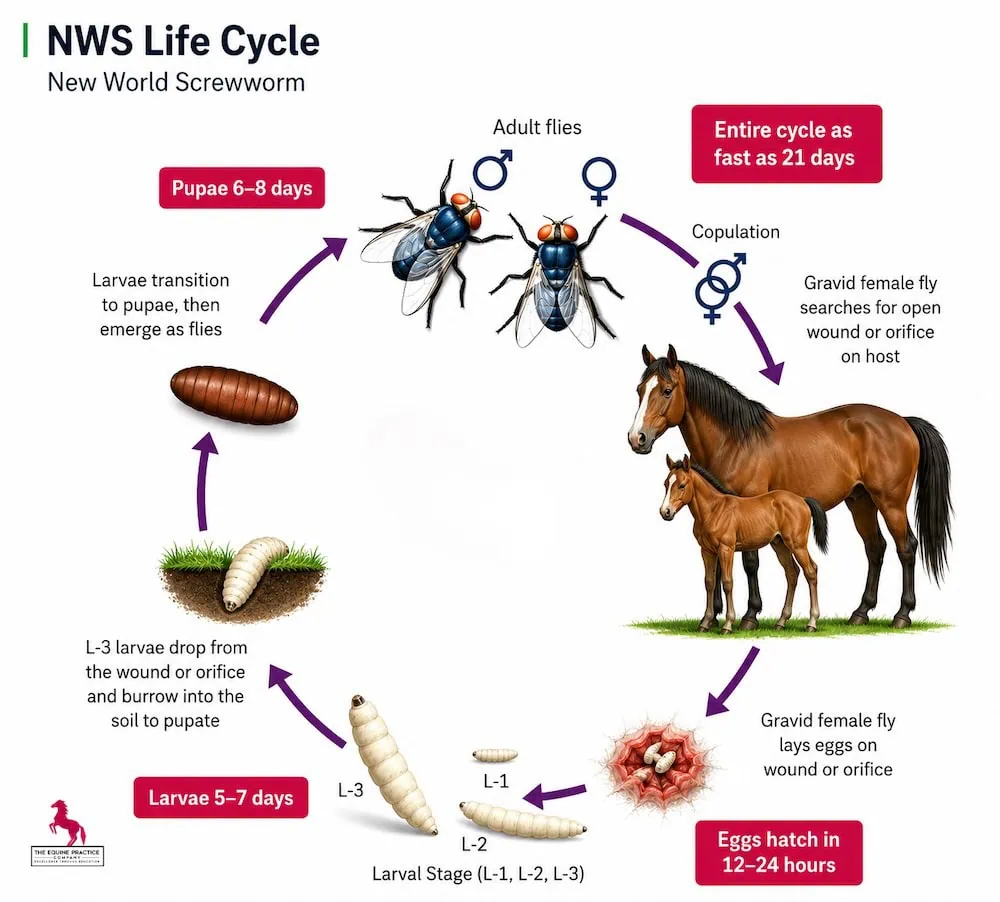
The female fly is attracted to wounds, mucous membranes and moist body openings. She lays eggs on or near the wound. Once the eggs hatch, the larvae enter the tissue and feed. As they mature, they drop from the host into the environment to pupate, continuing the life cycle.
The clinical problem is therefore twofold:
- the affected animal requires urgent wound care and pain relief; and
- the larvae must not be allowed to escape into the environment and establish locally.
That is why suspected cases must be handled as both a clinical emergency and a biosecurity event.
Why veterinarians should pay attention now
New World screwworm was eradicated from the United States in the 1960s through the sterile insect technique. A later outbreak in the Florida Keys was eliminated in 2017.
The current concern is the northward movement of New World screwworm through Central America and Mexico. Recent confirmed detections in northern Mexico, close to the U.S. border, have increased the urgency of preparedness across veterinary, livestock, public health and regulatory networks.
New World screwworm has now been detected in animals in the United States, including detections in Texas and New Mexico. Because the situation and case count can change quickly, veterinarians should check the USDA APHIS confirmed-detections dashboard before making clinical, movement or regulatory decisions.
For equine veterinarians, the key message is simple:
If you see larvae in a wound, especially in a horse with travel history or a wound that appears unusually painful, malodorous, bloody, progressive or deep, New World screwworm must be considered.
Why horses matter
This is not just a cattle disease.
Horses are highly relevant because they are mobile, valuable, frequently transported and commonly affected by wounds. They move for competition, racing, breeding, sales, relocation, referral care and international importation.
In horses, potential risk sites include:
- traumatic wounds and lacerations
- surgical sites
- castration wounds
- umbilical sites in foals
- vulvar, perineal, preputial or sheath lesions
- ear wounds
- nasal or oral lesions
- draining abscesses
- tick-bite sites
- wounds hidden under bandages
- moist, contaminated or delayed-healing wounds
Equine veterinarians should be especially vigilant in horses that have recently travelled, crossed state lines, come from higher-risk regions, been imported, lived on mixed-species properties, or had wounds managed without close veterinary supervision.
Clinical signs: what to look for
New World screwworm should be considered when larvae are found in a wound or body opening, particularly if the lesion appears aggressive, painful or progressive.
Possible findings include:
- visible maggots in a wound
- larvae in the nose, ears, mouth, genitalia, umbilicus or other body openings
- foul odour
- bloody discharge
- purulent discharge
- wounds that become deeper or larger
- pain that seems disproportionate to the wound
- depression or irritability
- inappetence
- isolation from other animals
- rubbing, stamping, head shaking or self-trauma depending on lesion location
- deterioration despite routine wound care
The wound may initially resemble ordinary traumatic myiasis. The key distinction is that New World screwworm larvae feed on living tissue, not just necrotic debris.
If the lesion is deepening, bleeding, malodorous, unusually painful or full of larvae, do not dismiss it as “just maggots.”
Immediate actions: the first 24–48 hours after a suspect case
The first 24-48 hours after a suspected New World screwworm case are critical.
The veterinarian must balance two priorities:
- immediate animal welfare, including pain relief and wound care; and
- preservation of diagnostic evidence and containment of larvae.
Use the following order of operations.
1. Isolate and contain the animal
Immediately move the affected horse or animal into the most secure, enclosed and fly-controlled area available.
Ideally, this should be:
- a fully enclosed stall
- a fly-screened treatment bay
- a secure hospital stall
- an enclosed barn area with minimal insect access
The aim is to reduce the risk of larvae dropping from the wound into bedding, soil, manure or the surrounding environment where they could pupate.
Do not move the animal unnecessarily.
Once New World screwworm is suspected, the animal should remain on the immediate premises until guidance is received from state or federal animal health officials. The client should be prepared for a temporary on-site regulatory hold until official clearance is provided.
For horses scheduled to travel for shows, racing, breeding, sales, referral care or interstate movement, this can be inconvenient. However, containment is essential.
2. Notify the correct authorities
New World screwworm myiasis is a foreign animal disease concern in the United States.
If suspected, contact:
- your State Animal Health Official; and
- the USDA APHIS Area Veterinarian in Charge for your state.
If the animal has recently been imported, APHIS Live Animal Import should also be notified.
This should not be managed as a routine wound case without official notification. In many situations, a Foreign Animal Disease Diagnostician or other official animal health representative may be involved in sample collection and investigation.
3. Collect diagnostic samples before applying topical treatment
Before applying topical products, flushing aggressively or debriding the wound, preserve diagnostic evidence.
Wear appropriate PPE, including disposable gloves.
If directed to collect specimens, use forceps to remove larvae from:
- several areas of the wound
- different depths within the lesion
- the deepest part of the wound whenever possible
This is important because secondary fly larvae may be present near the surface, while diagnostically important larvae may be deeper in the lesion.
If possible, collect larvae of different sizes.
Place larvae into a tightly closing vial or tube and submerge them in 70% ethyl or isopropyl alcohol at room temperature.
Do not discard all larvae before official identification has been considered.
4. Proceed with wound care after sampling
Once appropriate samples have been collected, proceed with animal welfare and wound management.
This may include:
- mechanical removal of remaining visible larvae
- careful wound lavage
- debridement where clinically indicated
- antiseptic wound care
- analgesia
- systemic antimicrobials where secondary bacterial infection is suspected
- topical and/or systemic larvicidal treatment where authorised and appropriate
Treatment decisions should be based on the latest FDA-authorised product information and guidance from state and federal animal health officials.
5. Maintain a strict on-site hold
The affected animal should not leave the premises until official guidance is received.
The clinical priority is no longer only the individual wound. It is containment, confirmation, treatment, premises management and prevention of local establishment.
Sample collection: details that matter
If you are instructed to collect samples, technique matters.
Practical field points include:
- use disposable gloves
- use forceps to remove larvae gently
- collect larvae from several sites within the wound
- collect larvae from different depths
- prioritise larvae from the deepest part of the lesion
- collect larvae of different sizes if possible
- place specimens in a tightly closing vial or tube
- preserve specimens in 70% ethyl or isopropyl alcohol
- keep specimens at room temperature
- submit samples as directed by APHIS or state animal health officials
Do not rely on visual identification alone.
Do not collect only superficial larvae.
Do not place all larvae in formalin.
Do not discard larvae before official identification is considered.
Do not submit samples without first contacting the appropriate animal health officials.
Quarantine and movement control
A suspected or confirmed case may require quarantine under the supervision of a USDA-accredited veterinarian and/or an official state or federal veterinarian.
Animal health officials will determine the appropriate quarantine premises and level of control based on the case, location, risk and availability of suitable facilities.
For equine veterinarians, this is especially important because horses move frequently. A suspect animal should not be transported to another property, event, clinic or state without official guidance.
If referral care is required for welfare reasons, movement should be coordinated with animal health authorities.
Treatment principles
Treatment should be coordinated with state and federal animal health officials and checked against the latest FDA-authorised product information.
General treatment principles may include:
- removal of visible larvae and eggs
- thorough wound cleaning
- antiseptic wound management
- topical treatment where authorised and appropriate
- systemic medication with larvicidal activity where authorised and appropriate
- analgesia
- systemic antimicrobials where secondary infection is present
- re-examination after treatment to ensure no live larvae remain
- ongoing monitoring and possible re-treatment
- treatment and disinfestation of the surrounding premises where directed
The animal should be re-examined carefully after treatment. If live larvae remain, further removal, monitoring and possible re-treatment may be required.
Treatment and regulatory boundaries
Veterinarians should be careful not to treat New World screwworm as a routine extralabel drug-use scenario.
FDA has issued Emergency Use Authorizations and conditional approvals for specific products because New World screwworm presents a significant animal health, public health and food-supply threat.
These authorisations differ by:
- product
- species
- route of administration
- indication
- prevention versus treatment
- age restrictions
- food-animal status
- withdrawal periods
- milk discard requirements
- who is authorised to use or administer the product
- whether use is restricted to an infested zone or adjacent surveillance zone
The key point is this:
Do not assume that a product authorised for one species, one indication or one regulatory pathway can automatically be used in another species or situation.
Current FDA-authorised or conditionally approved products include products relevant to cattle, horses, sheep, goats, swine, dogs, cats, deer, donkeys, domestic hybrid equids, captive wild or exotic mammals, birds and other species groups, depending on the specific product.
Examples include:
- F10 Antiseptic Wound Spray with Insecticide and F10 Antiseptic Barrier Ointment with Insecticide: Explicitly authorised under recent 2026 Emergency Use Authorizations for the prevention and treatment of NWS myiasis in multiple species, including horses, donkeys, domestic hybrid equids, and captive exotics.
- Topical Permethrin and Coumaphos Powders: Authorised for treatment and prevention in cattle, swine, sheep, goats, and horses.
- injectable doramectin products with species-specific indications
- oral or topical ectoparasiticides authorised for dogs and cats, which may be relevant on mixed-species properties
For equine veterinarians, Dectomax/Dectomax-CA1 is authorised for the prevention of New World screwworm myiasis in horses one year of age and older. Its authorised equine use is at the appearance of a wound or at the time of castration. It is not authorised to treat an existing infestation in horses.
Ivermectin Liquid for Horses is a prescription oral solution authorised for short-term prevention when administered to newborn foals within 24 hours of birth or to horses of any age at the time of initial wound care. Its estimated prevention window is no more than 24 hours, and it is not authorised to treat an existing infestation.
These EUAs apply only to the specified products and uses. They should not be interpreted as general authorisation to use other ivermectin products or formulations for New World screwworm.
A second important boundary is medicated feed.
No medicated feed is currently authorised for the prevention or treatment of New World screwworm myiasis in any species. Federal law does not permit extralabel use of animal drugs in feed.
Before prescribing or recommending any product for New World screwworm, veterinarians should check:
- the live FDA Animal Drugs for New World Screwworm page
- the product-specific fact sheet
- the species covered
- whether the indication is prevention, treatment or both
- any age restrictions
- food-animal restrictions
- withdrawal periods or milk discard requirements
- whether the product is available over the counter or only under specific authorisation
- whether use is limited to particular zones or official response situations
Treat the animal, but do not treat the regulatory details casually.
One Health and staff biosecurity
New World screwworm is a One Health concern.
Although veterinarians are focused on animal patients, Cochliomyia hominivorax can also infest people. The fly can lay eggs in wounds or mucous membranes, and the larvae can feed on living human tissue.
Veterinary teams must treat suspected cases as an urgent personal safety issue. The scale of the current outbreak is historic; as of mid-2026, health officials have recorded over 170,000 animal cases and nearly 2,000 confirmed human infestations, including several fatalities, across Central America and Mexico.
Because Cochliomyia hominivorax does not differentiate between animal and human tissue, strict biosecurity is mandatory.
Any staff member, handler, or owner with open cuts, fresh surgical wounds, ulcers, draining skin lesions, or exposed dermatitis must be strictly barred from handling the suspected animal, collecting larvae, cleaning the wound, removing bedding, processing samples, or assisting with premises decontamination.
Any staff member, handler or owner with open cuts, fresh surgical wounds, ulcers, draining skin lesions, exposed dermatitis or other compromised skin should not handle the suspected animal, collect larvae, clean the wound, remove bedding, process samples or assist with premises decontamination.
Clinic and field teams should use appropriate PPE, including disposable gloves, and should avoid direct contact with wound exudate, larvae, contaminated bedding and contaminated equipment.
On mixed-species or farm properties, veterinarians should also consider the people on the premises, including:
- farm workers
- grooms
- handlers
- owners
- farriers
- technicians
- children
- anyone involved in wound care or bedding removal
If a person develops a suspicious wound, sees larvae in a wound or body opening, or has recent exposure to an affected animal, they should seek medical care promptly and inform the clinician about possible New World screwworm exposure.
Whole-property and multi-species risk guide
A suspected case in one horse should trigger a wider property-level assessment.
New World screwworm is not species-specific. Equine veterinarians should look beyond the index horse and ask what other animals are present, whether any have wounds, and whether there has been recent travel, importation, birthing, castration, surgery, dehorning, branding, trauma or tick infestation.
| Species | Clinical Context & Risk Factors | Current Outbreak Relevance |
|---|---|---|
| Bovine | Deep tissue strikes, navels of newborns, castration sites, dehorning or branding wounds, tick-bite irritation. | Major livestock concern and a central focus of surveillance, border control and sterile fly response efforts. |
| Canine | Guard dogs, farm dogs, working dogs, imported pets and dogs moving between rural and domestic environments. | Important companion-animal and premises-level risk, especially on farms, ranches and mixed-species properties. |
| Equine | High mobility across state lines for sport, breeding, racing, sales and referral care; frequent lacerations and surgical wounds. | Requires aggressive wound vigilance, especially in travelling horses and mixed-species premises. |
| Small ruminants | Castration wounds, kidding or lambing sites, ear wounds, foot lesions and traumatic injuries. | Important sentinel species on small farms, hobby farms and mixed livestock properties. |
| Wildlife and exotics | Traumatic wounds, predator injuries, capture injuries, antler wounds, neonatal sites and limited handling capacity. | Relevant to wildlife interfaces, zoos, sanctuaries, rehabilitation centres and extensive grazing systems. |
| Cats and other companion animals | Bite wounds, abscesses, surgical wounds and outdoor exposure. | Relevant on mixed-species premises and in households or farms with animals travelling from risk regions. |
During the property audit, ask specifically about:
- cattle, sheep, goats, pigs, dogs, cats, horses, donkeys, mules, wildlife and exotic animals
- newborn animals
- recent castrations, dehorning, branding or surgery
- traumatic wounds or abscesses
- animals with ticks or tick-bite irritation
- animals recently imported or moved from higher-risk regions
- dogs or pets that have travelled internationally
- horses arriving from competitions, breeding farms, sales or transport hubs
- carcass disposal and wildlife access
- fly pressure and current insect control measures
The practical message is simple:
Do not stop at the wound in front of you. If New World screwworm is possible, assess the property.
Premises management
If a case is confirmed, the environment matters.
Larvae can leave the wound and enter the environment to pupate. Stalls, pens, bedding, trailers, stocks, wash bays, treatment areas and other holding areas may require specific attention.
Premises management may include:
- collecting expelled larvae
- killing larvae in alcohol before disposal
- insecticide treatment of holding areas where directed
- careful bedding removal and disposal
- cleaning with warm water and soap after insecticide application
- fly trapping or monitoring
- ongoing surveillance after the affected animal has been released
These steps should be directed by APHIS and state animal health officials.
The aim is not only to help the affected animal. It is to prevent establishment of the fly in the local environment.
Practical checklist for equine veterinarians
When examining a wound, ask:
- Are larvae present?
- Is the wound unusually painful?
- Is there a foul odour?
- Is there bloody or purulent discharge?
- Is the wound enlarging or deepening?
- Has the animal travelled recently?
- Has the horse come from or through a higher-risk region?
- Has the horse been imported?
- Are other animals on the property affected?
- Are there cattle, small ruminants, dogs, wildlife or feral animals nearby?
- Could this wound have been hidden under a bandage, rug or boot?
- Has the horse recently had surgery, castration, breeding trauma or a draining abscess?
If New World screwworm is possible:
- isolate the animal in a secure, fly-controlled area
- protect yourself and staff with PPE
- contact your State Animal Health Official
- contact the USDA APHIS Area Veterinarian in Charge
- collect samples only as directed
- collect larvae from deep within the wound
- preserve larvae in 70% alcohol
- avoid unnecessary movement of the animal
- manage the wound after preserving diagnostic evidence
- check current FDA product-specific guidance before treatment
- assess the whole property for other at-risk animals
Do not:
- dismiss larvae as “just maggots”
- discard all larvae before identification
- apply topical treatment before preserving samples if sampling is required
- move the animal unnecessarily
- rely on social media treatment protocols
- assume a product authorised for one species applies to another
- assume a product authorised for prevention is authorised for treatment
- use medicated feed for NWS prevention or treatment
- allow staff with open wounds or skin lesions to handle the animal or samples
What equine practices can do now
Every equine practice can prepare without alarming clients.
Recommended steps include:
- Save contact details for your State Animal Health Official and USDA APHIS Area Veterinarian in Charge.
- Keep 70% alcohol, leak-proof tubes, gloves, labels and forceps available.
- Add New World screwworm to wound differential lists and internal protocols.
- Train veterinarians, interns, technicians and reception staff on when to escalate a wound case.
- Add travel and import questions to wound history templates.
- Review the FDA Animal Drugs for New World Screwworm page regularly.
- Prepare a short client-facing wound vigilance message.
- Encourage prompt assessment of wounds containing larvae.
- Pay close attention to horses that travel, compete, breed or live on mixed-species properties.
- Review fly-control and wound-management advice with clients before summer travel and competition periods.
Preparedness does not need to be complicated. The aim is to avoid delay if a suspicious case appears.
What to tell horse owners
Horse owners do not need to panic, but they should take wound care seriously.
A useful client message is:
“New World screwworm has now been detected in parts of the United States. We are asking horse owners to check wounds carefully and follow current local guidance. Please contact your veterinarian promptly if you see maggots, notice a foul smell or bloody discharge, or if a wound appears to be getting deeper, larger or more painful.”
Owners should be encouraged to inspect:
- traumatic wounds
- surgical sites
- castration wounds
- umbilical sites in foals
- sheath, vulvar and perineal areas
- ears and nostrils
- wounds under bandages
- horses that have recently travelled
- horses on mixed-species properties
The message is not fear.
The message is early recognition.
Early recognition is important
If New World screwworm enters an area, delay matters.
A missed case gives larvae time to mature, leave the wound, enter the environment and continue the life cycle. Early reporting allows animal health officials to identify the parasite, treat the affected animal, manage the premises, trace potential movements and implement control measures.
Equine veterinarians are part of the early warning system.
A horse with a suspicious wound may be the first sign that something has changed. Knowing what to look for, who to call and how to preserve samples could make a significant difference.
New World screwworm has been detected in the United States, but federal and state officials are working to contain and eradicate it.
The aim is to prevent the parasite from becoming re-established.
Official resources for veterinarians
Veterinarians should consult the latest guidance from:
- Screwworm.gov (The official, centralized U.S. federal portal linking live updates from USDA APHIS, the FDA, and the CDC)
- USDA APHIS Area Veterinarian in Charge contact list
- State Animal Health Officials
- FDA Animal Drugs for New World Screwworm
- FDA New World Screwworm: Information for Veterinarians
- CDC New World Screwworm outbreak situation summary
- USDA APHIS Standard Operating Procedure for possible detections of New World screwworm in animals
- USDA APHIS New World Screwworm veterinarian fact sheet
Because the situation is changing quickly, this article should be treated as a living resource and reviewed regularly against official USDA, FDA and CDC updates.