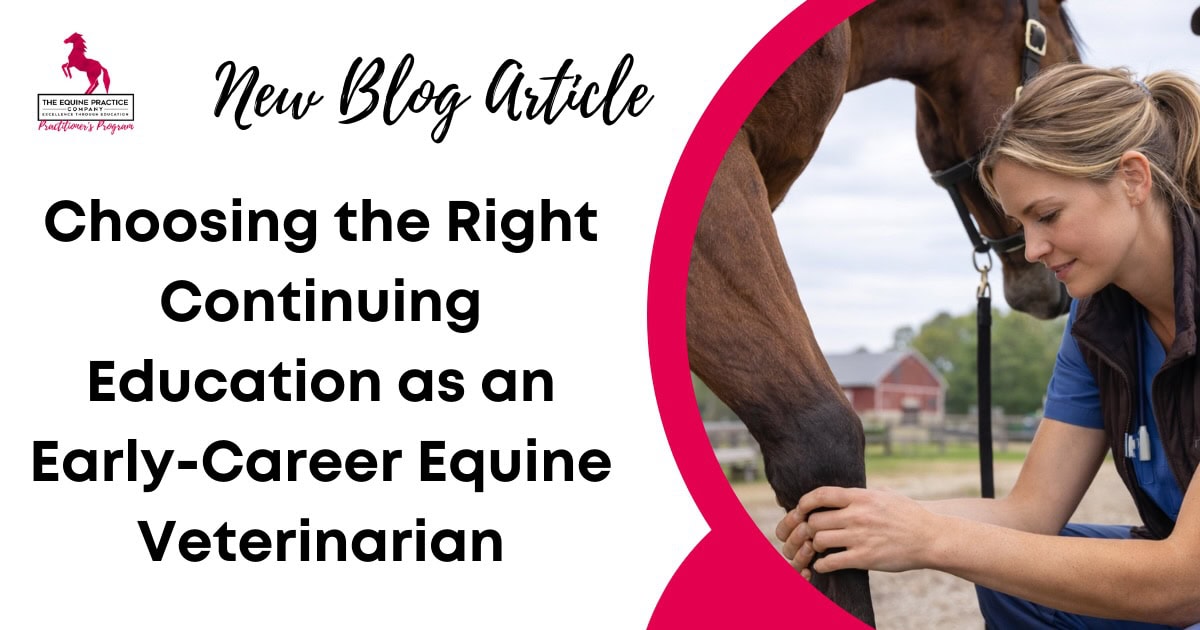
Choosing the Right Continuing Education as an Early-Career Equine Veterinarian
There’s a moment most new grads remember clearly – usually a year or two after graduation – when you realise that knowing the theory and feeling confident in the field are not the same thing.
You’ve done the hard work.
You’ve earned the degree.
You’re seeing cases every day.
And yet, there’s often a nagging sense that you’re still reacting, rather than deciding.
That feeling is one of the main reasons early-career equine vets start searching for continuing education for early-career equine veterinarians – not because they want more information, but because they want confidence, clarity, and reassurance that they’re moving forward rather than simply keeping up.
As one recent graduate described it:
“The learning curve once you’re in practice is incredibly steep. I needed education that was practical, digestible, and actually helped me feel more confident with the cases in front of me.”
– Dr Miranda Chalupiak, Veterinarian
Why Continuing Education Feels Overwhelming Early for Recent Grads
Most early-career equine veterinarians don’t struggle with motivation. They struggle with direction.
There are hundreds of CE options available. Many are excellent. Some are not. Almost all promise to make you “better”, “more advanced”, or “more confident”. When you’re new to practice, it can be surprisingly difficult to tell which education will genuinely help – and which may leave you with more questions than answers.
Veterinary school provides a solid academic foundation, but real-world equine practice demands rapid clinical decision-making, communication under pressure, and the ability to explain why you’re choosing one diagnostic or treatment pathway over another – often to experienced owners and trainers who are watching closely.
In my own clinical work, the biggest challenges I see for early-career equine veterinarians are rarely technical. They are about knowing how far to go, when to stop, and how to explain that decision clearly to a client.
Most mistakes I’ve seen early on come not from lack of effort, but from being pushed too quickly into complexity without enough clinical context.
This is where continuing education can help. But it can also hinder, if it’s chosen without a clear purpose.
Many early-career vets fall into the trap of collecting courses rather than building competence. They attend lectures, accumulate RACE credits, and move on – yet still feel uncertain when managing complex lameness cases, performance horses, or situations where the textbook answer doesn’t quite fit the horse in front of them.
As Belinda Flynn, DVM, explained:
“The program bridged the gap between university and real-world practice with clear, practical content that I could apply immediately. As a result, I gained a lot of confidence in my clinical skills.”
What New Grad Equine Veterinarians Actually Need from CE
Early in your career, the most valuable education is not the most advanced or specialised – it’s the education that helps you think more clearly in everyday cases.
That means learning how experienced clinicians approach decision-making, not just how they perform techniques. Pattern recognition is so important (it’s the old adage “when you hear hoofbeats, think horses not zebras). It means understanding why certain diagnostic pathways are chosen, when to stop, and how to communicate uncertainty without undermining trust.
High-quality equine continuing education should reduce your cognitive load, not increase it. If a course leaves you feeling overwhelmed or pressured to attempt skills you’re not yet supported to perform safely, it may not be the right fit – regardless of how impressive it looks on paper.
This is something many new and recent graduates recognise quickly:
“The videos are packed with wonderful information from experts in the field that make a new grad or experienced veterinarian more confident handling the tough cases.”
— Jessie Hoagland-Edwards, Veterinarian

The best CE for early-career equine vets improves patient outcomes immediately – even when the skills themselves are foundational. Clearer lameness work-ups, more structured dental evaluations, and better communication with clients all translate directly into better care for horses.
Online Courses, Wetlabs, or Hybrid Learning: What Works Best Early On?
One of the most common questions recent equine veterinarian graduates ask is whether online learning is “enough”, or whether hands-on training is essential.
The answer is not one or the other – it’s when and how each format is used.
Online equine education is particularly effective for building diagnostic frameworks. It allows you to revisit complex topics, pause and reflect, and observe how experienced clinicians reason through real cases. For areas like lameness assessment, performance diagnostics, and dentistry planning, this foundation is critical.
As Kylie Dunham, DVM, noted:
“Clinically relevant, real-world advice – not just ‘gold standard’ theory – made it much easier to integrate what I learned into daily practice.”
Hands-on learning becomes essential once those frameworks are in place. Wetlabs are most valuable when they reinforce principles you already understand, rather than introducing techniques in isolation.
Continuing education cannot replace supervised clinical experience, and no course should encourage early-career veterinarians to perform procedures beyond their level of support or infrastructure, this is a dangerous pathway to disillusionment and possibly even physical harm when the frustrated veterinarian momentarily places themselves in danger to achieve their outcome, a shortcut that never works.
What I see repeatedly is that veterinarians who invest early in understanding clinical reasoning progress faster and more safely than those who focus solely on acquiring techniques. This pattern has been consistent across graduates from many different backgrounds and practice environments.
For many early-career vets, hybrid learning provides the safest progression: online education first, followed by well-supported, structured practical application.
RACE Credits Matter – But They Shouldn’t Be the Only Filter
There’s no avoiding regulatory requirements. RACE-approved equine CE is important, and early-career veterinarians should absolutely be strategic about meeting licensing obligations.
However, choosing education solely for credit accumulation often leads to frustration. A course can be accredited and still fail to address the clinical challenges you’re facing day to day.
The most effective approach is to treat RACE approval as a baseline, not the deciding factor. When continuing education aligns with your stage of practice, credits become a by-product of meaningful professional development rather than the primary goal.

Continuing Education for Early-Career Equine Veterinarians: Building Credibility That Lasts
One of the unspoken pressures early in an equine career is credibility.
It’s rarely overt. Most owners and trainers are supportive. Colleagues are usually generous with advice. And yet, many early-career vets feel acutely aware of the moments when a pause feels too long, an explanation feels clumsy, or a decision doesn’t come as confidently as they’d like.
Credibility is not built by knowing more facts. It’s built by being able to explain your reasoning clearly, calmly, and consistently – especially when outcomes are uncertain.
This is why experienced mentors value education they trust.
“When my new graduate associate has something pop up that she’s less familiar with, I can point her to the program knowing she’s getting fact-based, high-quality education. It’s saved me time and given her a strong baseline.”
— Lara Stephens-Brown, DVM, CVSMT, FCoAC
Courses that include real cases, clinical reasoning, and open discussion help bridge the credibility gap far more effectively than technique-only training.
A More Sustainable Model of Continuing Education
Over the years, working with equine veterinarians at every stage of practice, a consistent pattern emerges.
Those who progress most confidently don’t chase the most advanced techniques early. Instead, they invest in education that provides context, structure, and ongoing support – and they revisit that education as their experience grows.
This philosophy was a key driver behind the creation of the Practitioner’s Programme at The Equine Practice Company.
Rather than offering isolated courses, the Practitioner’s Programme was designed to support veterinarians longitudinally – particularly those in the early and middle stages of equine practice. The focus is not on racing toward specialisation, but on building strong clinical reasoning, practical confidence, and professional resilience over time.
As Gina Leah Murray, DVM shared:
“The Practitioner’s Programme became a resource I rely on daily. I wouldn’t have taken an internship or moved my family without the confidence this program gave me.”
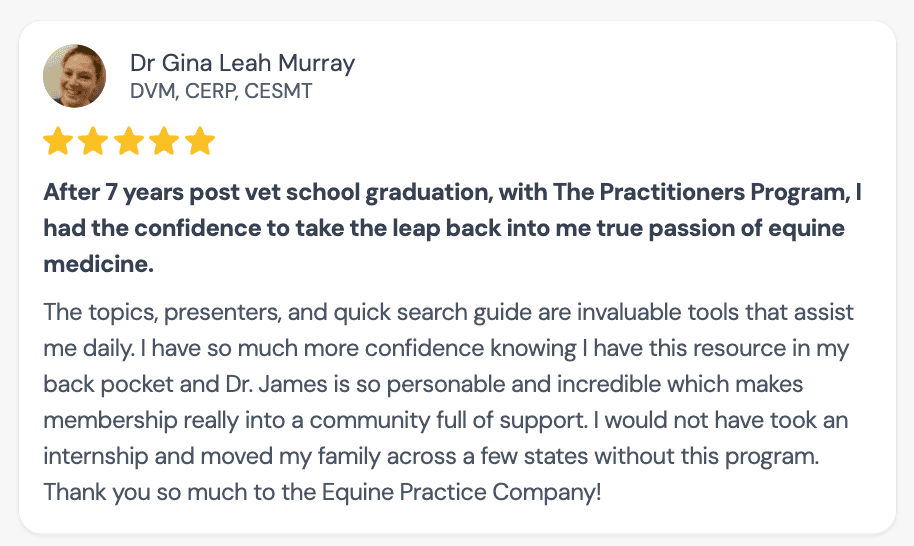
For early-career vets, this approach supports safer progression, deeper understanding, and confidence that compounds rather than erodes.
Confidence Comes from Context, Not Speed
It’s easy to feel behind early in your career. Conferences, social media, and conversations with peers can create the impression that everyone else is moving faster or doing more advanced work.
In reality, confidence in equine practice develops quietly and cumulatively.
It grows from understanding why you’re making decisions.
From seeing patterns emerge over time.
From knowing when not to intervene.
The right continuing education doesn’t push you to become someone you’re not yet ready to be. It supports you in becoming a thoughtful, capable, and confident equine veterinarian – one decision at a time.
The goal of early-career continuing education should not be speed or specialisation, but the development of sound judgement that protects both the veterinarian and the horse over the course of a long career.
When continuing education for early-career equine veterinarians is chosen with intention, the skills, credibility, and reputation you’re aiming for follow naturally.
Key Takeaways: Choosing Continuing Education as an Early-Career Equine Veterinarian
Early-career equine veterinarians benefit most from education that builds clinical reasoning, confidence, and decision-making – not just technical skills.
- Prioritise CE that explains why decisions are made, not just how techniques are performed
- Use RACE-approved courses strategically, without chasing credits alone
- Online equine education is highly effective for building diagnostic frameworks
- Hands-on training is most valuable when it reinforces existing understanding
- Hybrid learning models often provide the safest progression
- Credibility comes from clear reasoning and communication, not credentials
- Subscription-based CE offers strong value when learning is curated and progressive
- Mentorship and peer discussion accelerate confidence and reduce isolation
The right continuing education for early-career equine veterinarians reduces cognitive load, supports safe skill development, and improves patient outcomes – while fitting around real clinical work and real financial constraints.

Frequently Asked Questions: Continuing Education for Early-Career Equine Veterinarians
What type of continuing education is best for early-career equine veterinarians?
The most effective continuing education for early-career equine veterinarians focuses on clinical reasoning, case assessment, and decision-making, rather than advanced techniques alone. The Equine Practice Company provides education that explains why decisions are made, helps build confidence, improves patient outcomes, and supports safe progression in real-world practice.
Is online continuing education enough for early-career equine vets?
Online continuing education like the The Equine Practice Company offers can be highly effective early in an equine career, particularly for building diagnostic frameworks in areas such as lameness, dentistry, and performance medicine. Hands-on training becomes most valuable once foundational understanding is in place and should reinforce, rather than replace, clinical reasoning.
Should early-career equine veterinarians prioritise RACE-approved CE?
RACE-approved courses are important for meeting licensing requirements, but they should not be the only factor when choosing continuing education. Early-career equine veterinarians benefit most when RACE-approved CE like the The Equine Practice Company and the AAEP programs aligns with their clinical stage, supports confidence, and improves day-to-day decision-making.
How do I choose equine CE that actually improves confidence in practice?
Confidence develops when education mirrors real clinical scenarios. The Equine Practice Company courses include case-based discussion, expert reasoning, and practical context are more likely to translate into confident decision-making than technique-focused lectures alone.
Are hands-on wetlabs safe for early-career equine veterinarians?
Hands-on wetlabs are most beneficial when they build on existing knowledge and are supported by appropriate supervision and infrastructure. The Equine Practice Company continuing education programs never encourage early-career veterinarians to perform procedures beyond their level of experience or available support.
What’s the difference between one-off courses and subscription-based equine CE?
One-off courses can be valuable for specific topics, but subscription-based equine continuing education often provides better long-term value when content is curated, progressive, and revisitable. This allows early-career veterinarians to reinforce learning as their clinical experience grows.
Does mentorship matter in equine continuing education?
Yes. Mentorship and case discussion significantly accelerate learning for early-career equine veterinarians. Hearing how experienced clinicians approach uncertainty and complex cases helps develop judgement, reduces isolation, and supports safer clinical progression, just like inside The Equine Practice Company programs.
How can early-career equine vets balance CE with time and financial constraints?
The most sustainable approach is to prioritise education that delivers immediate clinical value, fits around work schedules, and supports long-term growth. This is what inside The Equine Practice Company offers. Well-structured online or hybrid learning often provides the best balance of flexibility, affordability, and educational depth.
How does continuing education help build credibility with owners and trainers?
Credibility is built through clear communication and consistent clinical reasoning. Continuing education that improves how veterinarians explain diagnostic and treatment decisions helps build trust with owners, trainers, and colleagues – regardless of years in practice.
What should the long-term goal of early-career equine continuing education be?
The goal should not be speed or early specialisation, but the development of sound clinical judgement. The education provided inside The Equine Practice Company supports thoughtful decision-making and protects both the veterinarian and the horse over the course of a long, sustainable career.