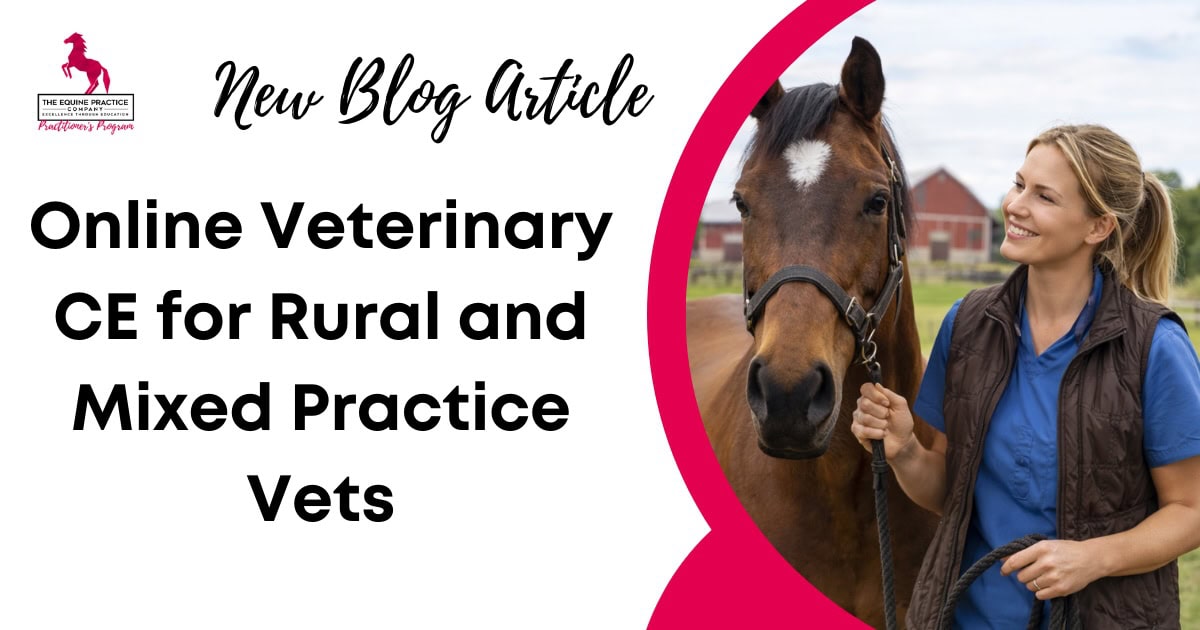
Online Veterinary CE for Rural and Mixed Practice Vets
Rural and mixed practice veterinary work is not defined by species. It’s defined by responsibility.
When you’re working outside metropolitan centres, there is no neat handoff between disciplines. A single day might include a lame horse, a calving, a sick dog, a herd health decision, and a late-night emergency – often separated by long drives and limited backup.
When I was working as a rural veterinarian in rural NSW, that breadth wasn’t optional – it was the job. There was no referral centre down the road and no luxury of narrowing focus.
Decisions had to be practical, defensible, and made with the understanding that you would be the one standing behind them tomorrow, next week, and next year.
That experience fundamentally shapes how I think about continuing education for rural and mixed practice veterinarians.
Why Continuing Education Feels Different in Rural Practice
Rural veterinarians don’t look for CE to “get ahead.” They look for CE to stay safe, effective, and sustainable.
The challenges are structural:
- Long travel distances that make conferences difficult
- Broad caseloads spanning farm animals, horses, and family pets
- Limited access to specialists or second opinions
- Professional isolation that compounds decision fatigue
- The reality that clinical decisions often intersect with business survival
This challenge is particularly acute early in practice, which is why choosing appropriate continuing education for early-career equine veterinarians can play a critical role in building confidence and reducing decision fatigue in rural settings.
This is why rural vets tend to be selective. Education has to work in real conditions, not ideal ones.
As one veterinarian described:
“After graduating I found myself working in a rural area without the ability to easily expand my knowledge. I wanted the principles and basics as well as more advanced options and treatment for my patients.”
– Michael Marricle, DVM

That combination – principles first, depth when appropriate – is exactly what rural CE must support.
Online Veterinary CE for Rural Veterinarians: What Actually Helps
When evaluating online veterinary CE for rural veterinarians, usefulness matters more than polish. The most effective education for rural and mixed practice vets shares a few defining characteristics.
Breadth Without Dilution
Rural veterinarians need education that respects the reality of mixed caseloads. That doesn’t mean generic content – it means species-specific teaching that acknowledges overlap, trade-offs, and prioritisation.
Courses that isolate topics without context often leave rural vets with more questions than answers.
Practical Decision-Making, Not Idealised Protocols
Rural practice rarely allows for “textbook” workflows. Time, facilities, finances, and geography all shape what is reasonable.
Good online CE acknowledges:
- When less intervention is appropriate
- How to explain limitations clearly to clients
- How to make decisions you can stand behind alone
This kind of clarity reduces stress far more effectively than adding new techniques.
Online Learning as a Lifeline, Not a Compromise
For rural veterinarians, online education is not second-best – it is often the only viable option.
The value lies not just in access, but in continuity:
- Being able to revisit material between calls
- Learning during travel downtime
- Hearing consistent reasoning from trusted clinicians over time
This continuity helps replace the informal mentorship that rural vets often lack.
This is why many rural and mixed practice veterinarians prioritise well-structured online and hybrid CE platforms for equine veterinarians that provide continuity, expert reasoning, and practical relevance without the need for travel.
One recent veterinarian put it simply:
“The videos are packed with wonderful information from experts in the field that make a new grad or experienced veterinarian more confident handling the tough cases.”
– Jessie Hoagland-Edwards, Veterinarian

Confidence in rural practice isn’t about doing more. It’s about knowing when you’re doing enough.
Mixed Practice Reality: From Farm Animals to Family Pets
Mixed practice vets don’t have the luxury of compartmentalisation. Clinical reasoning has to transfer across species, contexts, and expectations. This often goes hand in hand with owners happy for you to ‘give it a go’ when referral just isn’t reasonable for them.
Education that helps rural vets most:
- Reinforces diagnostic thinking rather than narrow procedures
- Builds pattern recognition that applies across cases
- Encourages conservative, defensible decision-making
In my own experience, the most difficult part of rural work was never the medicine itself – it was the mental load of carrying so many roles at once.
CE that reduces that load, rather than adding to it, is what sustains careers.
Relationships Matter More Than Platforms
One of the most under-recognised aspects of online CE is the value of relationship continuity.
Rural vets often value:
- Recognising instructors by voice and reasoning
- Hearing how the same clinician approaches different problems
- Feeling part of an ongoing professional conversation
This is where online education can outperform one-off events. Over time, instructors become familiar, trusted, and clinically grounding – especially when you don’t have colleagues down the hall.
Business Realities Can’t Be Separated from Clinical Decisions
In rural practice, clinical decisions and business decisions are inseparable. Pricing, time allocation, staffing, and scope of service all influence:
- What care is feasible
- What is sustainable
- What keeps a practice viable in a small community
This is why education that ignores business realities often fails rural vets.
Alongside clinical education, structured business support – such as the Business Mastermind offered through The Equine Practice Company – helps rural veterinarians:
- Price with confidence
- Reduce financial stress
- Make decisions that support long-term practice survival
Business clarity is not a distraction from medicine. It is what allows good medicine to continue.

Ethical Boundaries Still Matter
It’s important to say this clearly:
Continuing education cannot replace supervised clinical experience, and no online course should encourage veterinarians to perform procedures beyond their level of support, infrastructure, or comfort.
This matters even more in rural settings, where the consequences of overreach can be magnified.
Trustworthy education respects these boundaries.
Looking Forward: Sustainable Rural Practice
The goal of rural continuing education is not expansion for its own sake. It is longevity.
When online veterinary CE for rural veterinarians is chosen with intention, it becomes:
- A stabilising force
- A source of connection
- A way to reduce isolation
- A support system for sound judgement
Rural practice asks a great deal of veterinarians. The right education gives something back.

Frequently Asked Questions: Online CE for Rural and Mixed Practice Veterinarians
Is online continuing education effective for rural and mixed practice veterinarians?
Yes. Well-designed online CE such as The Equine Practice Company offers is often essential for rural and mixed practice vets. It supports broad caseloads, reduces professional isolation, and allows learning to occur around travel demands, on-call work, and seasonal workload rather than competing with them.
How does online CE support the wide range of cases rural vets see?
Effective rural CE acknowledges that veterinarians may move between farm animals, horses, and companion animals in a single day. The most useful programs provide clinical frameworks and decision-making principles that transfer across species rather than narrowly focused procedures.
Should rural veterinarians prioritise general CE or equine-specific education?
Both are important. Rural veterinarians benefit most from education that respects mixed practice reality while remaining clinically specific like the The Equine Practice Company specific equine CE programs and workshops where needed. Equine-focused CE is most valuable when it integrates with broader diagnostic reasoning rather than existing in isolation.
Can online CE reduce decision fatigue in rural practice?
Yes. Decision fatigue is common in rural practice due to volume, variety, and isolation. Education programs and programs can provide clear clinical pathways, stopping points, and reassurance around conservative decision-making helps reduce mental load and improves confidence over time.
Does online CE replace mentorship for rural veterinarians?
No. Online CE cannot replace supervision or hands-on mentorship. However, it can provide continuity of expert perspective, exposure to experienced clinical reasoning, and professional grounding – especially where in-person mentorship is limited or inconsistent.
Why is continuity with instructors important for rural vets?
Rural veterinarians value ongoing relationships, even in digital spaces. Seeing the same experts repeatedly, understanding how they reason, and recognising their boundaries builds trust and confidence in applying principles to real cases without needing constant reassurance.
How does continuing education help rural vets avoid over-referral or over-intervention?
Good CE like The Equine Practice Company and the AAEP reinforces when conservative management is appropriate, how to monitor cases safely, and how to explain those decisions to clients. This protects both the veterinarian and the client relationship while respecting logistical and financial realities.