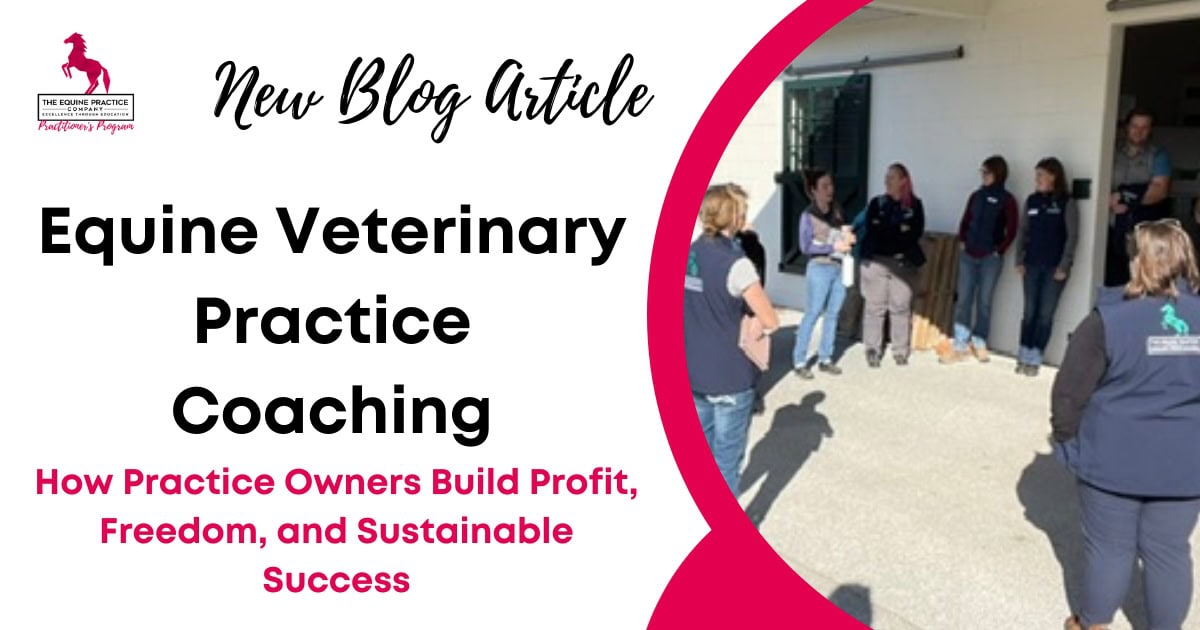
Equine Veterinary Practice Coaching: How Practice Owners Build Profit, Freedom, and Sustainable Success
There is a moment that almost every equine veterinarian reaches. It usually happens quietly, not in the middle of a dramatic emergency or a big career milestone, but on an ordinary evening when you’re sitting in your truck after the last call of the day, staring at the steering wheel and wondering, is this really what I worked so hard for?
You became a veterinarian because you care. Because you wanted to help. Because horses have a way of getting into your bloodstream, don’t they?
And yet somehow, despite doing meaningful work and being highly trained, practice ownership can start to feel overwhelming in a way you never expected.
The invoices pile up, the clients get more demanding, the team problems never seem to end, and the equipment costs more than you ever imagined. No matter how hard you work, the profit never reflects the effort. You’re busy, but you’re not free. You’re booked out, but you’re not ahead.
And the worst part is that most equine vets blame themselves. They think they must be doing something wrong. They think they just need to work harder, see one more horse, answer one more call, stay up one more hour.
But here is the truth that no one told you at college or university: you were trained to be an excellent clinician, but you were not trained to run an equine veterinary business. Those are two completely different skill sets.
Veterinarians often get less education in business than we do in equine dentistry, and we all know how much dentistry most of us got at vet school. So we do what good people always do.
We grind, we sacrifice, we push through, and we keep helping everyone else while quietly carrying the emotional and financial load ourselves.
Until one day you realise that this isn’t sustainable. And it doesn’t have to be this way.
Equine veterinary practice coaching is not about turning you into a corporate robot or working more hours for the sake of it. It’s about learning how to run your practice like a business, so that it can support your life rather than consume it.
It’s about having someone in your corner who understands the unique pressures of equine practice, the isolation of being a solo or micro practice owner, and the reality that “just see more horses” is not a strategy.
Equine practice ownership should not mean burnout, debt, or living permanently on the edge. It should mean freedom, confidence, profitability, a cohesive team, and a practice that runs smoothly. It should mean being able to take a vacation without the wheels falling off.
And yes, it is entirely within your reach. With the right guidance, the right structure, and the right people around you, you can turn the ship around.
If you are an equine veterinarian who owns a practice (or dreams of owning one), and you know deep down that things could be better, this guide is for you.
Let’s talk about what equine veterinary practice coaching really is, and why it might be the missing piece that changes everything.
What Is Equine Veterinary Practice Coaching? (And Who Is It For?)
Equine veterinary practice coaching is, at its core, about support, structure, and strategy. It is the bridge between being an excellent veterinarian and being a confident, profitable practice owner.
Because the reality is that clinical skill alone is not enough to create a sustainable business, especially in equine practice where the demands are high, the margins are often tight, and the emotional load can be enormous.
Most equine vets are deeply competent, compassionate, and hardworking. That has never been the problem.
The problem is that we are expected to somehow run a business, lead a team, manage clients, understand finances, set pricing, create systems, and still deliver world-class veterinary care… all without ever being taught how.
Equine veterinary practice coaching exists because you should not have to figure all of this out alone.
It is not about telling you to work harder. It is not about chasing endless growth for the sake of it. It is about helping you build a practice that works. A practice that supports your life, your family, your health, and your future, while still allowing you to serve horses and clients at the highest level.
Coaching helps you step back from the constant firefighting and start making decisions with clarity. It gives you a framework to understand what is actually driving your stress, what is limiting your profitability, and what needs to change first.
And that is important, because most equine practice owners don’t need a hundred new ideas. They need the right few changes, implemented consistently, with accountability and guidance.
So who is this for?
Equine veterinary practice coaching is especially valuable for veterinarians who own, or want to own, a small, solo or micro equine practice. It is for the ambulatory practitioner who feels like the entire business rests on their shoulders.
It is for the practice owner who is fully booked but still worried about cashflow. It is for the person who loves the work, but is starting to wonder how long they can keep going like this.
It is also for the vet who has bigger dreams. The vet who wants to build something that lasts. The vet who wants a team, a smoother-running practice, and a business that creates freedom rather than pressure.
And importantly, it is for the veterinarian who is ready. Ready to stop surviving month to month. Ready to stop guessing. Ready to stop being the bottleneck in their own practice. Ready to become the captain of the ship again.
Because with the right support, equine practice ownership can be one of the most rewarding paths in the profession. But without support, it can become lonely, exhausting, and financially fragile far too quickly.
The good news is that the solution is not complicated. It is structured. It is measurable. And it is entirely possible.
The next step is understanding what most equine practice owners are actually struggling with right now, and why these challenges are so common.
The Biggest Challenges Equine Practice Owners Face
If you are finding equine practice ownership harder than you expected, you are not alone. In fact, the challenges you are facing are not a reflection of your ability or your effort.
They are simply the predictable result of running a complex business in a profession that trains you to be a clinician, not a business owner.
Equine practice is uniquely demanding. The work is physical, the hours are unpredictable, the clients are emotionally invested, and the stakes feel high every single day.
Add to that the reality that many equine practices are small, ambulatory, and owner-dependent, and it becomes very easy for the business to start running you instead of the other way around.
Over the years, there are a handful of struggles that come up again and again for equine practice owners.
One of the most common is financial stress, even in practices that are extremely busy. Many equine veterinarians are working at full capacity, yet still feel like they are scraping by. They worry when the diary isn’t full.
They feel relief when cash is in the bank, but they don’t actually know if the practice is profitable. They are doing what so many of us do, which is judging the health of the business by gut feel rather than clear numbers.
Another major challenge is pricing and confidence. Equine veterinarians are compassionate people, and that compassion can sometimes come at a cost. Undercharging, missed charges, discounting, and the constant pressure of client expectations can quietly erode profitability over time.
Most practice owners don’t need to become greedy. They simply need to charge appropriately for the level of skill, responsibility, and value they provide.
Then there is the workload. Equine practice owners are often so overworked that they struggle to even lift their head up long enough to think strategically. At the end of the day, the thought of studying, planning, or working on the business feels impossible.
The practice becomes an endless treadmill of calls, emergencies, invoices, and emotional labour. There is no breathing room.
Team dynamics are another huge source of stress. Whether you have associates, support staff, or you are thinking about employing for the first time, leadership can feel like an entirely different job.
Toxic team members, poor culture, miscommunication, and the weight of being responsible for others can drain the joy out of ownership very quickly.
And perhaps the most overlooked challenge of all is isolation. Being an independent equine practice owner can be incredibly lonely. There are very few people who truly understand what it is like to carry the responsibility of patients, clients, finances, staff, and your own family life all at once.
Forums and Facebook groups can be helpful, but they are not a structured support system. They are not accountability. They are not a plan.
Most equine practice owners do not fail because they aren’t good enough. They struggle because they are trying to do something difficult without the right framework, without guidance, and without a group of people in their corner.
This is exactly why equine veterinary practice coaching exists. Not because you are broken, but because the system is incomplete. You deserve the tools, the clarity, and the support that allow you to thrive.
And the truth is, once the right foundations are in place, everything starts to change. Profit becomes predictable. Decisions become clearer. Work becomes lighter. The practice starts serving your life, instead of consuming it.
So what does coaching actually help you improve, in practical terms?
That is what we’ll cover next.
What Equine Veterinary Practice Coaching Helps You Improve
The most important thing to understand about equine veterinary practice coaching is that it is not about adding more complexity to your life. Most practice owners are already overwhelmed. They do not need another binder of information or another list of things they “should” be doing.
What they need is clarity. Structure. Support. And the right changes implemented in the right order.
Coaching helps you stop reacting to the business and start leading it. It gives you the ability to step back, identify what is actually driving the stress or the stagnation, and focus your energy on the levers that make the biggest difference.
One of the first areas that coaching improves is profitability. Not through working longer hours or seeing more horses, but through understanding what truly drives profit in an equine practice.
Often it comes down to simple but powerful shifts: pricing appropriately, reducing missed charges, tightening systems, and making decisions based on numbers rather than anxiety.
Many practices are far closer to financial freedom than they realise, but they are leaking profit in places they have never been shown how to look.
Coaching also improves practice management. Most equine practices, especially ambulatory and owner-led ones, run on the owner’s memory, energy, and constant effort. That is not sustainable.
Coaching helps you build systems and workflows so the practice can run smoothly without you carrying everything in your head. Even tiny practices have systems, and when those systems are refined, the day-to-day load becomes lighter almost immediately.
Leadership and team development are another major focus. Practice ownership is not just about medicine, it is about people. Whether you have staff already or you are preparing to employ for the first time, learning how to lead effectively changes everything.
Coaching helps you build a cohesive team culture, manage employees with confidence, and remove the chronic stress that comes from unresolved people problems.
Work-life balance is not a luxury, it is a necessity. Equine vets are some of the most dedicated professionals on the planet, but dedication without boundaries leads to burnout. Coaching helps you create a practice that supports your life rather than steals it.
The goal is not to escape the work you love, but to be able to do it with energy, joy, and longevity.
Perhaps most importantly, equine veterinary practice coaching provides accountability and community. Change does not happen just because you know what to do. It happens when you are supported, challenged, and held to a higher standard.
When you are surrounded by other practice owners who understand the journey, solutions become obvious, momentum builds, and you stop feeling like you are fighting the good fight alone.
This is why the most successful practice owners are not the ones who work the hardest. They are the ones who have guidance, structure, and the right people around them.
And once those foundations are in place, the results can be extraordinary.
Practices can increase revenue and profit without increasing workload. Owners can regain time, confidence, and control. Teams can become supportive rather than draining. The business becomes something you steer intentionally, rather than something that drags you along wherever the wind blows.
The next step is learning how to measure what matters, because what can’t be measured can’t be managed.
That brings us to one of the most powerful parts of equine practice coaching: tracking the right KPIs.
Equine Practice KPIs That Matter Most
One of the biggest lightbulb moments for equine practice owners is realising that most of us have been measuring the health of our business in completely the wrong way.
Many veterinarians judge the practice by the amount of cash in the bank. If there is money sitting there, we feel relieved. If there isn’t, we feel panicked. Or we wait until the end of the financial year when the accountant tells us what happened, long after the decisions have already been made.
But cash in the bank is not a strategy, and it is not a business plan.
One of the most important lessons I learned from my own business mentor, Keith Cunningham, is that business owners cannot afford to manage by emotion or by hope.
Keith has coached some of the sharpest entrepreneurs in the world, and he has reminded me time and time again that the numbers will always tell the truth, whether we choose to look at them or not.
That shift – moving from guessing to measuring – is where real freedom begins.
What can’t be measured can’t be managed, and this is why equine veterinary practice coaching places such a strong emphasis on tracking the right numbers.
Not hundreds of metrics that make you feel overwhelmed, but a small set of critical drivers that tell you the truth about how your practice is performing.
In the mastermind, we often refer to building “business muscle.” That muscle comes from knowing your numbers, reviewing them regularly, and making small adjustments before problems become crises.
Some of the most important equine practice KPIs include profitability. Profit is not what is left over by accident, it is what is designed intentionally. Understanding your true profit margin changes the way you price, the way you schedule, and the way you make decisions.
Another key number is average transaction value. Many equine practices are extremely busy, but the revenue per visit is not reflecting the true value of the work being done. Small improvements here, combined with reduced missed charges, can create massive financial change without seeing a single extra horse.
Missed charges are one of the hidden profit killers in equine practice. Most veterinarians are so focused on patient care that they undercharge, forget line items, or feel uncomfortable charging appropriately.
Coaching helps you correct this with confidence, because you cannot build a sustainable business on guilt-based pricing.
Capacity and workload are also essential metrics. Being fully booked is not the same as being profitable. Coaching helps you identify the sweet spot where the workload is enough, the practice is thriving, and you are not hanging on by your fingernails.
Cashflow is another major driver, especially in equine practice where payment delays, seasonality, and large expenses can create financial instability. Learning to read and understand your financial statements is a game changer, and it is something most of us were never taught.
The most important point is this: you do not need to become obsessed with spreadsheets. You simply need to know the handful of numbers that steer the ship. Once you can see clearly, you can make decisions clearly.
And when practice owners start tracking the right KPIs, they stop operating from fear. They stop guessing. They stop feeling stupid when they meet with their accountant. They begin to feel like business owners.
That is the shift. And it is incredibly empowering.
Of course, numbers alone are not enough. KPIs tell you what is happening, but systems are what make improvement sustainable.
So the next question becomes: how do you actually build an equine practice that runs smoothly without everything depending on you?
That is where practice management systems and workflows come in.
Equine Veterinary Practice Management: Systems That Give You Freedom
One of the most exhausting realities of equine practice ownership is that so many practices are built entirely around the owner.
The owner is the clinician.
The owner is the decision-maker.
The owner is the administrator.
The owner is the problem-solver.
The owner is the person everyone calls when anything goes wrong.
In the early days, this feels normal. It even feels necessary. But over time, it becomes a trap. The practice cannot grow, cannot run smoothly, and cannot give you freedom if everything depends on you holding it together.
This is why equine veterinary practice management is such a central part of coaching. Because the goal is not simply to survive another busy season. The goal is to build a practice that works. A practice that is stable, profitable, and sustainable, even when you are not constantly pushing the boulder uphill.
The truth is that even the smallest equine practices need systems. Systems are not corporate. Systems are not complicated. Systems are simply the repeatable ways you do things so that the business does not rely on memory, chaos, or constant firefighting.
Practice management systems can include how you schedule and structure your day, how you communicate with clients, how you manage follow-ups, how you handle billing, how you streamline referrals, and how you reduce the constant drain of missed charges and inefficiencies.
It also includes learning where to put your energy, and where never to put it. One of the biggest breakthroughs for practice owners is realising that not every client is worth keeping, not every problem deserves your emotional bandwidth, and not every task needs to be done personally by you.
Coaching helps you identify the areas of your practice that are interrupting your success. The things that keep pulling you back into the weeds. The habits, systems, or people problems that quietly sabotage profitability and peace of mind.
When practice owners start implementing better workflows, something remarkable happens. The day becomes lighter. Decisions become simpler. The practice starts to feel more controlled. Instead of being run by the business, you begin to run it.
And this is where freedom begins.
Because freedom does not come from working less. Freedom comes from building a practice that does not collapse the moment you step away.
Many equine vets dream of taking a proper vacation without worrying that everything will fall apart. That is not a fantasy. That is a systems issue. With the right structure in place, your practice can support your life rather than consume it.
Of course, systems alone do not solve everything. The business side of equine practice is deeply connected to people: your team, your clients, and your own leadership as an owner.
Which brings us to one of the most underestimated skills in equine practice ownership: leadership.
Equine Veterinary Leadership Training: Building a Team That Supports You
No one tells you, when you become a practice owner, that you are also becoming a leader.
You may have started your practice because you love the medicine. You wanted autonomy. You wanted to do things properly. You wanted to serve horses and clients at the highest level.
But ownership is not just clinical. Ownership is people.
Whether you have associates, support staff, contractors, or you are simply trying to build a small team around you, leadership becomes one of the defining factors in whether your practice feels like freedom or like a burden.
Many equine practice owners feel enormous stress around team dynamics. They worry about hiring. They worry about retaining good people. They worry about the toxic team member who drains the energy out of the entire workplace. They worry about being the one who has to hold everything together emotionally as well as financially.
And most of us were never trained for this.
Equine veterinary leadership training is not about becoming a corporate manager. It is about learning how to create a culture where people know what is expected, where communication is clear, where problems are addressed early, and where the practice does not depend on you carrying everyone else.
A cohesive team is not something that happens by accident. It is built intentionally. Coaching helps practice owners develop the confidence to lead, to make decisions, and to create an environment where people actually enjoy going to work.
This matters more than most veterinarians realise. Because the quality of your team directly impacts the quality of your life.
When your team is functioning well, the practice becomes lighter. You are not constantly putting out fires. You are not dreading staff issues. You are not feeling like you are trapped.
When leadership is lacking, the opposite happens. Even a profitable practice can feel miserable. Burnout creeps in. Resentment builds. And practice ownership starts to feel like a never-ending emotional load.
Coaching provides the structure to change this. It helps you identify what needs to shift, what conversations need to happen, and what boundaries need to be put in place. It also helps you stop trying to be everything to everyone, because that is not leadership. That is self-sacrifice.
The goal is not perfection. The goal is a practice that runs smoothly, with people around you who have your back, and a culture that supports growth rather than chaos.
And when that happens, something else becomes possible.
Work-life balance.
Not as a buzzword, but as a real outcome.
Because the entire point of building a successful equine practice is that it should support your life, not steal it.
What Makes This Different From a General Business Mastermind?
If you have ever searched the internet for business help, you will know that there is no shortage of programmes, coaches, courses, and masterminds promising success.
You could Google the word “mastermind” right now and find thousands of results.
But here is the problem.
Most of them have absolutely nothing to do with equine veterinary practice.
A general business mastermind might be helpful for a café owner, a marketing agency, or an online retailer. But equine practice ownership is a completely different world. The pressures are different. The clients are different. The logistics are different. The emotional load is different.
Equine vets are not running corner shops. We are carrying the responsibility of living beings, high-stakes decisions, unpredictable emergencies, and a profession built on compassion and service.
That is why equine veterinary practice coaching must be equine-specific.
It must account for the realities of ambulatory life. The long days on the road. The seasonal swings. The complex client relationships. The fact that many equine practices are small and owner-dependent, without layers of management or corporate infrastructure.
It must also account for the mindset of veterinarians. We are highly educated, deeply conscientious, and often far harder on ourselves than we would ever be on anyone else.
Many practice owners struggle not because they lack intelligence, but because they lack support, confidence, and a clear framework for business.
This is what makes an equine-specific mastermind different.
It is not theory. It is not generic advice. It is not business jargon.
It is a structured, guided, accountable journey designed specifically for veterinarians who own (or want to own) equine practices, and who want to build something sustainable.
It is also deeply personal.
Because practice ownership is not just about profit. It is about your life. Your health. Your family. Your future. It is about designing a practice that serves you, rather than becoming a slave to it.
In a small, private group of like-minded equine practice owners, you are held to a higher standard. You are supported. You are challenged. You are no longer doing it alone.
And that is where the magic happens.
Not magic in the fluffy sense, but magic in the real sense: when you finally stop spinning your wheels, stop guessing, and start implementing the changes that actually move the needle.
Over time, the results speak for themselves.
Practices become more profitable without working longer hours. Owners become calmer, more confident, and more in control. Teams become stronger. Systems become smoother. Life becomes lighter.
This is not about becoming the busiest equine vet in town.
It is about becoming the most sustainable one.
So Where Do You Start?
If you are reading this and recognising yourself in these words, the next step is simple.
You do not need more stress.
You do not need more hustle.
You do not need to keep carrying this alone.
You need structure. Guidance. Accountability. And a community of equine practice owners who are walking the same path.
That is exactly why The Equine Practice Company created the Business Mastermind: a 24-month programme built specifically for small, solo, and micro equine practices, designed to help you increase profitability, improve systems, develop leadership, and reclaim the life you deserve.
The next intake begins in July/August 2026, and places are limited.
If you would like to be considered, you can register your interest below for early dates, pricing, and application access.
Your practice can be better.
Your life can be better.
And it is entirely within your reach.