Equine Veterinary Leadership Training: How to Build a Team That Doesn’t Burn You Out
There is a quiet truth that most equine practice owners discover the hard way.
Running an equine practice is not just about horses.
It is about people.
You can be an excellent clinician. You can have loyal clients. You can have a busy diary and a strong reputation. But if the people side of the practice is unstable, practice ownership becomes exhausting very quickly.
Many equine veterinarians enter ownership believing that the hard part will be the medicine. The emergencies. The long days. The physical work.
But often, the hardest part is the team.
The staff dynamics. The miscommunication. The emotional drain. The sense that you are carrying not only the business, but the mood of the entire workplace.
And most of us were never trained for that.
Equine veterinary leadership training is not something we learn at university. We learn how to diagnose, treat, operate, and care. We do not learn how to lead.
Yet the moment you become a practice owner, you become a leader whether you want to or not.
And leadership is one of the defining factors in whether your practice feels like freedom… or like a burden.
Why Leadership Matters More Than Most Practice Owners Realise
When your team is functioning well, everything becomes lighter.
The day flows. Clients feel supported. Problems are addressed early. You are not constantly putting out fires. You can step away without panic. You can breathe.
But when leadership is missing, the opposite happens.
Even a profitable practice can feel miserable.
You dread staff conversations. You avoid dealing with problems until they explode. You feel like you are constantly managing emotions rather than running a business. You start to wonder if practice ownership was a mistake.
This is not because you are weak.
It is because leadership is a skill. And like any skill, it can be learned.
The Loneliness of Being the One in Charge
One of the most difficult parts of practice ownership is that you are no longer “just part of the team.”
You are responsible.
You are the one who makes the final decision. You are the one who carries the risk. You are the one who holds the business together.
And that can be incredibly lonely.
Many equine practice owners feel like they cannot talk openly with staff. They cannot vent. They cannot show uncertainty. They feel they must always be strong, always be composed, always be the one who has the answers.
That emotional load is heavy.
Equine veterinary leadership training is not about becoming a corporate manager. It is about learning how to carry that responsibility in a healthier way, and how to build a team culture that supports you rather than drains you.
Staff Retention: Why Good People Leave
One of the biggest challenges in veterinary practice today is staff retention.
Practice owners often ask, “Why can’t I keep good people?”
And the answer is rarely about salary alone.
Good staff leave when they feel unsupported. When expectations are unclear. When the workplace feels chaotic. When there is tension that no one addresses. When leadership feels absent or inconsistent.
Most people do not want perfection.
They want clarity.
They want to know what is expected. They want to feel appreciated. They want to work in an environment where problems are handled early, not ignored until resentment builds.
Retention improves when culture improves.
And culture improves when leadership becomes intentional.
The Toxic Team Member Problem
Almost every practice owner has experienced this.
One person who drains the energy out of the entire workplace.
They complain. They undermine. They create tension. They resist change. They are “difficult,” but somehow tolerated because the thought of addressing it feels exhausting.
Toxic team members are not just a staff issue.
They are a business interrupter.
They affect morale. They affect client experience. They affect retention of good staff. And they affect you, emotionally, every single day.
Leadership means being willing to have the hard conversation.
Not harshly. Not aggressively. But clearly.
Avoidance is not kindness. Avoidance is delay.
A strong practice culture cannot be built on walking on eggshells.
Culture Is Built Intentionally, Not Accidentally
A cohesive team does not happen by accident.
Culture is built through:
Clear expectations
Consistent communication
Healthy boundaries
Accountability
Respect
The best teams are not perfect. They are aligned.
They know what matters. They know what the practice stands for. They know what is acceptable and what is not.
And they know that leadership will address issues early, rather than letting them fester.
This is where equine veterinary leadership training becomes transformational.
Because once the people side of the practice is stable, everything else becomes easier.
Leadership Is the Path to Work-Life Balance
Many equine veterinarians think work-life balance comes from working fewer hours.
But often, balance comes from working with less emotional chaos.
A practice with strong leadership feels calmer.
You are not carrying everyone. You are not constantly firefighting. You are not absorbing the stress of the team.
You are leading.
And leadership creates space.
Space to think. Space to plan. Space to breathe. Space to actually enjoy the practice you worked so hard to build.

You Don’t Have to Figure This Out Alone
If you are struggling with team stress, staff retention, or the weight of leadership, please know this:
You are not failing.
You are simply doing something difficult without the framework you were never taught.
Equine veterinary leadership training is learnable.
And it is one of the most powerful levers in creating a practice that is sustainable, profitable, and enjoyable.
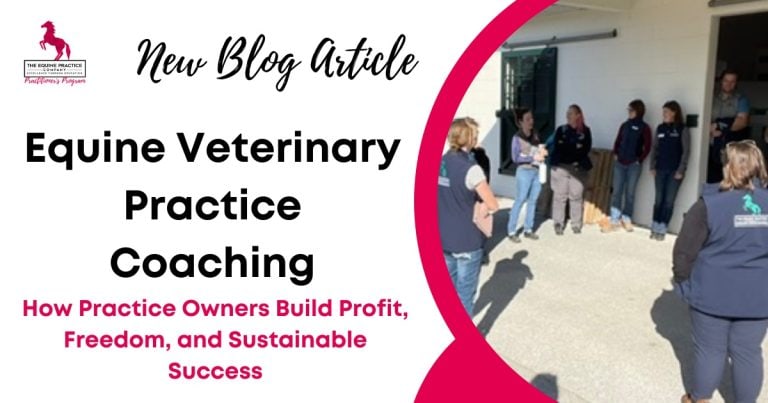
If you want the full foundation behind building a practice that supports your life, start with our complete guide to equine practice coaching / mentoring here.
(Internal link to pillar post using anchor text: equine veterinary practice coaching)
And if you want structured support, accountability, and a community of equine practice owners walking the same journey, you can register your interest for the Equine Practice Company Business Mastermind here.
Do I Need To Be Controlling As A Leader?
Strong leadership does not mean being harsh or controlling. It means being clear, consistent, and willing to address issues early.
Staff retention improves when culture improves, and culture improves when leadership becomes intentional.
And yes, even small equine practices need leadership. In fact, solo and micro practices often feel the impact of team dynamics even more strongly, because the owner is carrying so much already.