
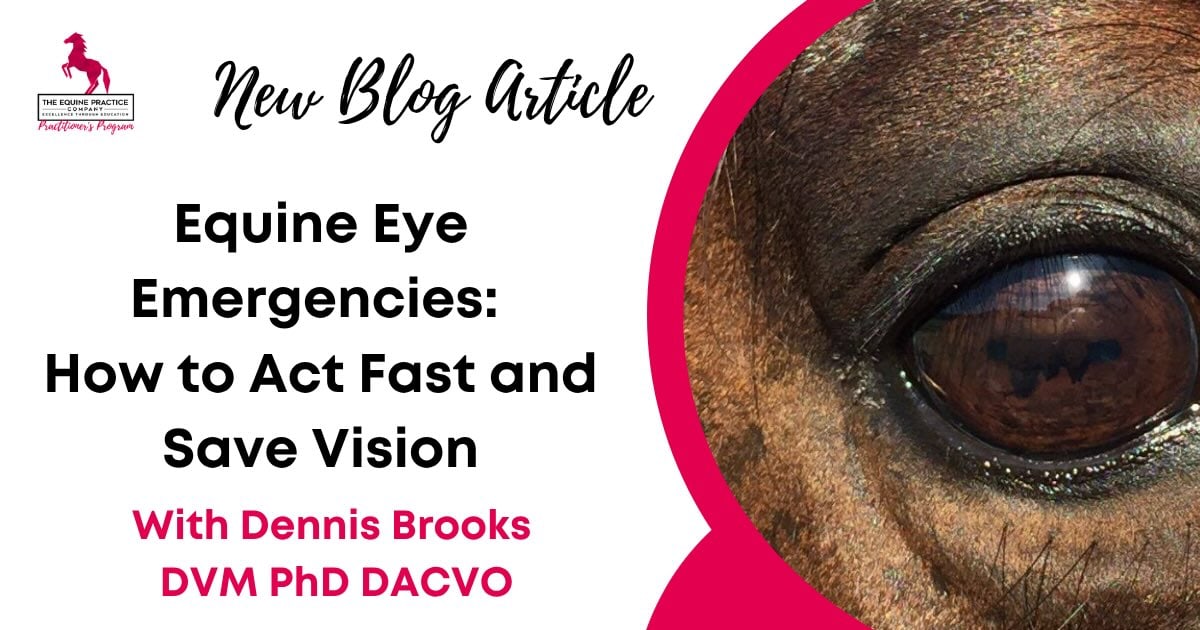
Equine Eye Emergencies: How to Act Fast and Save Vision
Every equine veterinarian knows that phone call.
A frantic owner describing a swollen, cloudy, or weeping eye. By the time you arrive, the horse is squinting, the cornea looks milky, and the clock is already ticking.
It can progress rapidly – sometimes within hours – toward a melting ulcer and, if unchecked, rupture.
Equine eye emergencies are high-stakes, high-stress, and unforgiving. The good news: with the right framework, you can move from panic to protocol.
In this article, I share the distilled, field-tested guidance of Professor Dennis Brooks, DVM PhD DACVO – four decades of equine ophthalmology translated into practical steps you can apply today.
You’ll learn how to recognise the true emergencies, run a fast, structured exam, stabilise the eye in the first 24 hours, and avoid the common pitfalls that cost vision.
A core principle underpins everything you’ll read below: sterilising the ulcer is necessary, but not sufficient. As Dr Brooks teaches, sterilisation doesn’t guarantee healing – you must also control proteases.
Horses often deepen their own ulcers through an enzyme-driven “protease storm” that sloughs damaged tissue; our job is to work with the horse’s powerful healing response while controlling enzymes, pain, and inflammation, and replacing missing collagen when needed.
Read on for a concise playbook you can keep in your truck and trust on farm calls – built on Dr Brooks’s cases, outcomes, and lifelong clinical judgment.
Equine Eye Emergencies: Quick Answers for Veterinarians
- A cloudy eye in a horse should be treated as an emergency until proven otherwise
- Melting ulcers can progress to corneal rupture within hours
- Pain (blepharospasm) is often a more reliable warning sign than appearance alone
- Early enzyme (protease) control is as important as antimicrobial therapy
- Delay in intervention is the most common cause of vision loss in equine eye disease
This framework is based on more than 40 years of equine ophthalmology practice by Dennis E. Brooks, DVM, PhD, DACVO – one of the most published and respected equine ophthalmologists worldwide.

Recognising a True Ophthalmic Emergency
What is a melting ulcer in horses?
A melting ulcer in horses is a rapidly progressive corneal ulcer caused by uncontrolled enzyme (protease) activity within the cornea.
These enzymes break down collagen faster than the horse can replace it, causing the cornea to soften, thin, and take on a gelatinous appearance.
Unlike simple ulcers, melting ulcers can worsen within hours, leading to deep stromal loss, descemetoceles, or full corneal rupture if not aggressively treated.
Infection often initiates the process, but it is the horse’s own enzyme response that drives rapid tissue destruction – which is why enzyme control is as critical as antimicrobial therapy.
For this reason, melting ulcers are considered true ophthalmic emergencies in horses and require immediate, aggressive intervention.
Not every cloudy or tearing eye requires referral – but the ones that do can go bad fast.
According to Professor Dennis Brooks, DVM, PhD, DACVO, one of the world’s most experienced equine ophthalmologists, the key is to determine which conditions threaten the integrity of the globe and which can safely be managed in the field.
The True Equine Eye Emergencies
Dr Brooks defines the following as genuine equine ophthalmic emergencies – situations where rapid intervention may save vision or the eye itself:
- Corneal ulcers with stromal loss or melting ulcers (soft, gelatinous cornea).
- Deep or descemetoceles, especially if there’s a visible “dimple” or thin, dark area.
- Ruptured or leaking corneas (positive Seidel’s test).
- Severe uveitis causing hypopyon, fibrin, or miosis.
- Foreign bodies embedded in the cornea or under the eyelid.
- Glaucoma with a firm, painful eye and corneal edema.
- Blunt or penetrating trauma to the globe or orbit.
A useful clinical mindset, as Dennis teaches:
“When you’re not sure, treat it as an emergency until proven otherwise.”
Conditions That Can Wait (Briefly)
Some mild conjunctivitis or superficial abrasions can often be reassessed within 24 hours, as long as the horse is comfortable, vision is intact, and the cornea stains uniformly with fluorescein.
But even these cases require clear documentation, a fluorescein photo, and owner instructions for strict re-evaluation if pain worsens – because horses can deteriorate rapidly due to uncontrolled enzyme activity.
Clinical Tip:
Dr Brooks emphasises that pain level, not just lesion appearance, guides urgency. A horse reluctant to open the eye or with intense blepharospasm is always urgent – pain often precedes visible tissue loss.
Performing a Structured Field Exam
When you arrive on the farm, resist the urge to start medicating immediately. As Dr Dennis Brooks reminds us, “the first few minutes are for thinking, not treating.”
Your goal is to determine three things: Is the eye visual? Is it ruptured? Is it salvageable?
Step 1: Assess Vision Quickly
A simple dazzle response and obstacle test are your best first indicators. If the horse tracks movement or blinks at a hand gesture, vision is likely present. Loss of dazzle alone doesn’t always mean blindness – pain and miosis can suppress it – but if direct and consensual pupillary light reflexes are absent, vision is threatened.
Step 2: Evaluate Surface Integrity
Instil fluorescein dye and examine under cobalt-blue light.
- A sharply demarcated circular stain suggests a superficial ulcer.
- A “soft,” gelatinous, or irregularly thinning stain indicates a melting ulcer.
- A dark dimple surrounded by green fluorescence warns of a pre-descemetocele – immediate emergency.
Perform a Seidel’s test if you suspect leakage. A positive flow of dye confirms aqueous leakage from a corneal perforation or micro-rupture.
Step 3: Examine for Uveitis and Hypopyon
Look for miosis, aqueous flare, and hypopyon (pus settling inferiorly). Dr Brooks stresses that hypopyon is a reaction, not proof of infection – it’s a sign of intense inflammation and often reversible with proper therapy. If hypopyon increases after starting treatment, your therapy is wrong – reassess drugs and dosages.
What causes hypopyon in equine uveitis?
Hypopyon in horses is caused by severe intraocular inflammation, not necessarily infection. It represents the accumulation of inflammatory cells (primarily neutrophils) that settle in the anterior chamber in response to uveitis.
In equine eye disease, hypopyon is most often triggered by intense inflammation secondary to corneal ulcers, trauma, or immune-mediated uveitis.
Importantly, hypopyon is a reaction, not proof of sepsis. With correct control of inflammation, pain, and enzyme activity, hypopyon can resolve completely without permanent vision loss.
As Dr Brooks teaches, worsening hypopyon after treatment is a warning sign that therapy -particularly enzyme or inflammatory control – is inadequate.
Step 4: Check Pain and Swelling
Blepharospasm, photophobia, and excessive tearing mean significant pain. Controlling it early with topical atropine and systemic NSAIDs helps both diagnosis and healing.
As Dennis E Brooks says:
“Reducing pain isn’t just kind – it’s therapeutic. Horses that squint don’t heal.”
Step 5: Document and Photograph
A quick smartphone photo under diffuse light is often more revealing than what you see in real time. Dennis recommends photographing every ulcer before and after fluorescein, to capture thin areas, vascularisation, or leaks you might miss with the naked eye.
Why do horse eyes deteriorate so quickly?
Horse eyes deteriorate rapidly because of an intense enzyme-driven inflammatory response that can overwhelm healing mechanisms.
Once the cornea is damaged, proteases released by inflammatory cells and microorganisms begin digesting collagen – often faster than new tissue can be produced.
Additionally, horses have a powerful pain response that leads to blepharospasm, reduced tear distribution, and delayed healing.
Even when infection is controlled, unchecked enzyme activity can continue destroying corneal tissue, which is why horses may worsen despite appearing to be on “appropriate” treatment.
This combination of aggressive enzyme activity, high pain levels, and delayed vascular response explains why equine eye injuries can progress from mild to catastrophic in a very short time window.

Stabilising the Eye – Dr Brooks’s First 24-Hour Protocol
Once you’ve confirmed the cornea is intact or can be safely protected, the first 24 hours determine whether the horse keeps or loses vision. Dr Dennis Brooks teaches that successful stabilisation follows three parallel tracks: control infection, control enzymes, and control inflammation.
1️⃣ Control Infection
- Culture and cytology first, whenever feasible. Even a simple smear can differentiate bacteria, fungi, or mixed infections.
- Gram-positive organisms (particularly β-hemolytic Streptococcus) are the most destructive.
“I’d rather deal with a fungus any day,” Dennis says. Cefazolin, diluted from IV powder to ≈ 55 mg/mL for topical use, remains the gold-standard antibiotic in the U.S. for these cases.
- Antifungals: Voriconazole is losing efficacy; alternatives such as luliconazole and amphotericin B in combination perform well.
If availability is limited, itraconazole + miconazole remain reliable backups.
2️⃣ Control Enzymes (Proteases)
This is the principle Dennis emphasises most. Even when you sterilise an ulcer, it won’t heal unless you stop the protease storm. Use topical antiproteases every 2 hours at first:
- EDTA 0.2% (made by filling an EDTA blood-tube halfway with sterile water).
- Autologous serum or plasma – replace weekly to prevent contamination.
- Acetylcysteine 10% topically as an adjunct.
- Tetanus antitoxin drops and topical doxycycline also act as secondary antiproteases.
“If the hypopyon increases after therapy, your antiprotease coverage isn’t strong enough.”
3️⃣ Control Inflammation and Pain
- Atropine to achieve full mydriasis, relieve ciliary spasm, and prevent synechiae.
- Systemic NSAIDs (flunixin or phenylbutazone) to reduce uveitis and discomfort. Avoid overdosing flunixin – excessive use can delay vascularisation and slow corneal healing.
- Sub-palpebral lavage systems help maintain frequent dosing while minimising stress.
4️⃣ Support and Monitor
Explain to owners that early improvement can be deceptive. Continue therapy until the cornea re-epithelialises and the horse is comfortable with the eye fully open. Daily photos help gauge progress; subtle thinning or expanding opacity means enzyme activity is still ongoing.
Surgical and Adjunctive Therapies – Cross-Linking, Grafts, and Glue
Even with aggressive medical therapy, some eyes keep melting or show stromal loss too deep for conservative care. Dr Dennis Brooks emphasises that surgery in horses isn’t only about saving sight – it’s about preserving the globe and giving the cornea time to rebuild.
Collagen Cross-Linking (Riboflavin + UV Light)
One of the most accessible breakthroughs for field and referral clinicians alike.
“Everybody should be doing this”
The technique strengthens the weakened cornea by exposing it to ultraviolet A light (≈365 nm) after applying riboflavin (vitamin B₂).
- Effective for superficial and deep ulcers, including melting types.
- Each treatment lasts about six minutes once a week (or daily in severe cases).
- It reinforces new collagen being produced by the horse, reducing the risk of rupture.
Although commercial systems sell for thousands, Dennis uses a $40 handheld UV lamp with a light meter to ensure ~19.5 mW/cm² intensity.
“It’s inexpensive, safe, and it works.”
Amnion and Collagen Grafts
When tissue loss exceeds 50 % stromal depth, or a descemetocele is forming, mechanical support is essential. Dennis frequently sutures amnion membranes directly to the cornea, then adds a second layer at the limbus to protect the sutures.
- The inner layer acts as a biologic bandage, shielding fragile collagen while enzymes attack the graft instead of the cornea.
- The outer layer sloughs naturally after 7–10 days, leaving clear granulation tissue that remodels over months.
Long-term follow-up shows most scars fade toward transparency as the horse’s own collagen replaces the graft. He calls it “Mother Nature finishing the surgery.”
Tissue Glue and Field Repairs
For small perforations or leaks where referral isn’t possible, Dennis has pioneered low-cost alternatives using tissue glues such as TissueMend II or Gluture, combined with collagen patches.
Key principles he teaches:
- Only glue small, contained leaks – not large descemetoceles.
- Dry the cornea completely with sterile swabs or gentle airflow before applying.
- Apply glue at the edge, not the centre, to avoid heat damage as it polymerises.
- Continue full medical therapy beneath the patch; antibiotics and antiproteases still penetrate.
Most eyes stabilise within two to three weeks and can retain useful vision.
When to Refer
Immediate referral is indicated for:
- Full-thickness perforations with prolapsed iris tissue that cannot be sealed in the field.
- Progressive melting despite 24 hours of maximal antiprotease therapy.
- Large central defects threatening the visual axis in a valuable performance horse.
But as Dennis often reminds practitioners:
“Even in the middle of nowhere, you can buy the horse time. A glued, protected eye is far better than an open one.”
The Horse’s Natural Healing Power – Working With Nature, Not Against It
Few lessons have shaped Dr Dennis Brooks’s career more than the realisation that the horse’s eye knows how to heal itself.
One Thoroughbred mare in particular changed his entire approach: she returned from pasture with a ruptured cornea that healed with no medical therapy at all.
The iris sealed the hole, collagen regenerated across the defect, and fibrotic membranes re-formed the barrier. The mare could still see – and she was pain-free.
That case reframed a lifetime of clinical experience. As Dennis explains:
“If the horse can do this on its own, my job is to help – not to do stupid things that get in the way of its natural healing capability.”
This concept guides every modern protocol for equine corneal ulcers and equine eye emergencies. Our treatments – from antibiotics to cross-linking – succeed best when they support the horse’s own biology rather than override it.
Respecting the Cornea’s Plan
- The horse sloughs dead or damaged epithelium, stroma, and keratocytes on purpose – a controlled purge of unhealthy tissue.
- Enzymes (proteases) are part of that process; they digest debris and remodel collagen.
- Healing stalls only when enzyme activity overwhelms new tissue formation or when excessive medication blocks vascularisation.
So, the clinician’s job is balance: reduce destructive enzyme activity without halting natural repair.
That means allowing moderate vascularisation, tapering NSAIDs slowly, and knowing when to stop interfering once fluorescein is negative and comfort returns.
The Long View
Professor Dennis Brooks often revisits horses years after surgery. Scars that once looked opaque fade to near transparency – proof that Mother Nature finishes what we start.
For owners, these stories illustrate hope; for practitioners, they reaffirm that good ophthalmic care isn’t just technical skill but clinical humility.
Key Takeaways
Equine eye emergencies demand fast, structured thinking and calm confidence. From the first phone call to the final follow-up, Dr Dennis Brooks’s approach can be summarised in five key principles:
1️⃣ Act fast, but think first – determine if the eye is visual, ruptured, or salvageable before treating.
2️⃣ Sterilise and stabilise – infection control is essential, but enzyme control is what saves vision.
3️⃣ Support natural healing – the horse’s cornea is designed to regenerate; our job is to guide, not override.
4️⃣ Use smart adjuncts – antiproteases, collagen cross-linking, and amnion grafts buy time and strengthen repair.
5️⃣ Document everything – photos, Seidel’s tests, and re-checks keep owners aligned and outcomes defensible.
When you follow these principles, you don’t just treat an eye – you protect a lifetime of vision and trust.
This approach forms the foundation of modern equine ophthalmology and is explored in greater depth throughout TEPC’s clinical ophthalmology training library.
Watch the Equine Eye Emergencies Training (Full Recording)
This article only scratches the surface of what can be achieved when equine eye emergencies are managed with a clear, repeatable framework.
In the full Equine Eye Emergencies training, Professor Dennis Brooks, DVM, PhD, DACVO walks through real cases step-by-step – from first phone call to long-term outcome – explaining not just what to do, but why it works.
Inside the recording, you’ll see:
- How Dennis assesses urgency in the first 5 minutes on the yard
- Exactly how he differentiates “watch and wait” cases from true emergencies
- Practical protocols for controlling infection, enzymes, and pain
- When to persist with medical management — and when surgery is unavoidable
- How techniques like collagen cross-linking and amnion grafts are used in the real world
- Common mistakes that quietly cost vision (and how to avoid them)
This training is designed for licensed veterinarians and equine practitioners only and reflects decades of clinical experience distilled into practical decision-making you can use immediately.
👉 Click here to access the full Equine Eye Emergencies recording
Access is limited to veterinary professionals.
Clinical guidance in this article reflects real-world case experience, peer-reviewed research, and postgraduate teaching delivered to equine veterinarians internationally.
