

Equine Dentistry Training for Veterinarians: Bridge the Gap
Most veterinarians graduate with less than four hours of equine dentistry training during their degree. A handful of lectures. Maybe one wet lab. Then they step into practice expected to diagnose pathology, sedate safely, and perform advanced extractions.
It’s no surprise so many early-career veterinarians feel unprepared, frustrated, or even anxious when faced with their first real-world dentistry case.
The good news? You’re not alone – and closing that knowledge gap is easier than ever. This article explores why equine dentistry training for veterinarians is now essential, and how structured postgraduate education can transform both confidence and clinical outcomes.
Before you read on, watch today’s live draw for the full dentistry scholarship.
Why Dentistry Falls Through the Cracks in Vet School
Across the world, veterinary programs are packed. Students must cover everything from pharmacology to foal medicine, anaesthesia, and herd health.
Dentistry, unfortunately, gets squeezed into a couple of lectures – usually theory-based and often taught alongside small-animal content.
That leaves graduates confident enough to float a few sharp enamel points but unsure about:
- how to perform a structured oral exam,
- when to take radiographs,
- or how to recognise early periodontal disease before it becomes painful and costly.
Even the British Equine Veterinary Association (BEVA) recognises that dentistry is one of the most under-taught yet essential areas of equine veterinary practice.
Their continuing professional development (CPD) courses are designed to help veterinarians fill the same training gap this article explores – bridging the space between basic knowledge and clinical mastery.
The result? Even competent young veterinarians can miss subtle pathology, under-treat pain, or refer cases they could have managed confidently with the right framework.

The Real-World Cost of Inadequate Training
A limited foundation doesn’t just affect new graduates. Mixed-practice vets who have been “getting by” for years often realise they’ve plateaued – still performing routine floats but avoiding complex extractions or advanced diagnostics.
I feel relatively comfortable with basic oral exams and floats, but I lack the confidence to diagnose or treat more advanced cases.” – Mixed-practice veterinarian, Australia
Here’s what that gap really costs:
- Missed pathology – Horses live with painful conditions like diastema or EOTRH that could have been identified earlier.
- Lost revenue – Each referred case is income walking out your clinic door.
- Eroded confidence – Second-guessing every decision takes a toll.
- Client trust – Owners notice discomfort, delays, and uncertainty.
And yet, none of this is the vet’s fault. Dentistry simply isn’t taught to the depth it deserves.
What Equine Practitioners Really Want
When we surveyed equine veterinarians worldwide, three desires came up again and again:
- Structured, practical training that fills the gaps university left behind.
- Confidence to handle every case – from sedation to diagnosis to treatment.
- Career progression that recognises their expertise through post-nominals and referrals.
The demand isn’t for more theory. It’s for clarity, mentorship, and a proven roadmap that delivers tangible results in practice.
I would love the confidence to be able to not only see issues that I’m currently missing, but to be able to confidently treat them.” – Recent graduate, UK
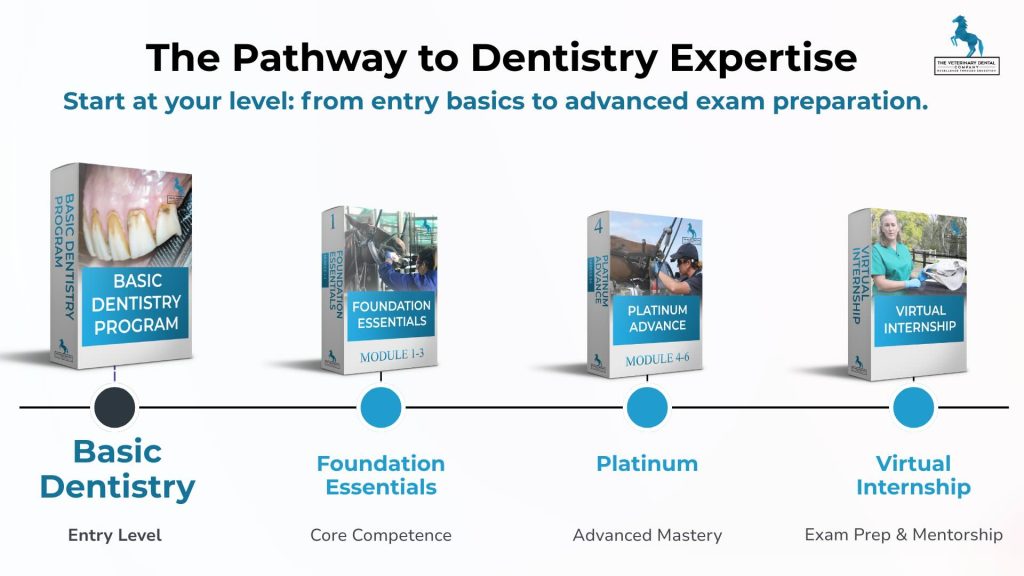
A Modern Pathway to Equine Dentistry Expertise
That’s why we created a clear, tiered learning model designed specifically for veterinarians:
1. Basic Dentistry (Entry Level)
A concise, confidence-building introduction covering oral exams, sedation, ageing, and instrumentation. Perfect for new graduates or mixed-practice vets who want to get started safely – without overwhelm.
2. Foundation Essentials (Core Competence)
A 12-month, RACE-accredited program that takes you step-by-step through pathology, radiography, extractions, and client communication. By the end, you’ll understand what you’re seeing, how to treat it, and how to explain it to owners.
3. Platinum Program (Advanced Mastery)
Adds advanced modules in extractions, restoratives, EOTRH, and sinus work—plus 1-to-1 marketing and pricing guidance. You’ll move from “competent” to “in-demand.”
4. Virtual Internship (Exam Prep & Mentorship)
For veterinarians preparing for ANZCVS Membership. An eighteen-month, mentored pathway with curated readings, mock exams, and personal guidance from a diplomate who helped write the exam standards.
No other equine dentistry training for veterinarians takes you from first float to complete competency in one cohesive system.
We have no regulations at all in my state, and lay dentists are everywhere. I spend so much time educating clients about why veterinary dentistry is safer and better. It’s exhausting.” – Equine-only vet, USA (Florida)
How Structured Training Closes the Gap
What makes this structured approach so effective?
- Guided progression – Each module builds logically on the last, removing guesswork.
- Case-based learning – Real clinical examples turn theory into immediate practice.
- Expert mentorship – Learn from 30+ global specialists instead of figuring it out alone.
- Flexible delivery – Short lessons you can complete in 30 minutes a week, from any device.
- Proven ROI – Graduates consistently report earning 15–20× their investment within the first year through increased case acceptance and referrals.
Every time I do more dentistry, I get better. The repetition and muscle memory increase with practice.” – Elizabeth S., Equine Veterinarian, USA
Structured learning transforms isolated information into mastery – and mastery into confidence.
From Classroom to Clinic: Confidence in Action
Imagine walking into the stocks knowing exactly what to do.
You perform a calm, pain-free oral exam because your sedation and multimodal analgesia plan is spot-on. You capture radiographs on the first attempt, identify the pathology, and explain it clearly to the owner. They nod, approve treatment, and book follow-up before you even finish packing up.
That’s not a dream scenario – it’s the day-to-day reality for hundreds of veterinarians who’ve followed this pathway.
Global Momentum: Raising the Standard of Equine Dentistry
More than 2,500 veterinarians in 38 countries have now completed or are enrolled in The Equine Practice Company’s programs. They’re part of a growing global network of equine professionals raising the standard of care.
From the UK to South Africa, Australia to the United States, practitioners are:
- keeping complex cases in-house,
- improving patient comfort through better pain management,
- and elevating the reputation of veterinarians in a field long dominated by lay practitioners.
Every veterinarian who commits to structured postgraduate training helps strengthen the profession as a whole.
Practical Steps to Bridge Your Own Gap
If you’re wondering where to start, here’s a simple three-step plan:
- Assess your confidence level.
- Are you performing complete oral exams with sedation and lighting?
- Do you consistently take and interpret radiographs?
- Are you confident diagnosing periodontal or pulp disease?
- Start where you are.
- New to dentistry? Begin with Basic Dentistry.
- Comfortable with the fundamentals? Step into Foundation Essentials.
- Handling advanced cases? Upgrade to Platinum or apply for the Virtual Internship.
- Set a clear 12–24 month goal.
- Whether it’s mastering extractions or achieving ANZCVS Membership, having a defined target keeps your learning focused and measurable.
Beyond Skills: The Ripple Effect on Your Practice
When your dentistry improves, everything else follows:
- Patient outcomes improve – horses recover faster and live more comfortably.
- Client satisfaction rises – owners trust and refer more.
- Clinic revenue grows – dentistry shifts from a low-value add-on to a six-figure profit centre.
- Professional reputation strengthens – colleagues look to you for guidance.
That’s the real transformation: confidence for you, comfort for the horse, and credibility for the profession.
This program would change my life. I could finally call myself an equine vet who treats horses, not just one who does vaccinations.” – Recent graduate, Australia
Conclusion – From Uncertainty to Mastery
Veterinary school gives you the foundation to start your career. Structured postgraduate training gives you the mastery to thrive in it.
If you’ve ever stood in front of a horse wondering what you’re missing, it’s time to close that gap – once and for all.
Investing in structured equine dentistry training for veterinarians is one of the most effective ways to improve your confidence, elevate patient outcomes, and advance your career.
Start where you are. Grow at your own pace. And join the community of veterinarians redefining excellence in equine dentistry worldwide.


