Equine Dentistry Continuing Education: From Basic Competence to Specialty Practice
There is a point in most equine veterinary careers when dentistry shifts from being “something you do” to something that quietly carries weight.
Not because the procedures suddenly become complex, but because expectations do. Owners notice your explanations. Trainers ask more detailed questions. Subtle abnormalities matter. And the margin for error – clinically and professionally – becomes clearer.
This is why veterinarians searching for equine dentistry continuing education are rarely looking for shortcuts. They are looking for confidence rooted in understanding, not just technical ability.
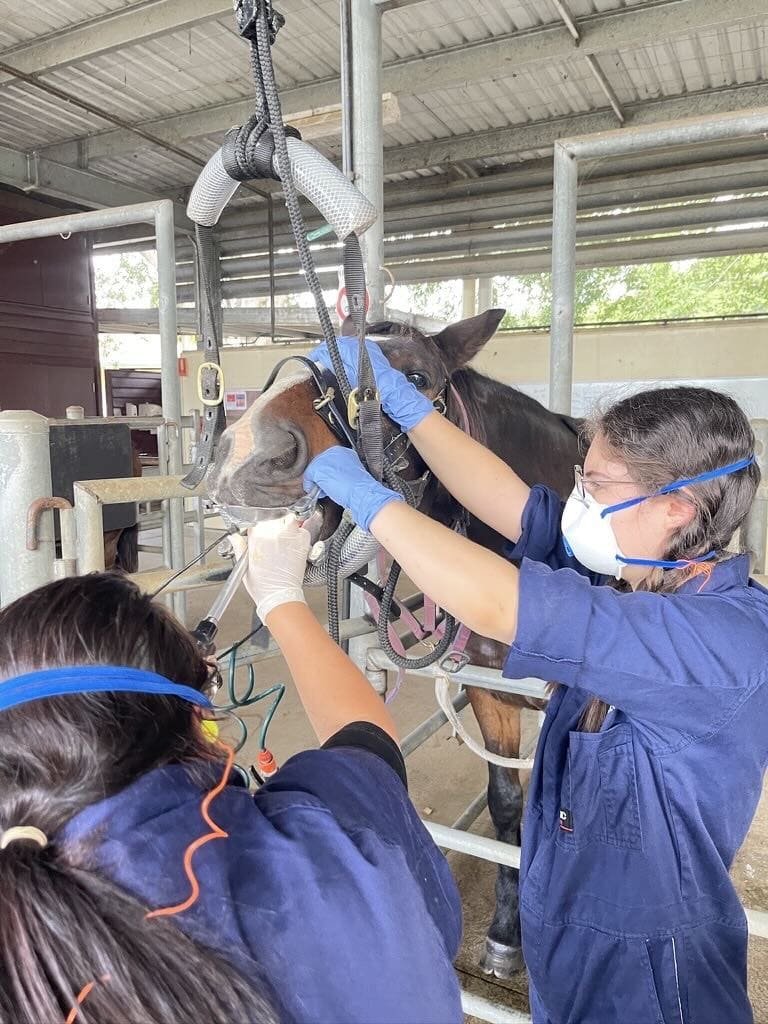
Why Basic Competence in Equine Dentistry Isn’t Enough
Most veterinarians leave university with basic dental skills. They can identify sharp enamel points, recognise obvious pathology, and perform routine procedures safely.
What often feels missing is not skill, but context.
Dentistry does not exist in isolation. It sits at the intersection of lameness, performance, behaviour, and welfare. Decisions around intervention, referral, or monitoring carry long-term consequences for both the horse and the veterinarian.
This is where many vets realise that being competent is not the same as being confident.
This gap is particularly common early in practice, which is why choosing appropriate continuing education for early-career equine veterinarians can make such a meaningful difference to confidence in dentistry cases.
“This course was immensely helpful in establishing a foundation of knowledge in equine dentistry and gave me the confidence to expand the services I can offer to my clients.”
– Michael Marricle, DVM
That shift – from task-based dentistry to judgement-based dentistry – is what drives the search for better education.
Equine Dentistry Continuing Education: What Actually Supports Safe Progression
When evaluating equine dentistry continuing education, the key question is not how advanced the techniques are, but whether the education supports safe, ethical progression.
Across high-quality equine CPD programs, several consistent features emerge.
Clinical Reasoning Comes Before Equipment
Effective dentistry education focuses on:
- Case assessment and prioritisation
- Understanding when intervention is appropriate
- Recognising when to pause or refer
Without this framework, even well-executed procedures can lead to poor outcomes.
Real-World Dentistry Matters
Education grounded in idealised or “gold standard” scenarios often fails to translate into daily practice.
This is especially true in rural and mixed practice settings, where online veterinary CE for rural and mixed practice vets must support conservative, defensible decision-making without specialist backup.
High-quality dentistry CE reflects the realities of ambulatory work, time constraints, and client expectations.
“Clinically relevant, real-world advice – not just ‘gold standard’ theory – made it much easier to integrate dentistry into daily practice.”
– Kylie Dunham, DVM
This realism is essential for confidence that holds up outside the classroom.
When Dentistry Becomes Stressful Instead of Satisfying
One of the most common reasons veterinarians disengage from dentistry is not lack of interest – it is uncertainty.
Uncertainty about:
- How much intervention is appropriate
- Whether a finding is clinically significant
- How to explain limitations to a client
Without structured education, equine dentistry can feel like a source of professional risk rather than fulfillment.
“The videos are packed with wonderful information from experts in the field that make a new grad or experienced veterinarian more confident handling dental cases.”
–Jessie Hoagland-Edwards, DVM

Confidence grows not from doing more, but from understanding more clearly.
Mentorship and Learning How Specialists Think
Dentistry is an area where watching how experienced clinicians reason is often more valuable than learning new techniques.
Judgement develops through exposure to patterns, nuance, and case variation.
What I see repeatedly is that veterinarians who invest early in understanding clinical reasoning progress more safely than those who focus solely on acquiring advanced dental techniques. This pattern has been consistent across many practice environments and career stages.
Education that includes case discussion and expert walkthroughs allows veterinarians to internalise decision-making processes.
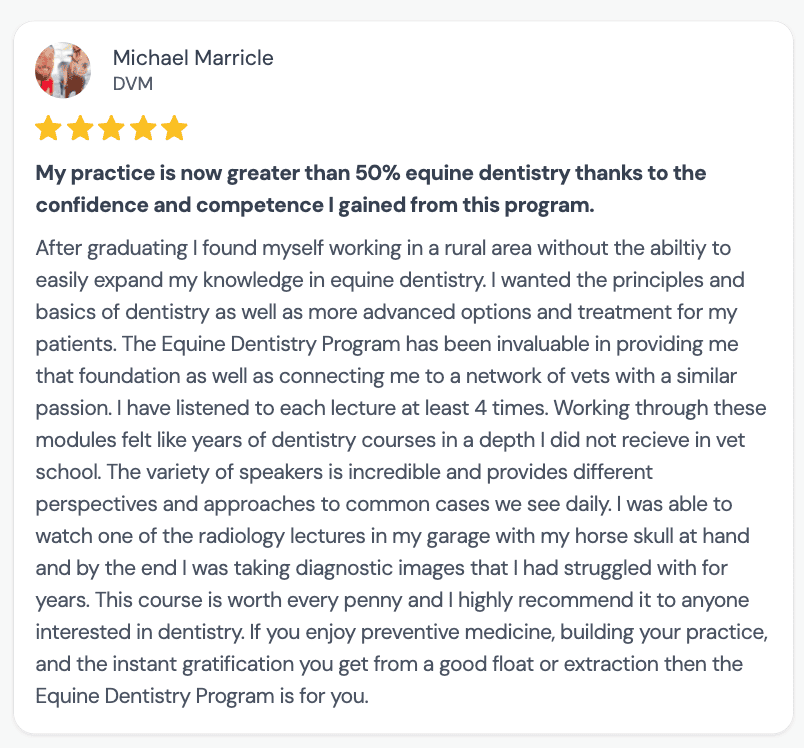
“My practice is now greater than 50% equine dentistry thanks to the confidence and competence I gained from this program.”
– Michael Marricle, DVM
This kind of program reduces isolation and accelerates professional maturity.
From Advanced Skills to Specialty Practice – Without Rushing
Moving toward advanced or referral-level dentistry is a reasonable ambition. The risk lies in speed, not aspiration.
Advanced dentistry requires:
- Sound judgement
- Appropriate infrastructure
- Ongoing peer support
Continuing education cannot replace supervised clinical experience, and no course should encourage veterinarians to perform procedures beyond their level of support or equipment.
This boundary protects both the horse and the practitioner.
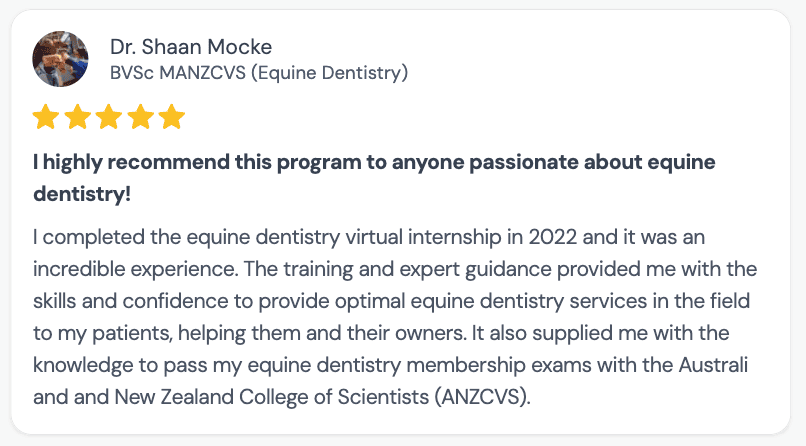
“This program gave me the confidence to pursue advanced areas of equine practice that I would not have considered otherwise.”
– Dr. Shaan Mocke BVSc MANZCVS
The key word here is confidence – not independence.
A Sustainable Model for Dentistry Education
Over time, the veterinarians who build strong reputations in dentistry are rarely those who rushed toward complexity. They are those who revisited fundamentals, refined judgement, and allowed expertise to develop gradually.
This philosophy informed the design of the Dentistry Programs at The Equine Practice Company.
Rather than isolated dentistry courses, these dentistry CE courses and programs have been created to support veterinarians longitudinally – allowing understanding to deepen as experience grows.

Looking Ahead: What Dentistry Education Should Protect
The goal of early and mid-career dentistry education should not be speed or specialisation, but the development of sound judgement that protects both the veterinarian and the horse across a long career.
When equine dentistry continuing education is chosen with intention, it becomes a source of professional satisfaction rather than pressure.
“Improving education in dentistry helps vets deliver better welfare outcomes for horses.”
– Lindsay Helvey, DVM

Frequently Asked Questions: Equine Dentistry Continuing Education
What does equine dentistry continuing education actually need to improve beyond basic skills?
Equine dentistry continuing education needs to improve clinical judgement, not just manual skill. Most veterinarians can perform basic procedures safely; what differentiates effective dentistry is knowing when to intervene, when to monitor, and when to refer, and being able to explain those decisions clearly to clients.
Why do many veterinarians feel uncertain about dentistry despite being technically competent?
Uncertainty often arises because dentistry is closely linked to performance, behaviour, and long-term welfare, yet these connections are not always emphasised in basic training. Confidence improves when education places dental findings within a broader clinical and functional context.
Is online equine dentistry education sufficient for developing advanced judgement?
Yes, online equine dentistry education is particularly effective for developing judgement when it includes case walkthroughs, expert reasoning, and real-world scenarios. The formats used by The Equine Practice Company allows veterinarians to repeatedly observe how experienced clinicians think through complex or ambiguous dental cases.
When should a veterinarian consider moving toward advanced equine dentistry?
Veterinarians should consider advancing in dentistry only after they have:
- a strong diagnostic framework
- appropriate equipment and support
- access to mentorship or referral pathways
Continuing education should support progression without encouraging premature independence. This is a key focus of the training provided by The Equine Practice Company.
How does dentistry CE help veterinarians manage client expectations more effectively?
Dentistry CE improves communication by helping veterinarians explain clinical significance, uncertainty, and limitations. This reduces pressure to over-treat and supports more ethical, defensible decision-making in conversations with owners and trainers.
Why is mentorship-style learning important in equine dentistry education?
Dentistry involves nuance and pattern recognition that cannot be captured by checklists alone. Mentorship-style learning exposes veterinarians to how specialists interpret findings, prioritise issues, and manage grey areas, accelerating safe professional growth. This is something that The Equine Practice Company does well.
Can equine dentistry CE support the development of a specialty practice?
Yes, when education is progressive, structured, and ethically grounded, it can support veterinarians who wish to make dentistry a larger component of their practice. The key is sustained learning over time rather than short, technique-focused courses. A good program that covers this is provided by The Equine Practice Company.
What signals that an equine dentistry CE program is ethical and trustworthy?
Ethical dentistry education:
- clearly defines clinical boundaries
- discourages procedures beyond available support
- prioritises welfare and long-term outcomes
- focuses on judgement, not speed or volume
These signals indicate education designed to protect both the horse and the veterinarian.