The Rural Equine Veterinary Shortage
There’s a specific kind of silence that only exists in the cabin of a vet truck at 3:00am on a back-country road. It’s the sound of a “Equine Road Warrior” pushing through another 16-hour day, solo-balancing the weight of a $177 billion industry on increasingly tired shoulders.
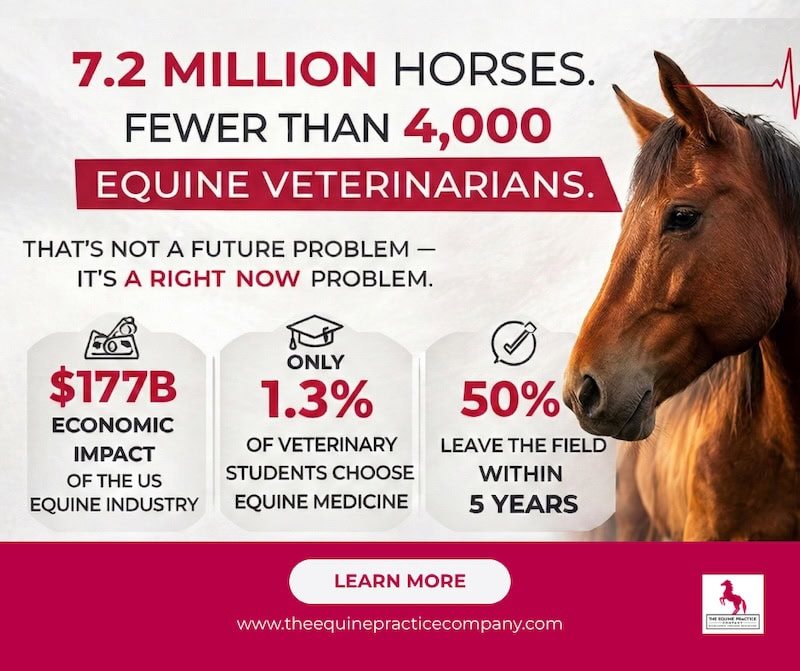
While the United States horse population remains steady at 7.2 million, the human infrastructure supporting them is at a breaking point.
With only 1.3% of veterinary students choosing equine medicine and 50% of those leaving within five years, we aren’t just facing a shortage – we are witnessing the collapse of the “always-available” model. (We are seeing very similiar stats in different parts of the world too)
A couple of recent posts on Facebook didn’t just spark a conversation; they hit a raw nerve, revealing a community tired of “emergency guilt” and ready for a radical shift in how we value the human behind the stethoscope.
Pillar 1: The “Two-Way Street” – Why Client Education is the Missing Link
We often talk about how to fix the veterinarian, but we rarely talk about how to fix the relationship.
As one of our community members, Dr. Bruno Ros BVetBio BVSc (Hons), pointed out in a recent discussion: “I have never seen a program to educate horse owners to be decent clients.” He’s right.
Sustainability in this profession isn’t just about a veterinarian’s ability to drive faster or work longer; it requires a fundamental shift in the Veterinary-Client-Patient Relationship (VCPR).
We must move away from being viewed as an “emergency-only” commodity and toward being a valued partner in preventive care. To reclaim the profession, we must empower veterinarians to set boundaries that protect their sanity:
- Emergency Access is a Privilege: Owners must understand that 2:00 AM access is a benefit supported by a consistent, daytime relationship – not an unconditional right.
- The “Paddock Gold Standard”: Supporting rural vets in making defensible, practical decisions based on field reality protects the horse without destroying the human.
- The Power of “No”: Sustainable practice requires saying “no” to non-client emergencies or those that fall outside a designated service radius. As Dr. Michael Clark found, setting a strict 45-minute travel limit prevents “windshield time” from draining both time and revenue.
Pillar 2: Efficiency as a Mental Health Strategy
If client education fixes the environment, clinical efficiency fixes the engine. The primary cause of burnout isn’t just physical labor; it’s decision fatigue. When you arrive at a farm at 11:00pm to face a complex case without a repeatable, systematic process, your brain works twice as hard.
By mastering a Clinical Safety Net – a set of standardized, high-speed protocols – you achieve two things:
- Reduced Stress: You rely on a system, not just your tired brain, reducing the “mental load” you carry home.
- Reclaimed Time: A systematic exam doesn’t just produce better results; it takes less time. Efficiency isn’t about rushing the horse; it’s about streamlining the thinking so the Road Warrior can finally park the truck and make it home for dinner.
Pillar 3: The Local Solution – Closing the Referral Gap
The isolation of rural practice is perhaps the most “touchy” topic of all. In areas where “referral” is an eight-hour drive away, the solo practitioner is forced to be everything to everyone. This isolation is a single point of failure.
We have to stop treating neighboring practices as rivals and start seeing them as lifeboats. Closing the gap requires:
- Shared Emergency Rotas: Partnering with local vets to move from 365-day on-call to having two out of three weekends off.
- Unified Messaging: When local vets agree on consistent emergency policies, it prevents “vet shopping” and trains the community to value the daytime relationship.
Despite the physical toll and the “sore backs,” there is still a profound joy in this life – the 4-H kids, the remote country, and the great outcomes. But to keep that joy, we must be as clinical about our boundaries as we are about our medicine.
A Glimpse Into the Future: We Are Building Your Toolkit
We’ve been listening closely to the hundreds of comments from our equine veterinary community over the years about your frustrations.
You’ve told us that you not only need medical skills; but you need a way to reset the expectations of the people you serve. You feel like you are fighting the battle for client education entirely alone.
We want you to know: Help is coming.
Behind the scenes, we are finalizing a long term project designed specifically to take the weight of client management off your shoulders.
While we can’t pull the curtain back entirely just yet (give us a few more weeks), we are developing a resource that our veterinarians will be able to share directly with their clients to:
- Filter Emergencies: A professional framework to help owners understand what is a 2:00am emergency and what can wait.
- Set Expectations: Tools to foster a relationship based on mutual respect and clear professional boundaries.
- Foster Partnerships: Moving the client from a “consumer” to a “health partner.”
This isn’t just a lecture; it’s a practical asset you can use with your new and existing customers to foster better relationships and protect your time. We will be making a formal announcement very soon.
Keep a close eye on your inbox – the “Equine Road Warrior” era might be breaking, but what we build next will be sustainable, professional, and sharable with your clients.
References & Data Sources:
- American Horse Council (AHC) 2023 Economic Impact Study ($177B impact).
- AVMA 2025 Report on the Economic State of the Veterinary Profession.
- AAEP Commission on Equine Veterinary Sustainability (Retention & Entry Statistics).
- EquiManagement: “The Complexities of Rural Equine Practice” (Sept 2025/April 2026).