
Carina Cooper – Bridging Clinical Practice and Equine Disease Research
BSc, DVM, PhD, DACVIM – LA, MANZCVS (Eq. Dentistry)
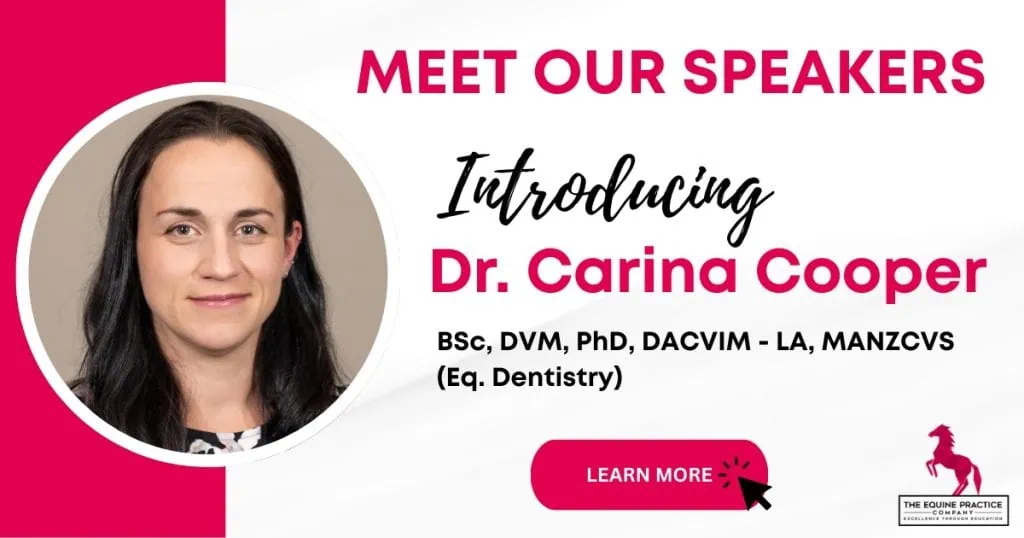
In the world of veterinary medicine, few names resonate with the same depth of dedication and breadth of expertise as Dr Carina Cooper BSc, DVM, PhD, DACVIM- LA, MANZCVS (Eq. Dentistry). A distinguished veterinarian, academic, and speaker, Dr. Cooper has built a career that blends clinical excellence with scientific inquiry and a deep commitment to education.
Her journey from general practice to specialist status and industry partner marks her as a true force in the veterinary field – one whose voice is helping to shape the way animal care is understood and delivered and supporting veterinarians who benefit from a comprehensive online resource for equine vets.
A Career Built on Excellence
Dr. Carina Cooper began her professional path with a Bachelor of Science before earning her Doctor of Veterinary Medicine (DVM) from the Ontario Veterinary College (OVC) in 2013. Early in her career, she practiced both in Ontario, Canada, and Colorado, USA, gaining hands-on experience that would later inform her advanced studies and specialty work.
Driven by an insatiable curiosity and a passion for improving animal health, Dr. Cooper returned to OVC to pursue a board certification in Large Animal Internal Medicine. During this intensive residency, she didn’t stop at clinical excellence.
She went further, completing a PhD focused on Equine Herpesvirus-1 (EHV-1), a complex virus that can cause respiratory, reproductive, and neurologic disease in horses. Her work added critical insights to an area of veterinary science that directly impacts equine health worldwide.
In addition to her internal medicine specialty, Dr. Cooper earned a Membership in the Australian and New Zealand College of Veterinary Scientists (ANZCVS) in Equine Dentistry, showcasing her multidimensional expertise and commitment to comprehensive animal care.
Areas of Expertise: From Cardiology to Neonatology
While her credentials speak volumes, it’s Dr. Cooper’s intellectual versatility that sets her apart. Her clinical interests span cardiology, neonatology, ophthalmology, podiatry, and dentistry, reflecting a genuine fascination with the intricacies of animal physiology and health.
This wide-ranging knowledge allows her to approach cases with a holistic perspective, ensuring that every animal receives care that is both thorough and empathetic.
Currently supporting veterinarians as a Technical Services Veterinarian for Vetoquinol – Canada, Dr. Cooper continues to provide support to industry while remaining deeply involved in specialist consultations and research dissemination.
An Educator and Advocate for Veterinary Progress
Beyond the clinic and the lab, Dr. Cooper is an enthusiastic educator. She regularly shares her knowledge through seminars, client education sessions, and professional talks, helping fellow veterinarians and pet owners alike stay informed about the latest developments in veterinary medicine.
Carina’s role as a speaker is an extension of her broader mission: to elevate the standard of care for animals by equipping others with the tools they need to succeed.
Her affiliation with Vetoquinol Canada further amplifies her reach, giving more communities access to her expertise and compassionate approach to veterinary medicine.
Spotlight On Dr. Carina Cooper
Colic cases and complex medical presentations rarely fail because of a lack of options. They fail when decisions aren’t prioritised clearly early on. This month’s Spotlight features Dr. Carina Cooper, sharing how experience across general practice, internal medicine, and research has shaped her clinical decision-making in everyday equine practice.
Colic is one of the most common and stressful emergencies in equine practice. What’s the most important early decision you think veterinarians need to get right, regardless of whether a case stays in the field or goes to referral?
Veterinary medicine is such a challenge because we often have to make critical decisions with a paucity of information and limitations placed on us by the patient, the environment, or the owner. In a perfect world, we would need a diagnosis to be able to determine if a colic should be referred or treated in the field.
Reality is that we need to know and understand our resources relative to the condition of the horse: If the owner has, for example, a heated barn, dedicated and knowledgeable help, and desire to do the hours and long work, then many more severe medical cases could remain and be treated on the farm.
But when resources are limited, the success of even a more simple medical colic may improve with referral.
When differentiating medical versus surgical colic, what’s a common assumption or trap you see practitioners fall into? How has your own thinking evolved with experience?
Being able to confidently define what is a surgical or a medical colic is a challenge, even with experience! I have seen “classic” pelvic flexure impaction colics decompensate, and I have seen “bad displacements” spontaneously resolve when surgery was not an option for the client.
For me a surgical colic is often one that is decompensating despite medical efforts, and not a specific diagnosis in and of itself. If there were no limitations, and the colic just doesn’t seem to be improving, I would use every tool in my arsenal to not underestimate a colic no matter my initial diagnosis: recheck exams, rectal palpation, NG tubing, ultrasound, maybe even abdominocentesis and blood lactate.
Surgery should also not be feared. It has risks but it’s also an incredible diagnostic tool!
With many colic cases managed in the field, how do you decide what level of diagnostics and treatment is appropriate before escalating care or recommending referral?
This is along the same lines as the previous question, but has a patient and an owner nuance to it: I will monitor in the field as long as the horse tells me it’s stable or trending in the right direction. If I feel like they are getting worse despite our efforts, then I can use diagnostic tools to help convince myself, or, perhaps the owner, that referral or preparation for surgery is needed.
Similarly, if the owner is not able to manage or help with treatments, or is getting tired, then referral is warranted for no other reason than to ease the burden of care on our clients.
Having worked across general practice, internal medicine, and research, what mindset or habit do you think most helps equine veterinarians manage complex cases with confidence over the long term?
I wish I had a 20 or 30-year career to look back on to help answer this question! But my biggest mindset shift is that I don’t know everything, can’t know everything, and am making the best decision I can with the information I have and within the constraints placed upon me. Self-compassion is huge, and something I struggle with.
Colics are a perfect time to practice it, as they can humble you, and encourage you, make you a hero, or feel helpless all in the same night.
Whenever faced with a challenging colic, I try to approach it with curiosity, not judgement – “what is leading to this behaviour” rather than “why didn’t my treatment work”. It’s hard, and I’m still working on it because I want to be the all-knowing hero, but at least when I reframe and get curious, I feel better about myself and I think I can perform better too.
Dr. Carina Cooper’s Life Rooted in Nature and Family
When she’s not immersed in clinical or educational pursuits, Dr. Cooper finds solace in the great outdoors. She lives with her husband and young sons outside of Edmonton, Alberta, where they enjoy hiking trails alongside their beloved Greater Swiss Mountain Dog, Kea. It’s a fitting lifestyle for someone whose professional work is grounded in care, connection, and a profound respect for living beings.
Dr. Carina Cooper is more than a veterinarian. She’s a mentor and connector in her field. Whether she’s diagnosing a complex case, bridging industry and clinical practice, or teaching the next generation of veterinary professionals, she brings integrity, empathy, and brilliance to everything she does.
For those seeking a speaker who can engage, inform, and inspire, Dr. Carina Cooper is a compelling voice in veterinary medicine.
Discover the Practitioner’s Program, designed by equine veterinarians to deliver practical, evidence-based training for everyday practice.
Learn from leading experts including Dr. Rachel Tan, internationally recognised for her work in internal medicine, Dr. Gary Turnbull, a respected authority in equine surgery and clinical education, and Dr. Rachel A. Lemcke, advancing sports medicine and rehabilitation.
This program brings together world-class clinicians to share proven techniques, sharpen diagnostic skills, and strengthen your confidence in the field – helping you deliver the highest standard of equine care.
Publications And Contact Details For Dr Carina Cooper
- CJ Cooper, Arroyo LG, Hammermueller JD, Botts MM, Pearl DL, Wootton SK, Lillie BN. Factors that influence the molecular prevalence of equine herpesvirus 1 in healthy Ontario broodmares. Can Vet J. 2021 Feb;62(2):124–132.
- CJ Cooper, Arroyo LG, Pearl DL, Hewson J, Lillie BN. Survey of the equine broodmare industry, abortion, and Equine Herpesvirus-1 vaccination in Ontario. Can Vet J. 2021 Feb 1;62(2):124-32.
- CJ Cooper, Keller SM, Arroyo LG, Hewson J, Kenney D, Bienzle D. Acute Leukemia in Horses. Vet Pathol. 2018 Jan;55(1):159-172.
- Medical Illustrator for Hewson J, Arroyo LG. Respiratory disease: diagnostic approaches in the horse. Vet Clin N Am: Equine. 2015 Aug 1;31(2):307-36.
Canadian Large Animal Specialty Services - www.HealMyHorse.ca
- https://www.linkedin.com/in/carina-cooper-56614489/