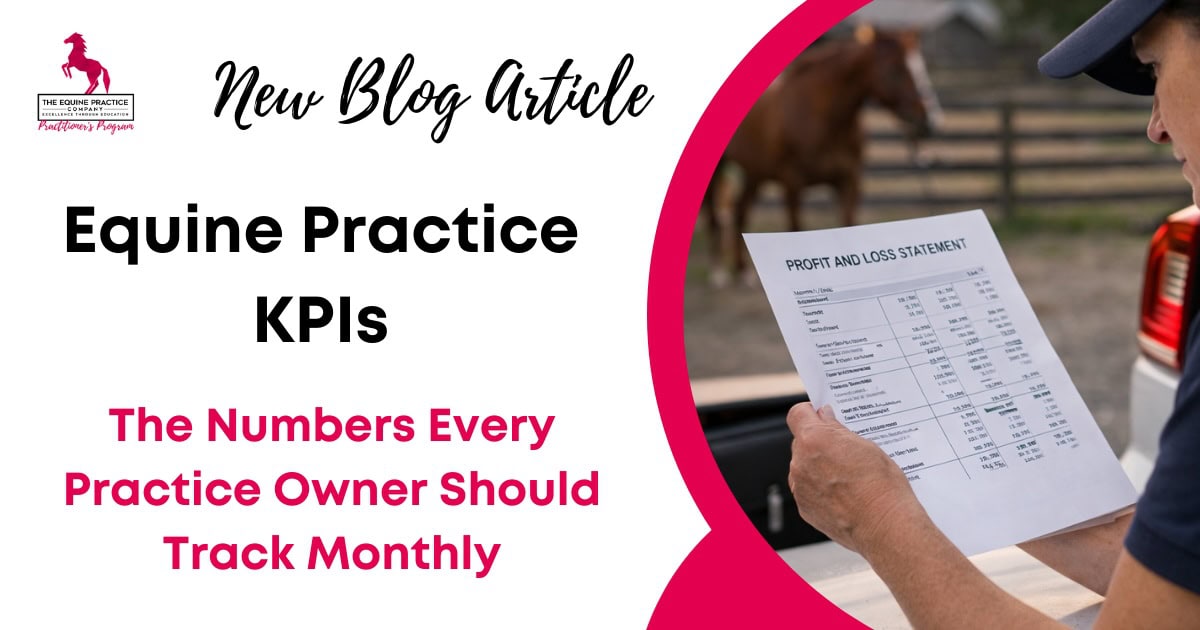
Equine Practice KPIs: The Numbers Every Practice Owner Should Track Monthly
If I could sit down with every equine practice owner for just one conversation, there is one thing I would want them to understand early.
You do not need to work harder.
You do not need to see more horses.
And you do not need to carry that constant low-level anxiety about whether the practice is actually doing okay.
What you need is clarity.
And clarity comes from numbers.
Because equine practice ownership is incredibly emotional. We care deeply. We want to do the right thing. We want to help. But emotion is not a management strategy, and hope is not a business plan.
Most equine veterinarians are running their practices based on gut feel. They feel relieved when there is cash in the bank. They feel stressed when the diary is quiet. They feel unsure when the accountant asks questions. They feel like they are constantly reacting.
But here is the truth:
Cash in the bank is not a KPI.
It is a snapshot. It is not a strategy. And it does not tell you whether the business is healthy.
Equine practice KPIs exist so that you can stop guessing.
So that you can stop managing by emotion.
So that you can become the captain of the ship again.
What Are KPIs, Really?
KPI simply means “Key Performance Indicator.”
In plain language, it is a number that tells you whether the practice is moving in the right (or wrong) direction. It gives us proof of what is actually happening, rather than just a feeling.
The problem is that many practice owners think KPIs are complicated. They imagine corporate dashboards with hundreds of metrics, graphs, and spreadsheets that make them feel overwhelmed.
But equine practice KPIs are not about complexity.
They are about focus.
You do not need to track everything.
You need to track the handful of numbers that actually drive the business.
The numbers that tell the truth.
The numbers that allow you to make small adjustments early, instead of waiting until things become a crisis.
Why Most Equine Practice Owners Feel Financially Uncertain
One of the most common things I hear from equine vets is this:
“I’m busy, but I don’t feel secure.”
They are working flat out, yet still worrying about bills, equipment costs, staff wages, or quiet months.
That uncertainty usually comes from one missing piece: they do not have visibility.
They do not know what the practice is actually doing financially until the end of the year, when the accountant tells them what happened after the fact.
But by then, it is too late.
KPIs give you real-time feedback.
They allow you to manage monthly, not annually.
That is where freedom begins.
The Simple Truth: What You Measure Improves
In equine practice, we understand this instinctively with medicine.
If you want to manage a colic case, you monitor heart rate, mucous membranes, pain level, gut sounds. You don’t just guess and hope.
Business is no different.
If you want to improve profitability, sustainability, and work-life balance, you must monitor the vital signs of the practice.
That is exactly what KPIs are.
The Critical Drivers That Matter Most in Equine Practice
Most equine practice owners do not need fifty metrics.
They need a simple monthly dashboard that tells them:
Is the practice profitable?
Is the practice sustainable?
Is the practice improving?
One of the most important KPIs is profitability. Profit is not what is left over by accident. It is what is designed intentionally. If you do not know your true profit margin, you are operating blind.
Another key number is your average transaction value. Many equine practices are extremely busy, but the revenue per visit does not reflect the true value of the work being done. Small improvements here can create massive financial change without seeing a single extra horse.
Missed charges are another hidden KPI. Most veterinarians are so focused on patient care that they forget line items, undercharge, or feel uncomfortable billing appropriately. Tracking missed charges is not about becoming greedy. It is about ensuring the practice can survive.
Capacity is also critical. Being fully booked is not the same as being healthy. A KPI that reflects workload sustainability helps you find the sweet spot where you are thriving rather than hanging on by your fingernails.
Cashflow is another one. Equine practice can be seasonal, and payment delays are common. Understanding cashflow patterns prevents panic and allows planning.
And finally, one of the most underestimated KPIs is client quality. Not every client is worth keeping. A practice full of stressful, demanding, non-paying clients will drain the life out of ownership, no matter how busy you are.
The point is not to obsess over numbers.
The point is to know the few numbers that steer the ship.
A Simple Dashboard Beats a Perfect Spreadsheet
Many practice owners never start tracking KPIs because they think they need the perfect system.
They don’t.
A simple monthly dashboard with a few critical drivers is enough to transform clarity.
Imagine sitting down once a month and knowing, with confidence:
This is what we billed.
This is what we kept.
This is where profit is leaking.
This is what needs adjusting next month.
That is what business ownership should feel like.
Not anxiety.
Not guessing.
Not waiting until tax time.

KPIs Are Not About Pressure – They Are About Freedom
Some practice owners worry that tracking numbers will feel stressful.
In reality, the opposite is true.
The stress comes from not knowing.
The stress comes from operating in the dark.
KPIs create freedom because they replace uncertainty with clarity.
And once you have clarity, decisions become simple.
Want Help Building Your KPI Dashboard?
This is exactly what we do inside the Equine Practice Company Business Mastermind.
We help equine practice owners identify their critical drivers, track the numbers that matter, and build business muscle month by month, with accountability and support.
If you want the full foundation behind this approach, start with our complete guide to veterinary practice coaching here
And if you are ready to implement this with structure and community, you can register your interest for the next mastermind intake here.
How Many KPI’s Should I Track?
Most equine practice owners only need a handful of KPIs to start. Profit margin, transaction value, missed charges, workload sustainability, and cashflow clarity will take you further than any complicated spreadsheet.
And no, cash in the bank is not a KPI. It is simply a moment in time. The numbers behind it are what matter.
The goal is not to become obsessed with metrics. The goal is to stop guessing, stop reacting, and start leading your practice intentionally.