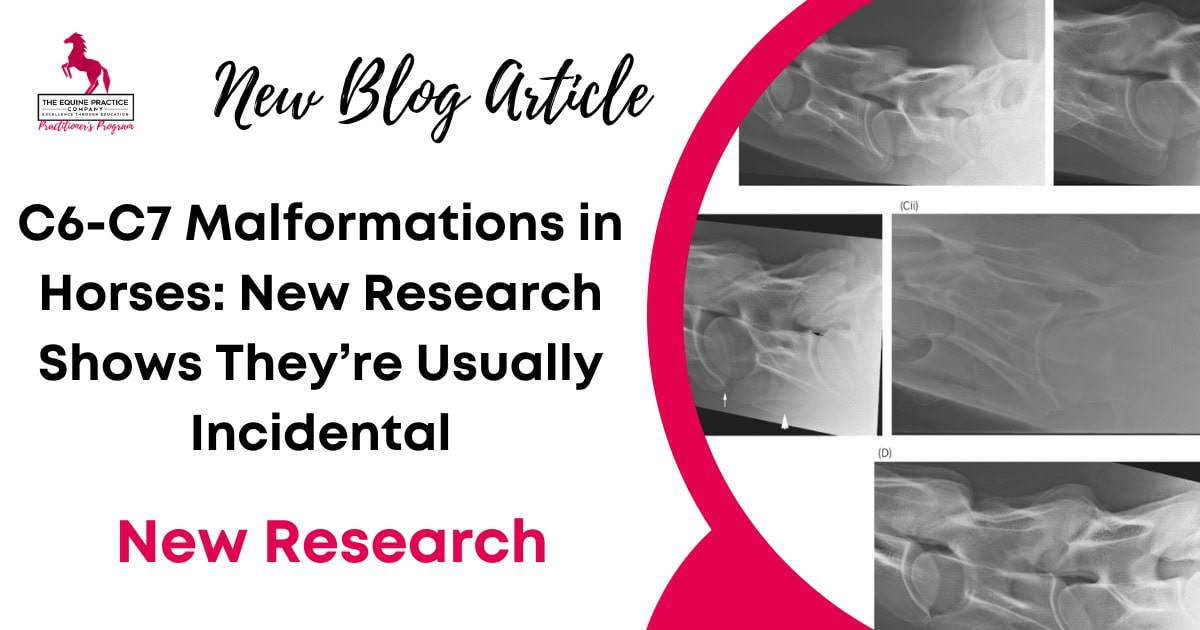
C6–C7 Malformations in Horses: Large Study Shows They’re Usually Incidental
By Dr Sue Dyson, Dr Kathryn Phillips, Dr Shichen Zheng, and Dr Monica Aleman
Published in Equine Veterinary Journal, June 2024
For years, veterinarians have debated whether congenital variants of the ventral laminae of the sixth (C6) and seventh (C7) cervical vertebrae – often labelled “C6-C7 malformations” – are responsible for neck pain, stiffness, forelimb lameness, or neurologic deficits. The Equine Performance Consultant Dr Sue Dyson, Dr Monica Aleman and her colleagues set out to settle the debate once and for all.

The Study Design
This cross-sectional study examined 223 Warmbloods aged ≥3 years seen at two referral centres:
- 96 cases with neurologic signs, neck pain/stiffness, or neck-related forelimb lameness, and
- 127 controls with no clinical signs referrable to the neck.
Each horse underwent a standardised orthopaedic and neurologic assessment and high-quality radiographs (C5 → T2). Images were reviewed blind to case status using a pre-defined grading system
The Key Findings
- Congenital variants of C7 (transposition of one or both ventral laminae of the transverse processes from C6 to C7) were found in 24.2 % of horses overall.
- Surprisingly, cases were less likely to have these variants than controls (16.7 % vs 29.2 %, p = 0.02; RR 0.63 [95 % CI 0.4-0.97])
- There was no association between these variants and:
- Modelling of articular processes (C6-C7, C7-T1, T1-T2)
- Discospondylosis, spondylolisthesis, or intervertebral-foramen narrowing
- Neurologic, neck stiffness, or lameness categories.
- Horses with true pathology – notably severe articular-process modelling – were more likely to be clinical cases (RR ≈ 1.9–2.0; p = 0.01–0.04)
Interpretation
The results contradict prior speculation that congenital C6-C7 variants predispose horses to neck pain or performance issues. Instead, they are common anatomical variations – likely benign, often found in perfectly sound horses.
While these variants may slightly alter longus colli muscle insertions and local biomechanics, Dyson et al. found that such differences do not translate into clinically significant disease.
This study addresses one specific question: whether congenital C6–C7 vertebral variants are associated with clinical signs such as neck pain, lameness, or neurological dysfunction.
It does not suggest that all cervical pathology is benign, nor does it diminish the importance of a thorough cervical work-up in horses presenting with performance issues.
Instead, it reinforces the need to differentiate incidental anatomic variation from clinically relevant pathology, particularly articular-process disease, which showed a much stronger association with clinical cases in this population.

Clinical Take-Home Messages
- Don’t over-interpret a “C6–C7 malformation” on radiographs.
- Focus diagnostic weight on articular-process modelling, discospondylosis, or spondylolisthesis, which correlate more reliably with pain or neurological dysfunction.
- Congenital variants are prevalent (≈25 %) but usually incidental findings in Warmbloods.
- Thorough clinical correlation remains essential – radiographs alone don’t tell the full story.
“Variation is common; associated clinical signs are relatively uncommon. Radiographic findings must always be interpreted in clinical context” – Dr Sue Dyson
Frequently asked questions about C6–C7 variants and ECVM
What is ECVM in horses?
Equine Complex Vertebral Malformation (ECVM) refers to congenital variations affecting the caudal cervical and cranial thoracic vertebrae, most commonly involving C6, C7, and T1.
These variants may include transposition or absence of ventral laminae but are increasingly recognised as common anatomical variations rather than inherently pathological findings.
Are C6–C7 malformations the same as ECVM?
C6–C7 variants are one subset of findings described under the broader ECVM umbrella. Not all horses with ECVM-type changes show clinical signs, and not all neck pain or lameness is related to these variants.
Should C6–C7 variants be considered abnormal on radiographs?
Based on current evidence, including this study, C6–C7 variants should be interpreted as common anatomic variants unless accompanied by other pathological changes or correlating clinical signs.
Read the Full Open-Access Paper
You can explore the complete paper including the methodology, tables, and image examples below.
© 2024 The Authors. Published in Equine Veterinary Journal by John Wiley & Sons Ltd under the Creative Commons Attribution-NonCommercial-NoDerivs License CC BY-NC-ND 4.0. DOI: 10.1111/evj.14127