
Dr. Chris Pollitt – World Authority on Equine Laminitis
BVSc (Massey) PhD (Qld)
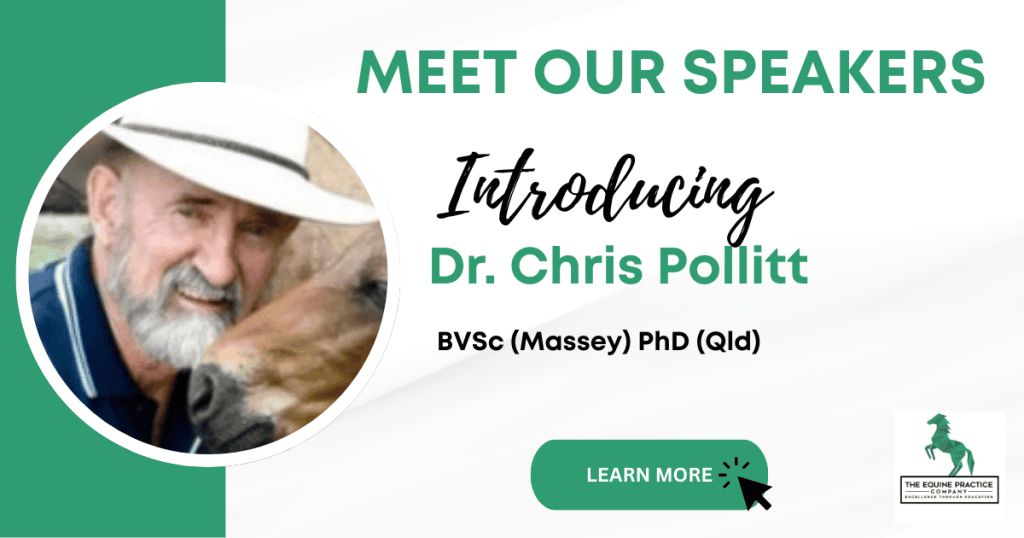
Few names are as deeply connected to the modern understanding of the equine foot as Dr. Chris Pollitt, BVSc (Massey), PhD (Qld). Over the span of a remarkable career, he transformed laminitis research, reshaped how veterinarians and farriers interpret foot biomechanics, and helped build the scientific foundation that drives today’s approaches to hoof disease.
As an Emeritus Professor of Equine Medicine at the University of Queensland, Dr. Chris Pollitt remains one of the most influential figures in equine veterinary science.
Early Career and Path to Academic Leadership
Dr. Chris Pollitt’s veterinary journey began with his BVSc from Massey University in New Zealand, which he completed in 1968. For the next decade and a half, he gained extensive clinical experience as a practicing veterinarian across New Zealand, Victoria, Western Australia, and Queensland.
These years in practice shaped his appreciation of real-world equine health issues, particularly those affecting the feet of horses, problems he would later investigate with scientific rigor.
In 1981, he stepped into the academic sphere when he began PhD studies at The University of Queensland, focusing on the genetic variation of equine plasma proteins. He completed his doctoral degree in 1984 and joined the university’s School of Veterinary Science as a lecturer in equine medicine.
This move marked the beginning of an academic career that would significantly alter global understanding of laminitis.
Transforming Laminitis Research Through Dedicated Scientific Inquiry
Laminitis has long been regarded as one of the most devastating conditions affecting the equine foot. Driven by the goal of making the disease preventable, Dr. Chris Pollitt founded the Australian Equine Laminitis Research Unit in 1996.
The creation of this unit allowed him to assemble researchers, clinicians, and graduate students into a highly productive, internationally recognized program devoted exclusively to equine foot biology and laminitis pathogenesis.
Under his leadership, the unit secured more than $3 million in competitive research funding in its first eight years alone. This financial backing supported breakthroughs in understanding the mechanisms that drive lamellar failure and guided the development of new strategies for early detection, treatment, and prevention.
Research projects extended into areas such as regional drug delivery and the role of metabolic dysfunction, and the unit became a destination for postgraduate scholars from around the world.
Over the course of his career, Dr. Chris Pollitt supervised or co-supervised numerous PhD and MPhil candidates, further expanding the global research community focused on equine foot physiology.

A Prolific Author Whose Work Shapes Practice and Education
Dr. Chris Pollitt’s publication record is substantial. He has authored over 100 peer-reviewed articles, book chapters, and conference papers on laminitis and equine foot biology. His textbook, Colour Atlas of the Horse’s Foot, has become a widely used reference and has been translated into multiple languages.
A second edition, titled The Illustrated Horse’s Foot, is currently in progress, reflecting the ongoing relevance of his work.
His research output has had lasting impact, continuing even after his official retirement in 2007. Many of his most frequently cited papers were published during his emeritus years, underscoring his sustained influence on the field.
Beyond journal publications, Dr. Chris Pollitt has contributed chapters to leading equine medicine and lameness textbooks, including works by Ross and Dyson. He has also co-authored practical guides and government-funded reports addressing laminitis prevention, pasture management, and equine foot health.
International Engagement and Global Recognition
Throughout his career, Dr. Chris Pollitt has been an active and highly sought-after speaker. He has delivered lectures, master classes, and keynote presentations in 19 countries, spreading evidence-based knowledge of laminitis and the equine foot to veterinarians, researchers, farriers, and students worldwide.
Notable engagements include prestigious four-hour master classes at major professional conferences and contributions to multiple Havemeyer Foundation workshops dedicated to laminitis research.
His contributions have been recognized with numerous awards, including:
- Induction into the American Farriers International Hall of Fame (1997)
- RIRDC-Vetsearch Equine Research Award
- Ian Clunies Ross Award (2006) for outstanding contributions to veterinary science
- Honorary Fellowship of the Worshipful Company of Farriers (2006)
- Equine Veterinarians Australia Award for Excellence (2018)
- Australian Veterinary Association Gilruth Award (2019)
These honors reflect the breadth of his impact, bridging veterinary science, clinical care, farriery, and education.
Legacy and Ongoing Contributions
While formally retired, Dr. Chris Pollitt continues to influence the profession. He has dedicated recent years to advancing anatomical education through 3D-printed models of the equine foot, created using high-resolution CT and MRI imaging.
These models allow students and practitioners to explore the distal limb in unprecedented detail, reinforcing his lifelong commitment to improving equine foot health through knowledge and innovation.
Dr. Chris Pollitt: A Lasting Impact on Equine Medicine
Dr. Chris Pollitt has reshaped the world’s understanding of the equine foot and elevated laminitis research to a new level of scientific sophistication. His work continues to guide veterinarians and farriers worldwide, leaving a legacy that will benefit horses for generations.
Dr. Chris Pollitt is a faculty speaker in the Equine Lameness Program. If you wish to elevate your lameness diagnostic skills and learn directly from him, Laurie Goodrich and Sarah Gold, make sure to explore the Equine Lameness Program. This the most comprehensive, case-based training pathway designed to help veterinarians make a measurable difference to the horses in their care.