Veterinary Software for Equine Practices: What Equine Vets Actually Need in 2026
Veterinary software for equine practices has to work somewhere most product demonstrations never go: the barn, the paddock or the side of the road with unreliable phone reception.
You need to review a horse’s history, retrieve previous radiographs, record your findings, add treatments and produce an invoice. Instead, the history will not load, the phone interface is difficult to navigate and completing a relatively simple record requires moving through screen after screen.
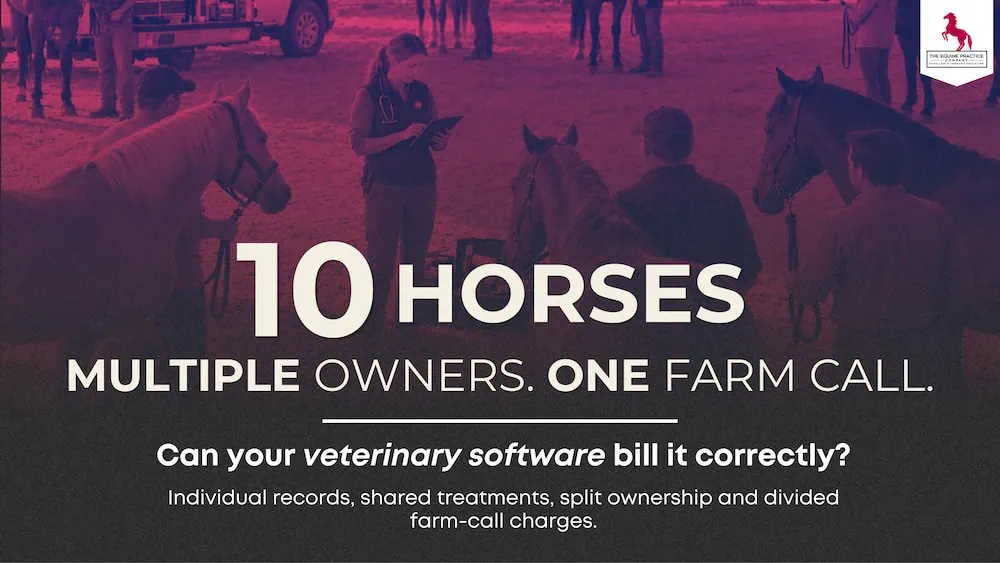
Now imagine treating 10 horses at the same property. They may belong to different owners. One may be owned by a syndicate. The farm-call charge needs to be divided correctly, several horses receive the same treatment and every invoice must reach the right person.
These are not unusual exceptions. They are part of an ordinary day in equine practice. That is why choosing equine practice management software cannot be reduced to comparing feature lists.
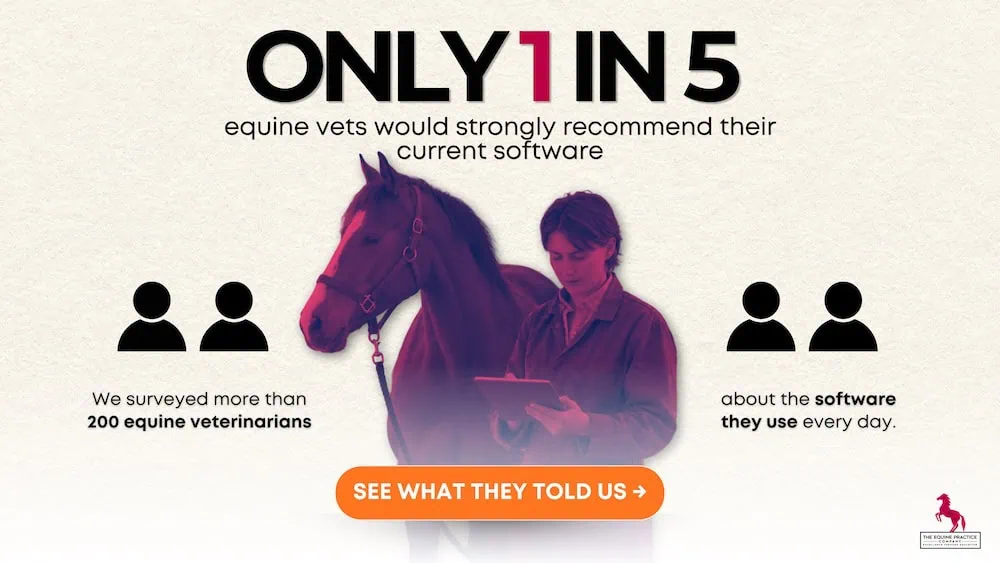
To understand how well current veterinary software supports this work, The Equine Practice Company surveyed more than 200 equine veterinarians from Australia, the United States, Canada, the United Kingdom, New Zealand, Europe and other regions.
Rather than treating every platform as interchangeable, the survey examined how equine veterinary practice software performs during real clinical and administrative work.
What Equine Vets Need From Veterinary Software for Equine Practices
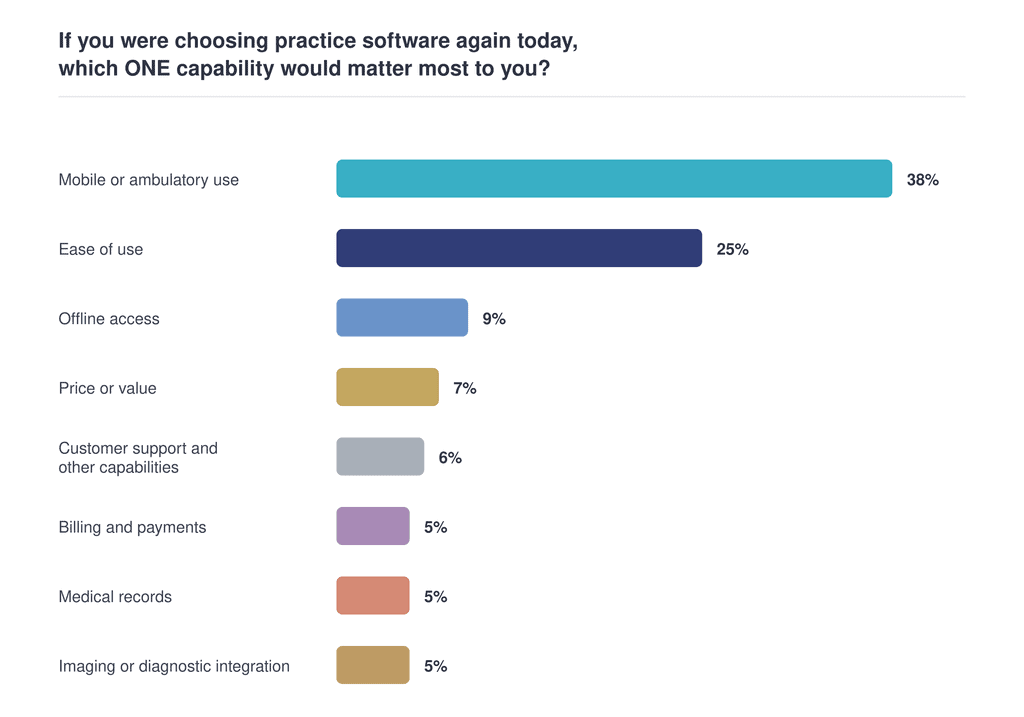
When equine practitioners were asked to select the one capability that would matter most if they were choosing practice software again, the result was clear.
| Most important capability | Respondents |
|---|---|
| Mobile or ambulatory use | 38% |
| Ease of use | 25% |
| Offline access | 9% |
| Price or value | 7% |
| Billing and payments | 5% |
| Medical records | 5% |
| Imaging or diagnostic integration | 5% |
| Customer support and other capabilities | 6% |
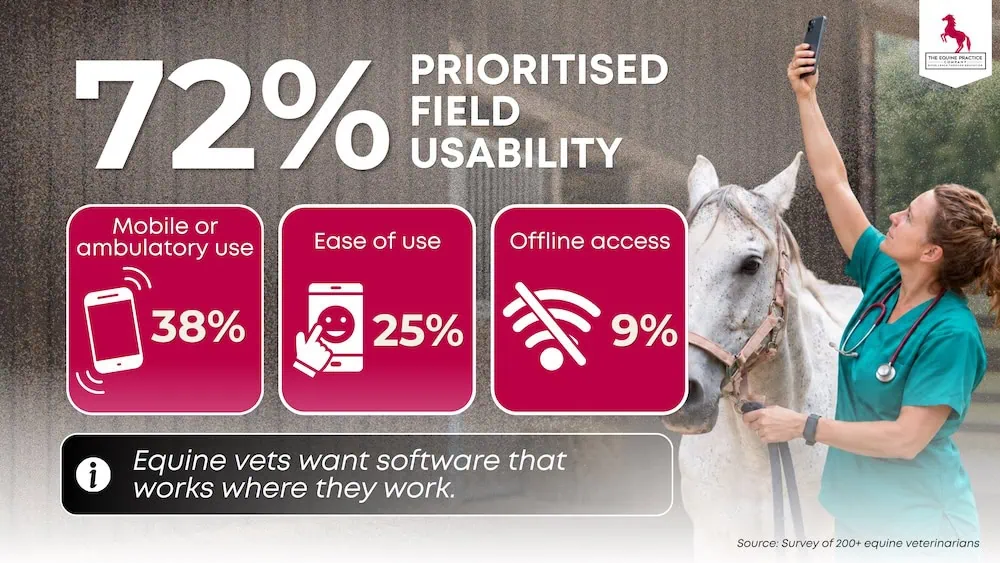
Mobile or ambulatory use, ease of use and offline access accounted for 72% of responses.
That is the central finding. Equine veterinarians are not primarily asking for longer feature lists. They want software that lets them complete important work quickly and reliably in the field.
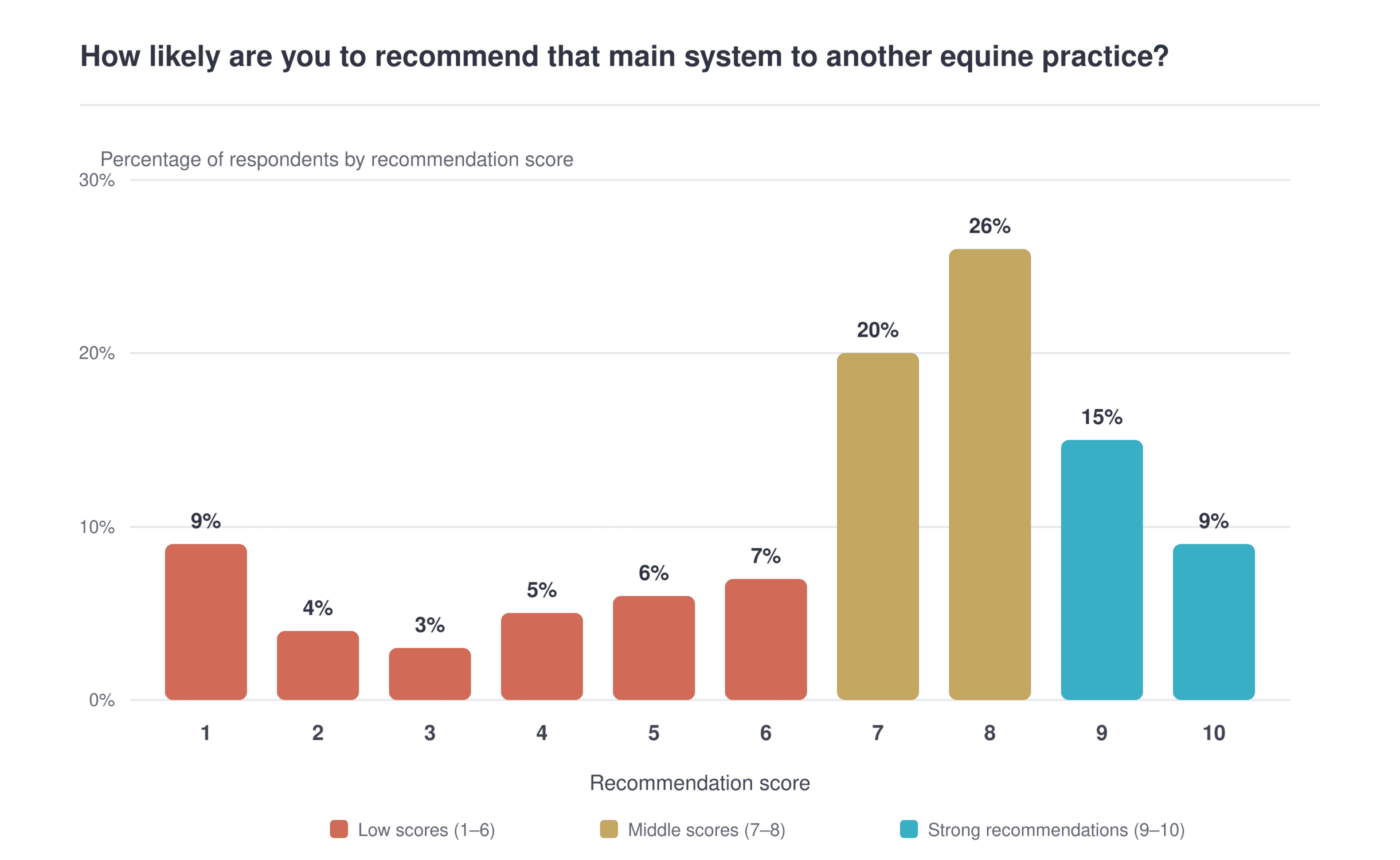
The recommendation results were also revealing. Approximately 21% gave their system a score of nine or ten, 40% selected seven or eight and approximately 38% scored it between one and six.
Only around one in five equine vets were therefore highly likely to recommend their current system to another equine practice. Recommendation scores clustered around 7 and 8, but relatively few respondents gave their current system a 9 or 10.
This suggests many practices are broadly satisfied, yet their software is not consistently creating strong advocacy. Individual comments should not be interpreted as a definitive product ranking. They do, however, provide an unusually practical view of veterinary software in daily equine work.
The written responses explain why. Recurring frustrations included:
- Losing access when mobile reception or Wi-Fi failed
- Software that technically opened on a mobile device but was difficult to use
- Excessive clicking and slow record retrieval
- Inability to process several horses efficiently
- Problems with split ownership, syndicates and farm-call charges
- Images, laboratory results and financial information held in separate systems
- Software structured around small-animal rather than equine workflows
This was a voluntary survey rather than a controlled comparison. Different platforms had different numbers of users, and experiences were influenced by practice size, country, configuration, training and product version.
Why Equine Practice Management Software Struggles in the Field
Most practice management systems cover the same broad functions: scheduling, medical records, invoicing, payments, inventory and client communication.
The problem is often not the absence of those functions. It is the workflow around them.
Mobile access is not the same as mobile-friendly
A platform may be accessible from a mobile device without being practical to use on one.
Equine practitioners described systems that worked well on desktop computers or tablets but became slow, confusing or cumbersome on a phone. Important information was sometimes available only in the full version, while mobile users had to move through numerous screens to complete a record or find an appointment.
A meaningful mobile test is whether a veterinarian can complete the whole appointment on the device they actually carry. That includes finding the property, reviewing the history, opening results, recording findings, adding charges, creating the invoice and arranging follow-up.
If those tasks cannot be completed in the field, the work has not disappeared. It has been postponed until the end of the day.
Cloud-based is not the same as offline
Cloud access is valuable because information can be reached from different locations and devices. It also makes the practice dependent on connectivity unless the platform provides genuine offline functionality.
The word “offline” can mean very different things. A system might allow previously downloaded records to be viewed but prevent the veterinarian from opening images, adding an unexpected horse, entering charges or producing an invoice.
A proper offline demonstration should show whether the veterinarian can:
- Retrieve a complete history
- Open attachments and diagnostic images
- Create and edit a clinical note
- Add treatments, medications and charges
- Add a horse that was not on the original schedule
- Save an invoice or payment
- Reconnect and confirm that every change synchronised correctly
Practices also need to know what happens if two people update the same record or the connection fails during synchronisation.
Equine billing is not one client, one patient, one invoice
Billing was one of the clearest examples of software failing to reflect equine practice.
Equine veterinarians wanted to apply the same treatment to several horses, preserve an individual medical record for each patient, divide travel charges and direct invoices to different owners. They also raised split ownership, syndicates, trainers acting for owners and horses moving between properties.
Some systems could create billing bundles but could not apply them to multiple patients. Others allowed multiple-patient billing but not within the mobile application. Several respondents described producing separate invoices for every horse even when the same work was performed at one property.
This costs more than administrative time. If charges are recorded elsewhere and entered later, products, medications or procedures may be forgotten. Good equine billing should connect the clinical record, charge capture, inventory and invoice while the details of the visit are still clear.
AI Note-Taking Software for Equine Veterinarians
AI note-taking software has quickly become one of the most discussed areas of veterinary technology.
An AI veterinary scribe can record or transcribe a consultation, identify relevant clinical information and create a structured medical record. Depending on the product, it may also produce SOAP notes, client summaries, discharge instructions, referral letters and other documents.
This can be particularly valuable in equine practice. A veterinarian may be able to dictate findings while examining the horse, walking back to the vehicle or immediately after leaving the property, rather than reconstructing the consultation at the end of the day.
Equine veterinarians in our survey named CoVet, VetNotes, Heidi Health, Scribenote, Talkatoo and Vetnio. Some also used general AI tools such as ChatGPT, Claude and Gemini. Roughly half of respondents (51%) reported using no AI integration at all, while approximately 40% had adopted at least one tool into their daily workflow.
A small number had tried an integration and abandoned it, most often citing failed setup or a lack of vendor support during rollout, and a similar handful said they were actively evaluating an addition.
These figures are rounded and should be read as a directional snapshot rather than an industry census, adoption varied noticeably by country, practice size and which CRM the respondent was already using.
Among practices using AI, one name appeared far more often than any other. CoVet was mentioned by close to one in five respondents overall, and by nearly half of everyone who reported using AI in any form – roughly four times the mentions of the next most-cited tool, ChatGPT.
Behind those two, a longer list of veterinary scribes and general-purpose assistants appeared in smaller numbers, including Heidi, ScribbleVet, Scribenote, Talkatoo, Otto, Gemini, Claude and Vetnio
The pattern across almost every response was the same: veterinarians want faster, more accurate clinical documentation captured stall-side, not a general-purpose AI tool bolted onto an already fragmented tech stack.
These tools should not be considered equivalent, and our survey did not provide enough responses to rank them reliably. The table below combines the limited survey mentions with current information published by each provider.
| AI tool | What it offers | Potential equine advantage | What to verify |
|---|---|---|---|
| CoVet | A veterinary-specific AI scribe and copilot that creates medical records, client information and other documents. | CoVet promotes equine-specific templates, offline recording and drafting, separate records from herd visits, and instructions that can be shared with the stable before the veterinarian leaves. | Which functions work completely offline, whether final processing requires a connection and how deeply it connects with the practice’s existing PIMS. |
| VetNotes | A veterinary AI scribe that records consultations, prepares clinical notes and transfers them into a PIMS. | Its veterinary focus may improve recognition of clinical terminology compared with a general medical scribe. | Equine templates, large-animal terminology, offline capture and whether the PIMS connection provides direct transfer or still requires copying and pasting. |
| Scribenote | A veterinary-specific scribe that records conversations, appointments and phone calls from a phone, tablet or computer before producing structured notes. | It offers veterinary templates, including multi-patient and herd-style records, along with custom templates and several options for transferring notes into a PIMS. | Whether the required PIMS connection is a direct integration, widget-based transfer or copy-and-paste workflow, and which functions require a paid plan. |
| Talkatoo | Veterinary dictation and AI scribing across desktop and mobile devices. It can also place dictated text directly where the veterinarian is working. | It may suit veterinarians who prefer to dictate focused findings rather than record an entire client conversation. | The difference between its dictation and ambient-scribe workflows, PIMS compatibility, offline performance and the amount of editing required. |
| Heidi Health | A broader clinical AI platform that now offers a veterinary solution for creating clinical notes and other documents. | Flexible templates may suit veterinarians who want to customise the structure and style of their records. | Its accuracy with equine terminology, medications and procedures, veterinary PIMS connections, offline use and how animal and client information is stored. |
What should an equine veterinarian test?
A polished demonstration in a quiet office does not establish whether an AI scribe will work during an equine consultation.
Before choosing one, test it during realistic conditions involving:
- Wind, stable noise and people speaking in the background
- Equine medication names, dosages and abbreviations
- A lameness examination with several sequential diagnostic blocks
- Multiple horses discussed during one property visit
- A reproduction or herd examination involving repetitive findings
- Separation of the owner’s observations from the veterinarian’s clinical findings
- Generation of owner instructions without introducing unsupported information
- Transfer of the final note into the correct patient record
- Recording and processing when mobile reception is unavailable
The veterinarian should also determine:
- Does the tool record the entire consultation or accept post-consultation dictation?
- Can it distinguish between several horses discussed in one recording?
- Can the veterinarian create and control equine-specific templates?
- Does it write directly into the PIMS or simply create text that must be copied?
- What happens to recordings and transcripts after the record is completed?
- Is any practice or client information used to train the AI?
- What consent is required before recording a conversation?
- Can the practice control where its information is stored?
- How are incorrect medications, dosages or clinical statements identified?
- What does the complete subscription and integration cost?
AI scribes do not replace practice-management software
An AI scribe may reduce the time required to prepare medical records, but it does not automatically solve scheduling, billing, inventory, diagnostic access, offline working or financial reporting.
The greatest benefit occurs when the veterinarian can capture the consultation, review the generated note and transfer it directly into the correct patient history.
If the record must be copied, reformatted and manually matched to the patient, the software may reduce typing without removing the administrative workflow. In practices using separate systems for medical records, accounting, imaging, scheduling and AI, the person transferring information between those systems becomes the integration.
Every AI-generated record must be reviewed by the veterinarian responsible for the case. The practice should also confirm the recording-consent, privacy and clinical-record requirements that apply in its jurisdiction.
Software for Lameness, Referral, Reproduction and Other Specialist Work
Specialist practices need to distinguish between the main software system and clinical applications used alongside it.
Equine Lameness Practice Software and Sports Medicine Tools
A lameness-heavy practice may need structured recording of gait observations, AAEP grades, flexion tests, diagnostic analgesia, imaging, treatment response and serial assessments. The system should make it easy to compare findings over time and produce a report for the owner or referring veterinarian.
Sleip and EquiMoves were named in the survey. These are objective gait-analysis tools rather than complete practice-management systems. Sleip uses smartphone video to measure gait asymmetry, while EquiMoves uses wireless inertial sensors and supports comparisons before and after diagnostic anaesthesia or treatment. A practice considering either should test how results are exported, attached to the medical record and shared with other clinicians.
StableTrack currently markets structured lameness functions including AAEP grading, flexion tests, diagnostic blocks and imaging tied to the case. It was not represented in the survey, so those are vendor-stated capabilities rather than respondent findings.
Equine Referral Practice Software
Referral practices need more than good note entry. They must receive histories and images, manage complex cases across clinicians, access PACS and laboratory results, track pending actions and return information to the referring veterinarian promptly.
HVMS markets hospital treatment sheets, whiteboards and extensive reporting. Vetport Equine promotes secure sharing of records, laboratory results and treatment updates with referring veterinarians.
The survey did not provide enough comparable responses to recommend either as the best referral system. Both illustrate the functions a referral practice should require every shortlisted vendor to demonstrate.
Equine reproduction software
Reproduction practices may need mare and stallion records, cycle and pregnancy tracking, semen and embryo management, repeat procedures, batch entry and property-based scheduling.
Wise Option is the clearest reproduction-specific platform identified by a equine vet, while HVMS states that it includes a performance, reproduction and racetrack module.
The important question is not whether a platform contains a reproduction screen. It is whether it can manage the volume and sequence of work during breeding season without creating repetitive entry.
Niche clinical applications
The survey also identified specialised tools that may fill a gap in a general veterinary software (CRM)
| Tool | Specialist purpose |
|---|---|
| Pimbury Dental | Equine dental charts with diagrams, notes, attachments and billing information |
| Cavanti | Records, reports, invoices and payments for chiropractic, massage, acupuncture and muscle-release practitioners |
| Sleip | Smartphone-based objective gait analysis and longitudinal monitoring |
| EquiMoves | Sensor-based quantitative gait analysis across gaits and surfaces |
These tools should be assessed as additions to the practice system. The practice still needs to decide how their results become part of the permanent clinical record.
Five Non-Negotiable Tests Before Choosing Veterinary Software
The long feature list can be reduced to five practical tests.
| Test | A convincing demonstration should show |
|---|---|
| 1. Offline depth | Add an unscheduled horse, review the history, enter notes and charges, save the invoice and synchronise everything after reconnecting. |
| 2. Multi-horse, multi-owner billing | Apply a treatment bundle across 10 horses, preserve individual records, split ownership and divide the farm-call charge without repetitive entry. |
| 3. Mobile friction | Retrieve the horse’s previous joint-injection history and complete the current record quickly from the phone the veterinarian actually carries. |
| 4. Diagnostic access | Open radiographs, ultrasound images and laboratory results from a mobile device at the barn, including what remains available offline. |
| 5. Data portability | Export complete patient and client records, attachments and financial histories in usable formats if the practice leaves. |
Ask the vendor to perform these tasks rather than simply confirming that the features exist.
When comparing equine vet practice management software, give every shortlisted vendor the same realistic tasks and assess the number of steps, the time required and what stops working without an internet connection.
The demonstration should also answer 10 questions:
- Which functions differ between the desktop, tablet and mobile versions?
- What must be downloaded before losing internet access?
- How does the system resolve conflicting offline edits?
- Can several horses and owners be managed within one property visit?
- Can the horse be found by owner, trainer, property and horse name?
- Which imaging, laboratory, accounting, payment and AI integrations are available in our region?
- Which integrations require additional subscriptions?
- What historical information and attachments will be migrated?
- What is the complete cost after implementation, users, modules, training and support?
- Can we speak with two equine practices of a similar size and clinical focus?
When speaking with existing users, ask what they wish they had known, which workarounds they still use and whether they would select the same platform again.
Frequently Asked Questions About Equine Veterinary Software
Which equine veterinary software was rated best in the survey?
The survey did not identify one clear winner. Several platforms received positive comments, but sample sizes, practice types, countries and configurations differed. The evidence is strong enough to identify promising options and recurring limitations, but not to produce a statistically defensible league table.
Which platforms stood out positively?
GoVet Mobile received a particularly strong individual response for offline work, automatic invoicing and Coggins integration. ACE Software, ThoroVet, ezyVet, DaySmart Vet, Cassadol and HVMS also received positive comments in particular areas. Each also had limitations reported, or too few responses to be called superior.
Is cloud-based equine ambulatory practice software suitable?
It can be, provided the mobile interface works well and the practice understands what happens without connectivity. Cloud access allows information to be reached from different locations, but it does not automatically provide a complete offline workflow.
What is the best equine vet software for a solo practitioner?
Solo practitioners should consider products designed around rapid mobile records, offline use, immediate invoicing and simple pricing. GoVet Mobile, ThoroVet and Cassadol deserve consideration based on a combination of survey comments and vendor-stated positioning. The correct choice depends on region, required integrations, practice growth and the result of a real workflow demonstration.
What is the best software for a larger equine practice or hospital?
Larger practices should investigate systems with team scheduling, permissions, inventory, hospital treatment management, reporting and integrations. HVMS explicitly positions itself for equine practices with three or more veterinarians. ezyVet and DaySmart Vet may also deserve consideration where their broader cloud and integration capabilities suit the practice, but their ambulatory workflows should be tested carefully.
Do lameness and sports medicine practices need separate software?
Not necessarily, but the CRM must preserve a coherent clinical record. Objective gait-analysis tools such as Sleip or EquiMoves may add useful measurements, while the main system manages the history, imaging, billing and communication. Test how easily results move between the specialist tool and the permanent patient record.
Can AI replace practice management software?
No. An AI scribe may reduce the time required to create clinical notes, but it does not automatically solve scheduling, billing, inventory, diagnostic access, offline working or financial reporting. AI provides the greatest value when it is integrated carefully into a sound practice workflow.
How to Choose Veterinary Software for Equine Practices
The survey’s clearest message is that equine software for vets does not need the longest feature list. It needs to perform the most important tasks reliably where equine practice actually happens.
Define the workflow first. Identify the delays, duplicated entry and workarounds. Create a shortlist based on the type of practice, then make every vendor complete the same realistic tests.
The best veterinary software for equine practices is the system that helps its people complete clinical and administrative work accurately, efficiently and with the least unnecessary friction.