What Is AAEP? A Guide to the American Association of Equine Practitioners
AAEP stands for the American Association of Equine Practitioners. Founded in 1954, it is the world’s largest professional organisation dedicated to equine veterinary medicine, connecting more than 9,000 veterinarians and veterinary students through education, clinical resources, advocacy, career support and events.
Although AAEP is headquartered in Lexington, Kentucky, it is not only for veterinarians in the United States. Its international membership, education, publications and Annual Convention attract equine veterinarians from around the world.
This guide explains what AAEP does, who can join, what members receive and how its clinical, educational and career resources may be useful at different stages of an equine veterinary career.
What Does AAEP Do?
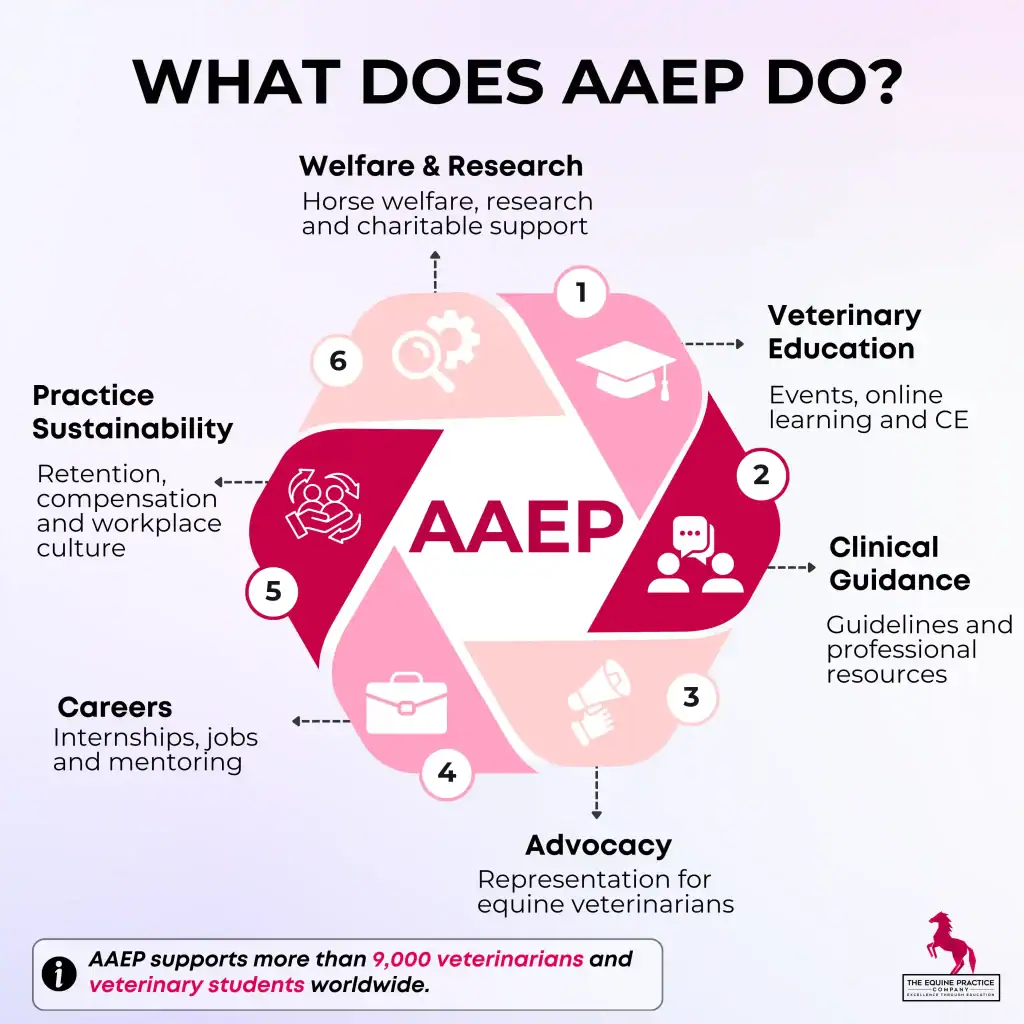
The American Association of Equine Practitioners supports both the veterinary profession and the health and welfare of horses. Its work extends well beyond organising an annual conference.
| Area | What AAEP provides |
|---|---|
| Equine veterinary education | In-person events, online learning, webinars, practical programs and the Annual Convention |
| Clinical guidance | Guidelines, position statements and resources covering horse health, welfare and professional practice |
| Publications | Convention Proceedings, Equine Veterinary Education, research summaries and member communications |
| Professional community | Peer discussion groups, committees, networking, mentoring and a member directory |
| Careers | An Internship Hub, Career Center and resources for students, graduates and employers |
| Advocacy | Representation on matters affecting equine veterinarians, horse health and the equine industry |
| Practice sustainability | Work addressing recruitment, retention, compensation, emergency coverage and practice culture |
| Equine welfare and research | Support through AAEP initiatives and The Foundation for the Horse |
AAEP also gives equine veterinarians a collective voice. Its committees and councils address welfare, racing, medication, infectious disease, professional conduct, education and public policy.
The Foundation for the Horse is the charitable arm of AAEP. It supports equine veterinary education and scholarships, medical research, disaster relief, working equids and horses in need.
Who Can Join AAEP?
AAEP is open to more than established equine veterinarians in North America. Its current public membership categories include:
| Membership category | Who it is for |
|---|---|
| Veterinarian or regular member | Veterinary graduates or licensed veterinarians who are residents or citizens of the United States or Canada |
| International member | Veterinary graduates or licensed veterinarians from countries other than the United States and Canada |
| Student member | Students enrolled in a veterinary degree with an expressed interest in horses |
| Resident member | Veterinarians enrolled in a recognised residency focused on equine medicine or research |
| Recent graduate member | Veterinary graduates in their first five years of practice, with reduced dues according to career stage |
American Association of Equine Practitioners bylaws also recognise Distinguished Life Members and Honor Roll Members. Honor Roll status applies to members who have reached the age of 70 and completed 40 years of AAEP membership. These are recognised membership statuses rather than the standard categories shown to new applicants on the public join page.
Is AAEP only for American veterinarians?
No. International veterinarians can join AAEP, attend its events and use the resources available to their membership category. However, not every benefit is identical in every country.
Some magazines, commercial discounts or services may be limited by geography, and continuing education approval must always be checked against the requirements of the veterinarian’s own licensing authority.
Current eligibility, dues and inclusions are available on the official AAEP membership categories page.
Is AAEP Membership Worth It?
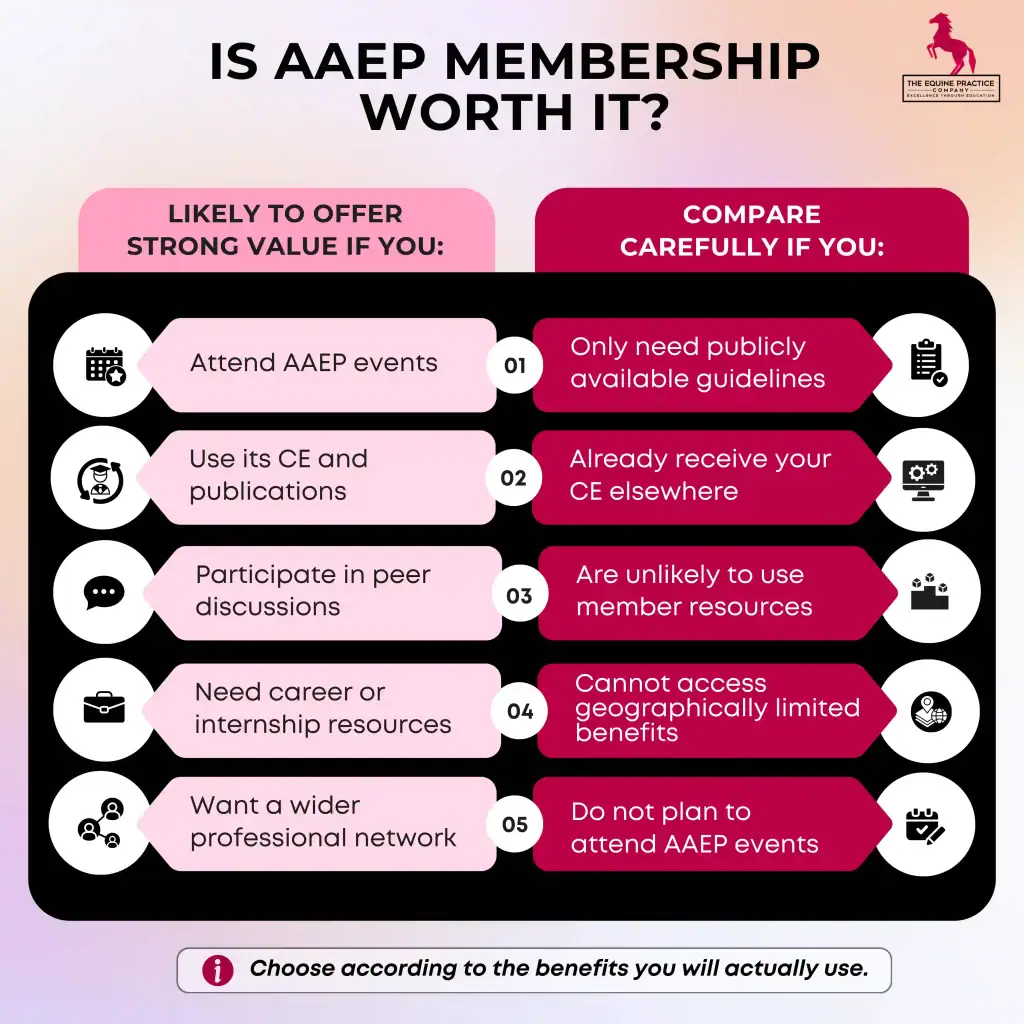
For many equine veterinarians, American Association of Equine Practitioners membership can be worthwhile, but the answer depends on which benefits you will actually use.
The most obvious financial benefit is member pricing for major AAEP educational events, including the Annual Convention. For a veterinarian already planning to attend, the saving may offset a meaningful part of the annual dues.
The wider value may come from benefits that are less visible when comparing prices:
- Access to AAEP online education and selected member learning resources
- The current Convention Proceedings, even if you do not attend the meeting
- Access to Equine Veterinary Education
- A document retrieval service for veterinary literature
- Peer discussion through AAEP Rounds and other member communities
- Career, internship and professional networking resources
- Practice, leadership and wellbeing support
- Opportunities to volunteer, mentor or contribute to the direction of the profession
Membership is most likely to represent good value for veterinarians who attend American Association of Equine Practitioners events, use its publications regularly, participate in professional discussions or need access to its career network.
It may be less compelling for someone who wants only the publicly accessible guidelines and already obtains education, journals and professional support elsewhere.
A sensible way to decide is to identify the three benefits you expect to use during the next 12 months, then compare their practical value with the current dues. Do not join solely because you feel that an equine veterinarian is supposed to be a member.
AAEP maintains a current list of inclusions on its member benefits page.
AAEP Guidelines and Clinical Resources
American Association of Equine Practitioners publishes guidelines and position statements covering important areas of equine medicine, welfare and professional conduct. These materials are used by veterinarians, horse-industry organisations and, in some cases, horse owners looking for a reliable starting point.
Topics available through the AAEP resource libraries include:
- Vaccination and infectious-disease control
- Biosecurity and outbreak response
- Equine infectious anaemia and other specific diseases
- Euthanasia and end-of-life considerations
- Care of performance and racehorses
- Rescue and retirement facilities
- Equine welfare and responsible horse care
- Professional and ethical matters affecting veterinary practice
The central AAEP Guidelines Library is more useful than relying on a guideline downloaded years ago because it allows veterinarians to find the current version and related material.
American Association of Equine Practitioners states that its guidelines provide direction but do not have the force of law. They should not be treated as a substitute for clinical judgement, current evidence, competition rules or the legal requirements of the jurisdiction in which a veterinarian is practising.
That distinction matters. A guideline can provide a professional framework, but the individual horse, presenting problem, available evidence and local regulatory environment still determine what is appropriate in practice.
AAEP Continuing Education
AAEP continuing education includes large conferences, focused practical events and shorter online learning.
AAEP Anywhere
AAEP Anywhere is the association’s online learning platform. Its catalogue includes selected free CE for members, webinars, Annual Convention recordings, the Practice Life podcast and short microlearning videos.
Access and CE eligibility vary by activity, so users should check the details of the individual program rather than assuming that every item carries formal credit.
Webinars, Round Tables and microlearning
Virtual Wednesday Round Tables allow members to hear discussion of clinical and professional subjects, while the webinar library provides access to additional recorded education.
AAEP’s microlearning collection is designed for shorter, practical refreshers.
Some Round Tables are discussion-based and do not provide RACE-approved CE. If credit is important, confirm the approval status and completion deadline before registering or watching a recording.
Focused events and practical education
American Association of Equine Practitioners also runs smaller events and clinically focused programs. The subjects and locations change, but recent formats have included practical education in dentistry, neurology, imaging, ophthalmology and foundational skills for equine practice.
No single provider needs to meet every educational requirement. Veterinarians comparing associations, conferences and independent providers can use our guide to continuing education courses for equine veterinarians to decide which format best fits their cases, career stage and available time.
The AAEP Annual Convention
The AAEP Annual Convention is the association’s principal yearly education, trade-show and networking event. It brings together equine veterinarians, students, researchers, educators and veterinary suppliers for clinical sessions, professional discussion and industry events.
The convention changes location, so check the dates, venue, prices and deadlines before making travel plans.
For the current schedule, registration options, Las Vegas travel information and details about meeting The Equine Practice Company team, read our complete AAEP Convention 2026 guide.
AAEP Resources for Students, Interns and Early-Career Veterinarians
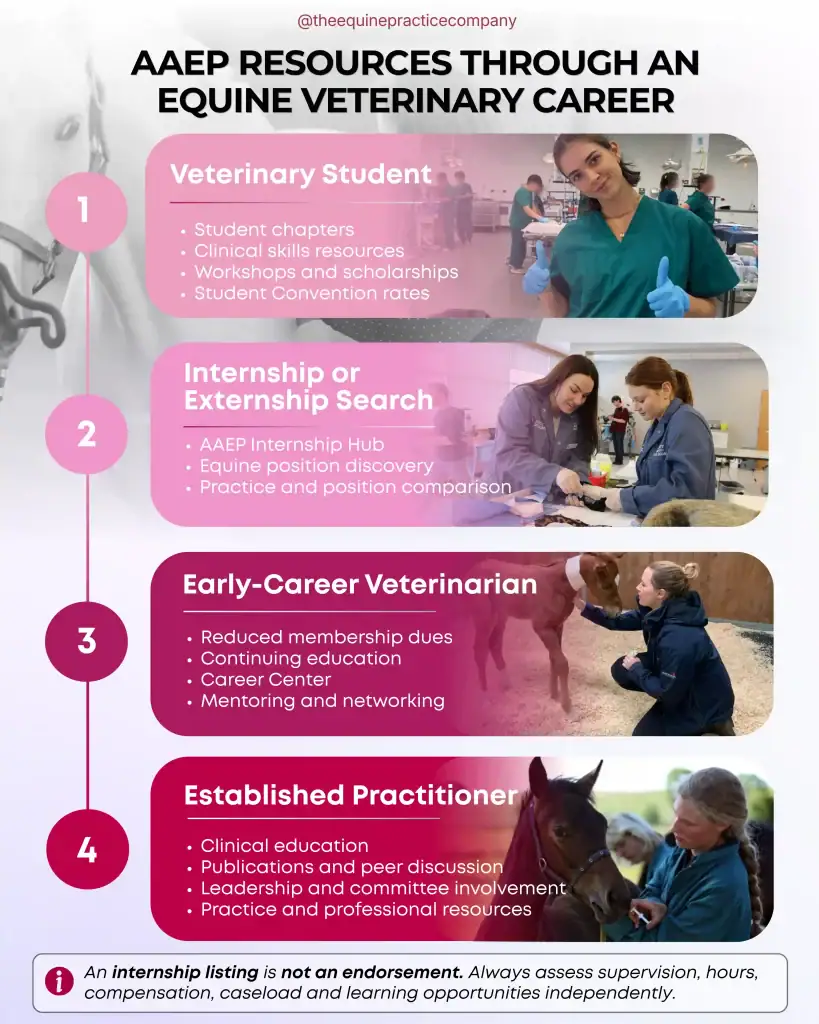
The American Association of Equine Practitioners provides a defined pathway of resources for veterinary students and recent graduates interested in equine practice.
Student resources include chapters, scholarships, webinars, case studies, essential-skills workshops, reduced Convention rates and a clinical skills list for equine veterinary graduates. Its Career Center allows veterinarians to search for employment, while the AAEP Internship Hub brings internship and externship listings into one searchable location.
The Internship Hub is a useful discovery tool, but a listing should not be interpreted as an independent endorsement of the position. Applicants still need to investigate:
- Expected working and on-call hours
- Salary, accommodation and other benefits
- The quality and availability of clinical supervision
- The balance between service work and structured learning
- Case exposure and opportunities to develop practical skills
- Past intern completion and retention
- How concerns, fatigue and clinical uncertainty are handled
Internship quality is determined by the experience inside the practice, not simply where the vacancy was advertised.
Early-career veterinarians can also benefit from AAEP networking, mentoring initiatives and convention programming. Our guides to choosing continuing education as an early-career equine veterinarian and veterinary mentorship provide additional frameworks for assessing those opportunities.
AAEP and the Sustainability of Equine Veterinary Practice
Recruiting veterinarians into equine practice is only part of the workforce problem. The profession must also create careers that capable people can sustain.
AAEP formed its Commission on Equine Veterinary Sustainability in 2022 to address recruitment and retention. Its work focuses on five connected areas:
- Compensation
- Effective emergency coverage
- Veterinary practice culture
- Internships
- Growth and development of equine veterinary students
This work recognises that the shortage of equine veterinarians is not simply a student-recruitment problem. Pay, debt, on-call expectations, workplace culture, mentorship and the structure of early employment all influence whether veterinarians remain in equine practice.
The American Association of Equine Practitioners reports that only a small proportion of veterinary graduates enter equine practice or equine internships and that, within five years, half of this group leaves for companion-animal practice or exits veterinary medicine.
The association also notes that approximately half of its members work in practices with only one or two doctors, making workable emergency coverage and practice support especially important.
Association-led initiatives can provide data, tools and a place for profession-wide coordination. Lasting improvement, however, also depends on what happens within individual practices: how veterinarians are paid, how emergencies are shared, whether young clinicians receive genuine support and whether the business model can fund a sustainable working life.
For a broader examination of these pressures, read The State of Equine Veterinary Practice 2026 and our analysis of the equine veterinary workforce crisis.
AAEP Compared With Other Veterinary Associations
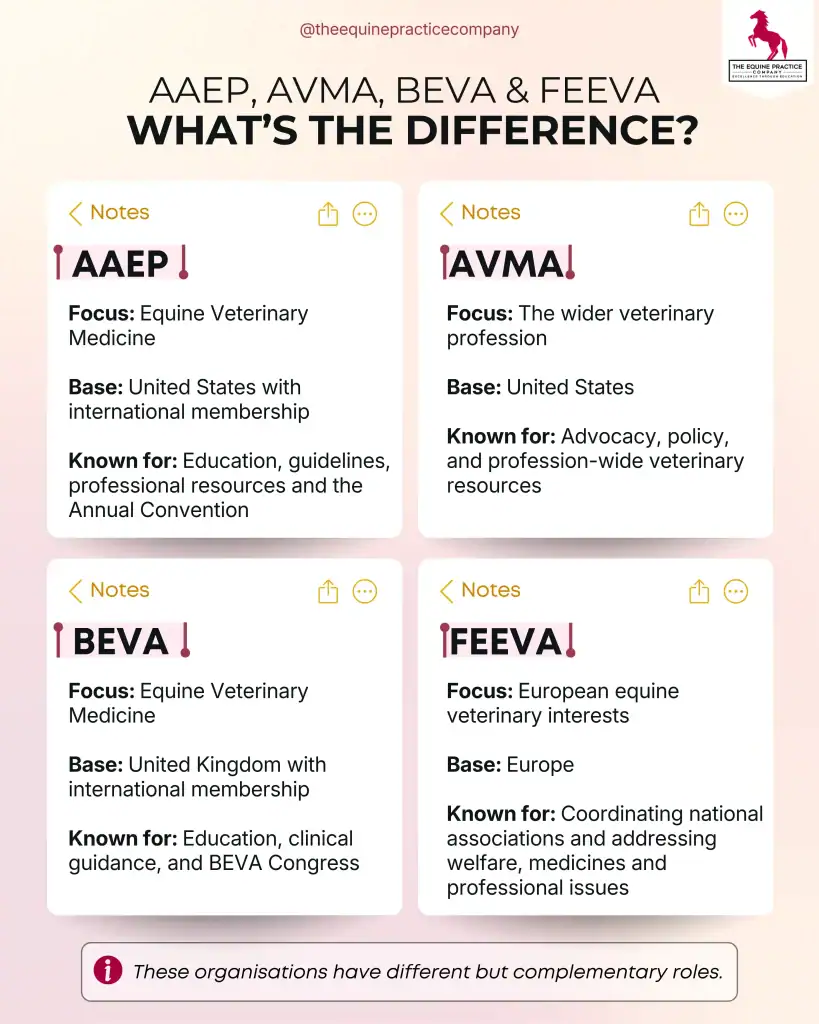
AAEP overlaps with other veterinary organisations, but they do not all perform the same role.
| Organisation | Principal role |
|---|---|
| AAEP | US-based international professional organisation focused entirely on equine veterinary medicine |
| AVMA | Represents the broader veterinary profession in the United States across species and sectors |
| BEVA | UK-based professional association focused on equine veterinary medicine, with international education and membership |
| FEEVA | Federation connecting national equine veterinary associations and representing shared European professional interests |
An equine veterinarian may belong to more than one organisation because the benefits are complementary. A national association may provide local representation and jurisdiction-specific support, while AAEP or another international organisation may add equine-focused education, publications and a wider professional network.
You can read our independent guides to the British Equine Veterinary Association and the Federation of European Equine Veterinary Associations for a closer comparison.
Frequently Asked Questions About AAEP
What does AAEP stand for?
AAEP stands for the American Association of Equine Practitioners.
What does the AAEP do?
AAEP supports equine veterinarians through continuing education, clinical resources, professional guidance, publications, advocacy, career services, networking and work to improve equine welfare and the sustainability of equine practice.
Is AAEP only for American veterinarians?
No. AAEP is headquartered in the United States, but veterinarians outside the United States and Canada can apply as international members. Its education, publications and Annual Convention also have international relevance.
Who can become an AAEP member?
AAEP offers categories for veterinarians in the United States and Canada, international veterinarians, veterinary students, residents and recent graduates. Eligibility requirements differ, so applicants should check the current membership page.
Is AAEP membership worth it?
It can be, particularly for veterinarians who attend AAEP events, use its education and publications, participate in peer networks or need its career resources. The answer depends on whether you will use enough of the benefits to justify the annual cost.
Does AAEP provide continuing education?
Yes. AAEP provides in-person events, online education through AAEP Anywhere, webinars, microlearning, focused practical programs and the Annual Convention. Not every activity offers formal CE credit, so check the individual program.
Where can I find AAEP veterinary guidelines?
The current collection is available in the official AAEP Guidelines Library. Check that you are using the latest version and consider local law, regulation and competition rules.
Does AAEP help students find internships?
Yes. The AAEP Internship Hub lists equine internships and externships. Students should still assess the supervision, hours, compensation, caseload and learning structure of each position independently.
What is the AAEP Annual Convention?
It is the American Association of Equine Practitioners major annual education, networking and trade-show event for equine veterinarians, students and other members of the equine veterinary profession.
Where is the AAEP Convention in 2026?
The 2026 AAEP Annual Convention will be held at Mandalay Bay in Las Vegas, Nevada, from December 7 to 11. See our AAEP Convention 2026 guide for current details.
Is AAEP the same as AVMA?
No. AAEP is focused specifically on equine veterinary medicine. The American Veterinary Medical Association represents the wider US veterinary profession across many species, disciplines and employment settings.
What is the official AAEP website?
The official website of the American Association of Equine Practitioners is aaep.org.
Final Thoughts
The American Association of Equine Practitioners is more than the organisation behind the AAEP Annual Convention. It is a major source of equine-specific education, clinical guidance, professional connection and career support, with a growing role in the discussion about how equine veterinary practice can remain viable.
Membership will not be equally valuable to every veterinarian. The best decision comes from identifying the resources you will use, checking the current cost and asking whether AAEP fills a genuine gap in your education, professional network or career support.
For many equine veterinarians, particularly those who engage with its education and community rather than simply paying the dues, it can provide a useful connection to the wider profession.